Terminal cleaning is not a janitorial task; it is a critical clinical procedure where the margin for error is exactly zero. In the high-stakes environment of Alberta and BC medical centres, terminal cleaning for healthcare facilities serves as the final, most important line of defence against healthcare-associated infections (HAIs). You know that a single missed touchpoint or an incorrect contact time for a disinfectant can compromise patient safety and invite regulatory scrutiny. It’s a heavy responsibility to carry, especially as provincial standards like the 2026 BC Health accreditation and AHS IPAC guidelines continue to evolve.
You likely feel the pressure of maintaining these rigorous standards while facing industry-wide staffing shortages and complex new Biocides Regulations. We understand that finding a reliable partner who treats your clinic with the same care you do is difficult. This guide will help you master these rigorous standards to ensure total patient safety and full regulatory compliance in your Canadian medical facility. We provide a clear, actionable 2026 checklist that aligns with current Health Canada requirements and Western Canadian health authority expectations. From verifying Drug Identification Numbers (DIN) to documenting outcomes, you’ll have everything you need to reduce cross-contamination and protect your reputation.
Key Takeaways
- Understand why terminal cleaning for healthcare facilities requires a clinical decontamination approach that goes far beyond standard janitorial sanitization.
- Learn the “Top-to-Bottom, Clockwise” movement pattern and pre-cleaning protocols essential for preventing re-contamination in patient areas.
- Navigate the latest 2026 AHS IPAC and BC Health standards to ensure your facility remains fully compliant with provincial regulations.
- Discover how to audit your cleaning partner by verifying specialized training certifications and requiring transparent digital completion logs.
- Master the rigorous standards necessary to eliminate healthcare-associated infections and maintain a safe environment for your patients and staff.
Understanding Terminal Cleaning: Why Standard Sanitization is Not Enough
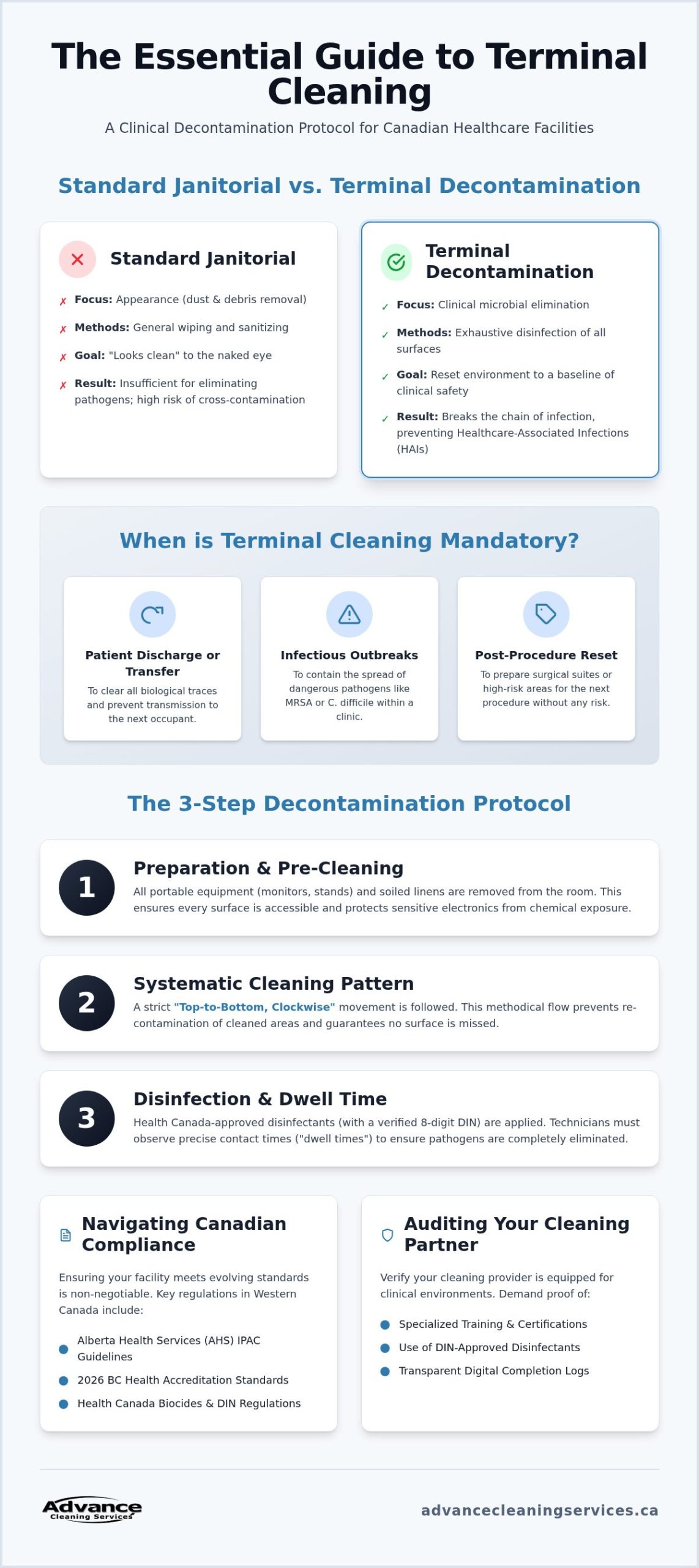
Terminal cleaning is a specialized clinical decontamination process performed after a patient has been discharged, transferred, or during an active infectious outbreak. Unlike daily maintenance, this method involves the complete removal of all portable equipment and the exhaustive disinfection of every square inch within a treatment room or surgical suite. For those managing medical offices in Calgary or dental clinics in Vancouver, terminal cleaning for healthcare facilities isn’t just about appearance; it’s a critical safety protocol designed to reset the environment to a baseline of clinical safety.
This process becomes mandatory in several high-risk situations. When a patient leaves a room, pathogens can remain behind on surfaces, waiting for the next occupant. Terminal cleaning is essential for:
- Patient Discharge or Transfer: Clearing the room of any biological traces from the previous occupant to prevent transmission.
- Infectious Outbreaks: Containing the spread of MRSA, C. difficile, or viral agents within a clinic.
- Post-Procedure Reset: Ensuring surgical or high-risk clinical areas are ready for the next procedure without risk of cross-contamination.
By breaking the chain of infection at these pivotal moments, facilities significantly reduce the risk of Healthcare-Associated Infections (HAIs). This protects both patient outcomes and the clinic’s operational standing in the community.
The Science of Bioburden and Cross-Contamination
Pathogens are surprisingly resilient. Certain bacteria and viruses can persist on high-touch surfaces, such as bed rails, door handles, or light switches, for days or even weeks. This invisible layer of biological material is known as bioburden. If it isn’t removed through a methodical cleaning pattern, it becomes a reservoir for cross-contamination. Specialized medical facility cleaning in Alberta requires local expertise because environmental factors, such as the dry climate in Calgary, can influence how long these pathogens remain viable. Breaking this cycle requires more than a quick wipe; it demands a deep understanding of how germs travel from surface to person.
Standard vs. Medical-Grade Cleaning Protocols
There’s a vast difference between standard janitorial services and clinical decontamination. While a standard office cleaner focuses on dust and debris, a medical-grade protocol prioritizes microbial elimination. Standard janitorial services often fail to meet the requirements of terminal cleaning for healthcare facilities because they lack the specialized training for biohazard remediation. This requires using Health Canada-approved disinfectants that carry a specific 8-digit Drug Identification Number (DIN). These products are tested for efficacy against specific pathogens and require precise contact times to work effectively. In a clinical setting, “looking clean” is never enough. Surfaces must be clinically sterile to be truly safe.
The Essential Terminal Cleaning Checklist: A Step-by-Step Guide
Success in clinical decontamination starts with a structured plan. Staff must begin with a pre-cleaning assessment to identify specific risks and remove all portable equipment. This includes moving out medical monitors, mobile stands, and all soiled linens. Clearing the area ensures every surface is accessible and prevents pathogens from hiding behind moveable objects. It also protects sensitive electronics from accidental chemical exposure during the process.
To prevent re-contamination, we follow a strict “Top-to-Bottom, Clockwise” movement pattern. This ensures any dust or microbial matter disturbed at a higher level is captured as the cleaner moves downward. By moving clockwise around the room, the technician creates a clear visual path. It’s a simple rule that ensures no surface is missed during the process. This methodical flow is a hallmark of professional terminal cleaning for healthcare facilities.
Zone-Specific Decontamination Steps
Effective terminal cleaning for healthcare facilities requires dividing the space into distinct zones. The patient zone includes the bed, rails, call buttons, and light switches, which are the highest-risk surfaces. The bathroom zone focuses on plumbing fixtures and floor drains, where moisture can harbour bacteria. Finally, the clinical zone covers hand-wash stations and diagnostic equipment. Each area requires a fresh microfibre cloth to eliminate the risk of transferring germs between zones.
Chemical Application and Dwell Times
Disinfectants don’t work instantly. The “dwell time” or “wet time” is the duration a surface must remain visibly wet to kill specific pathogens like MRSA or Norovirus. For example, some Health Canada-approved products require a full five-minute contact time to be effective. Staff must select agents specifically rated for the pathogens present; bleach-based solutions are often necessary for C. difficile spores. Always check the Drug Identification Number (DIN) to confirm the product’s efficacy.
Safety remains paramount during this intensive process. Technicians must use appropriate Personal Protective Equipment (PPE) and ensure adequate ventilation while applying high-level disinfectants. If your team lacks the specialized equipment or training for these rigorous steps, consider partnering with professional medical facility cleaning experts who specialize in biohazard remediation. This methodical approach ensures your facility meets the highest standards of patient safety and clinical excellence.
Canadian Compliance: Navigating Alberta and BC Healthcare Standards
Compliance isn’t just about following a checklist; it’s about meeting the legal and professional expectations set by provincial health authorities. In Western Canada, the regulatory landscape for terminal cleaning for healthcare facilities is shaped by a combination of national standards and specific provincial mandates. The Canadian Standards Association (CSA) provides the foundational framework for healthcare facility maintenance through the Z8000 series, but daily enforcement falls to bodies like Alberta Health Services (AHS) and the BC Ministry of Health.
Staying compliant requires meticulous record-keeping. During a provincial health inspection, auditors look for a clear paper trail that includes cleaning logs, chemical dwell time verifications, and staff training records. If a procedure isn’t documented, health inspectors generally consider it undone. This level of accountability ensures that every clinic maintains a safe environment for vulnerable patients while protecting the facility from liability.
Alberta-Specific Cleaning Requirements
In Alberta, community-based clinics must adhere to the AHS Infection Prevention and Control (IPAC) guidelines. As of February 2, 2026, new practice guidelines from the College of Licensed Practical Nurses of Alberta provide updated evidence-based directions for preventing disease transmission. For dental and veterinarian clinics in Calgary and Edmonton, these standards are particularly rigid regarding high-risk zones and biohazard disposal. Managers should consult resources on Professional Medical Facility Cleaning in Alberta to ensure their local protocols align with these 2026 updates. Following these specific provincial rules is the only way to guarantee a pass during an AHS audit.
British Columbia Regulatory Landscape
The regulatory environment in British Columbia saw significant updates on April 1, 2026, when the College of Physicians and Surgeons issued new accreditation standards for environmental cleaning in non-hospital facilities. These standards impact private surgical centres and specialty clinics throughout the Vancouver Coastal Health and Fraser Health regions. Compliance involves more than just a nightly sweep; it requires a deep understanding of local health authority cleaning frequency standards. Hiring a provider familiar with these specific BC audits is a strategic advantage. It ensures your facility is always prepared for unannounced inspections and maintains the highest level of patient trust in the Lower Mainland’s competitive healthcare market.
Evaluating Your Cleaning Partner: What to Look for in a Specialized Medical Cleaner
Selecting a partner for terminal cleaning for healthcare facilities is a high-stakes decision that directly influences your facility’s safety record and accreditation status. Many smaller clinics in Alberta and BC are moving away from internal custodial teams toward specialized outsourcing. However, not all vendors possess the clinical depth required for medical environments. You need a partner who functions as a professional expert, providing verifiable proof of specialized training in biohazard remediation and medical decontamination.
Auditability is the cornerstone of a reliable partnership. A specialized vendor should offer more than a verbal assurance; they must provide digital logs and detailed completion reports. These documents are vital during provincial health audits. They prove that every high-touch surface was treated with the correct disinfectant and allowed the necessary dwell time. Staff consistency also plays a massive role in infection control. Having a dedicated medical team that understands your specific clinic layout reduces the risk of procedural errors and ensures a higher standard of care.
The Risks of General Janitorial Services
The primary danger of hiring general janitorial services in Alberta for a clinical setting is the use of residential-grade equipment. Standard vacuums without HEPA filtration can actually aerosolize pathogens, spreading them throughout the facility. General cleaners often lack a deep understanding of pathogen-specific contact times, which can lead to ineffective disinfection. In a medical environment, the wrong equipment or a rushed application doesn’t just leave a room dirty; it leaves it dangerous. Specialized medical cleaning requires tools like colour-coded medical-grade microfibre to prevent cross-contamination between zones.
Interviewing a Potential Healthcare Cleaning Vendor
When evaluating a potential vendor, your interview should focus on technical proficiency rather than just price. Ask specifically about their disinfectant selection and require a list of Health Canada Drug Identification Numbers (DINs) for the products they use. You should also request proof of specialized training for medical environments and ask about their response time for emergency biohazard cleanup. A truly professional partner will be transparent about their protocols and eager to show how they maintain compliance with AHS or BC Health standards. If you’re ready to elevate your facility’s safety standards, contact our specialized medical cleaning team to discuss a tailored decontamination plan.
Advance Cleaning Services Inc.: Professional Terminal Decontamination Solutions
Advance Cleaning Services Inc. operates with a deep understanding of the human element behind every sanitization task. We don’t just clean; we protect. Our team is committed to the highest clinical standards across Western Canada, acting as a steady hand for facilities that cannot afford a lapse in safety. We’ve developed specialized protocols specifically for dental, veterinarian, and medical clinics. These environments have unique requirements that generic services simply cannot meet. Whether you’re managing a high-volume walk-in clinic in Calgary or a private surgical centre in Vancouver, our approach to terminal cleaning for healthcare facilities is built on reliability and technical precision.
Our service model integrates everything from routine janitorial care to complex biohazard remediation. This means you don’t have to manage multiple vendors for different levels of risk. We take pride in our workmanship and our ability to solve problems permanently. By positioning ourselves as a definitive solution, we allow healthcare providers to focus on patient care while we handle the rigorous demands of environmental safety. We currently serve Calgary, Edmonton, Vancouver, and their surrounding communities with a focus on long-term partnership and trust.
Our Medical Facility Cleaning Protocol
We build customized terminal cleaning plans based on your facility’s specific risk profile. A dental office requires different contact times and biohazard handling than a veterinarian clinic or a community health centre. Our staff undergoes rigorous training to stay ahead of 2026 AHS and BC Health compliance updates. We prioritize transparent reporting above all else. Facility managers receive digital logs and quality assurance reports that make provincial audits straightforward and stress-free. This methodical approach ensures that every square inch of your clinical space meets the highest standards of decontamination.
Beyond Terminal Cleaning: A Comprehensive Approach
Our expertise extends beyond a single room reset. We believe in a holistic approach to infection control that addresses every corner of your practice. This includes integrating commercial carpet cleaning to eliminate deep-seated allergens and pathogens in waiting areas and administrative offices. For more complex or sensitive situations, we offer specialized support for hoarding cleanup and high-risk biohazard remediation. Advance Cleaning Services Inc. is your reliable partner in maintaining a sterile, welcoming environment. Contact us today for a tailored facility assessment and a sanitization plan designed for your specific needs.
Elevate Your Clinical Standards for 2026
Mastering the rigorous requirements of terminal cleaning for healthcare facilities is more than a regulatory necessity; it’s a fundamental commitment to the safety of your patients and staff. By moving beyond basic janitorial tasks and embracing a methodical, clinical reset, you ensure your environment remains a safe centre for healing. Whether you’re navigating the latest AHS IPAC guidelines in Alberta or updated accreditation standards in BC, the key is consistency and verifiable documentation that proves your dedication to excellence.
Advance Cleaning Services Inc. brings over a decade of experience to your clinic, serving as a reliable partner in infection control. Our certified biohazard remediation specialists have the expertise to handle demanding decontamination needs while ensuring full compliance with provincial health authorities. We’re here to act as a steady hand, helping you maintain the highest standards of workmanship and care. Take the first step toward a safer, more compliant practice today. Request a Specialized Medical Facility Cleaning Assessment and let us help you protect what matters most. You’ve worked hard to build a trusted practice, and we’re here to help you keep it that way.
Frequently Asked Questions
What is the definition of terminal cleaning in a healthcare setting?
Terminal cleaning in a healthcare setting is the exhaustive decontamination of a patient room or clinical area following discharge, transfer, or a known infectious outbreak. This procedure involves removing all portable equipment and linens to ensure every surface is accessible for high-level disinfection. It’s a critical step in resetting the environment to a safe baseline. For clinics in Calgary and Vancouver, this process is essential for maintaining a sterile facility and preventing the transmission of resilient pathogens between patients.
How often should a medical facility undergo a terminal clean?
Terminal cleaning is not performed on a fixed calendar schedule but is triggered by specific events. You must perform a terminal clean whenever a patient is discharged or transferred from a treatment room or if a facility experiences an infectious outbreak. In high-turnover environments like dental clinics or surgical centres, this may occur several times a day. Following these event-based triggers ensures that your facility remains compliant with AHS and BC Health standards throughout the year.
What is the difference between terminal cleaning and concurrent cleaning?
The primary difference lies in the occupancy of the room and the depth of the process. Concurrent cleaning is the daily maintenance performed while a patient is still occupying the space to reduce microbial load. However, terminal cleaning for healthcare facilities is only done after the room is empty. It is a far more intensive process that includes floor-to-ceiling disinfection and the cleaning of all fixed and portable equipment to eliminate any remaining bioburden.
Are standard household disinfectants acceptable for terminal cleaning?
Standard household disinfectants are generally unacceptable for clinical terminal cleaning. Healthcare facilities in Alberta and British Columbia must use hospital-grade disinfectants that carry a Health Canada-approved Drug Identification Number (DIN). These specialized products are tested for efficacy against specific pathogens like MRSA, C. difficile, and Norovirus. Using household cleaners can lead to incomplete decontamination and may cause your facility to fail a provincial health inspection or accreditation audit.
Do veterinarian clinics require the same terminal cleaning standards as human medical facilities?
Veterinarian clinics in Calgary and Edmonton are held to rigorous sanitary standards that often mirror human medical facilities. While the specific pathogens may differ, the risk of zoonotic disease transmission makes terminal cleaning essential in animal hospitals. High-touch surfaces in exam rooms and surgical suites must be decontaminated between patients using clinical-grade protocols. Maintaining these standards protects the health of both the animals and the staff working within the facility.
How do Alberta Health Services (AHS) audits impact cleaning protocols?
Alberta Health Services (AHS) audits serve as a rigorous verification of your facility’s Infection Prevention and Control (IPAC) protocols. These audits require detailed documentation of cleaning frequencies, chemical dwell times, and staff training records. If your records are incomplete, health inspectors may mandate immediate changes to your cleaning schedule or provider. This oversight ensures that every community-based clinic in Alberta maintains a safe, verifiable environment that protects patients from healthcare-associated infections.
Can terminal cleaning be performed while patients are in the building?
You can perform terminal cleaning while other patients are in the building, but the specific treatment room must be completely unoccupied. The room should be closed off to prevent the spread of dust or aerosolized chemicals during the process. For clinics in busy hubs like Vancouver or Edmonton, this requires careful coordination to ensure that the intensive cleaning process doesn’t disrupt patient flow while still maintaining the highest possible safety and sanitization standards.
What PPE is required for staff performing terminal decontamination?
Staff performing terminal decontamination must wear appropriate Personal Protective Equipment (PPE) to prevent accidental exposure to pathogens and harsh chemicals. This typically includes medical-grade gloves, fluid-resistant gowns, surgical masks, and eye protection or face shields. The specific level of PPE may increase if the cleaning is responding to a high-risk outbreak, such as C. difficile. Proper donning and doffing procedures are essential to ensure the safety of the cleaning technicians and the facility.