Every time you wipe down a surface with a dry duster, you aren’t actually cleaning; you are launching abrasive silica particles straight back into the air. If you have spent hours scrubbing only to watch a stubborn white haze resettle across your hardwood floors by morning, you know how frustrating the process feels. Standard household vacuums merely exhaust microscopic drywall grit back into your living space, straining your furnace motor and threatening delicate custom finishes. Successfully removing fine dust after construction requires a far more methodical, staged approach.
You can achieve pristine surfaces without scratching brand-new paint or damaging delicate woodwork. In this complete guide, you’ll learn the exact multi-stage protocol to eliminate microscopic drywall and silica dust safely, protecting both your lungs and your HVAC systems from costly wear. We’ll walk step-by-step through true HEPA extraction, negative air containment, and safe wet-contact wiping techniques so your living space stays genuinely clean for good.
Key Takeaways
- Understand why microscopic gypsum and crystalline silica particles remain suspended for hours, requiring precise settling periods before physical cleaning begins.
- Discover why standard shop vacuums fail and why certified, sealed HEPA units paired with commercial air scrubbers are essential.
- Master the top-down, multi-stage protocol for removing fine dust after construction safely without scratching fresh paint or delicate millwork.
- Protect your furnace and HVAC ductwork from motor burnout and prevent dust re-circulation through mechanical isolation strategies.
- Evaluate your project scope, ceiling heights, and equipment costs to decide when DIY extraction makes sense versus hiring trained post-construction specialists.
Understanding Construction Dust: Why Ordinary Cleaning Methods Always Fail
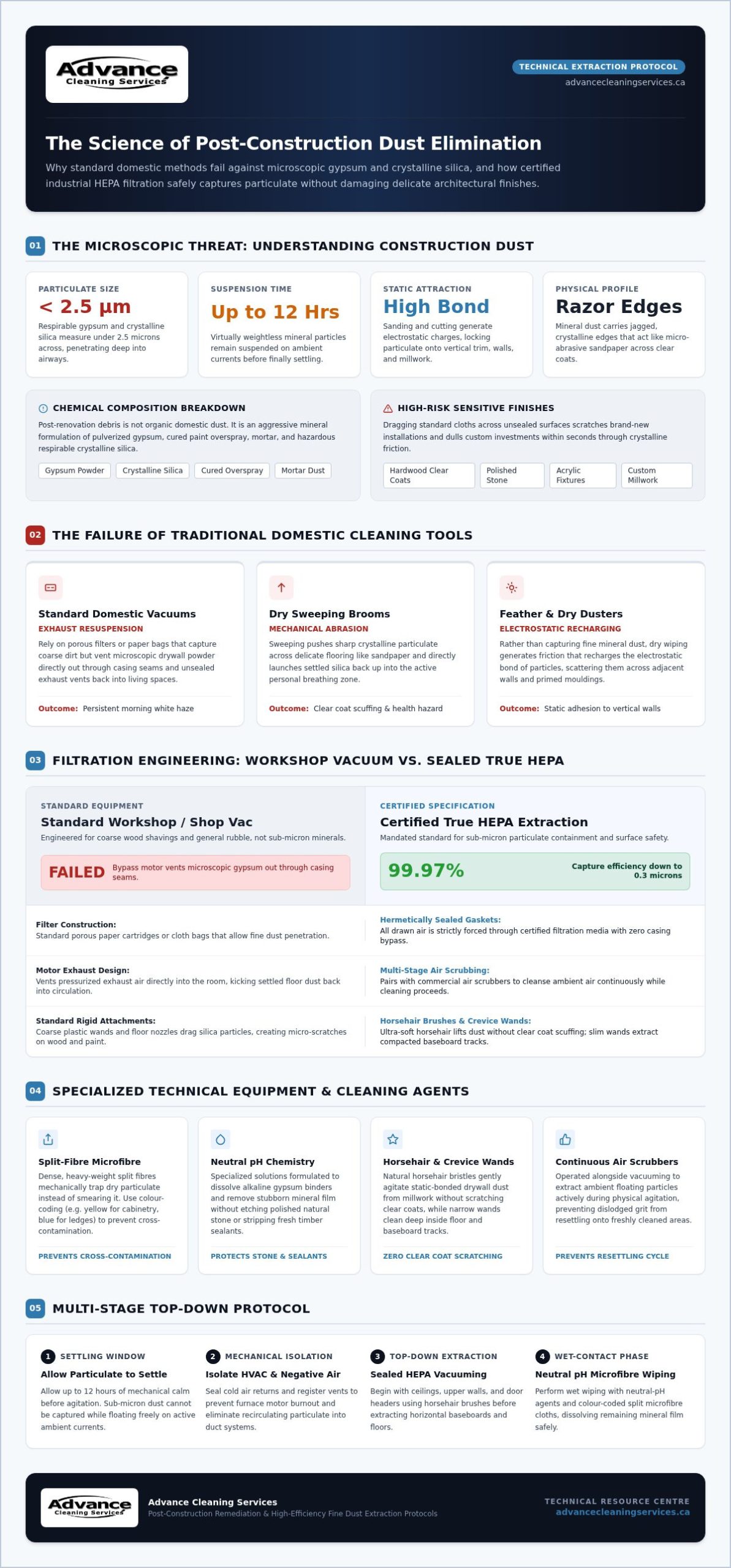
Post-renovation cleanup isn’t standard housekeeping. What looks like ordinary household grit is actually an aggressive blend of pulverized gypsum, cured paint overspray, mortar, and respirable crystalline silica. In scientific terms, these fine particles of solid matter often measure under 2.5 microns across. Because they’re virtually weightless, gentle indoor air currents keep them suspended in the ambient air for up to twelve hours before they settle. Inhaling this respirable construction particulate poses real occupational health risks, including severe respiratory irritation and chronic lung inflammation. Successfully removing fine dust after construction requires recognizing that what sits on your baseboards is only a fraction of what remains floating in the room.
The Chemistry and Composition of Drywall and Masonry Particulate
Gypsum compound and masonry powders behave differently than organic household dust. High-speed sanding and cutting generate a notable electrostatic charge across tiny particles. This static bond causes particulate to cling stubbornly to vertical drywall, primed trim, and cabinetry. In addition, these mineral particles have jagged, razor-sharp crystalline edges. Dragging dry cloths across new hardwood, polished stone, or acrylic plumbing fixtures acts like micro-abrasive sandpaper, scuffing clear coats and permanently dulling expensive custom finishes within seconds.
Why Traditional Domestic Cleaning Tools Make the Problem Worse
Standard household equipment simply isn’t engineered for mineral-based post-renovation cleanup. In fact, common domestic tools usually escalate the issue:
- Standard vacuum cleaners: Domestic machines and entry-level shop vacuums rely on porous filters or paper bags. They capture coarse debris while venting microscopic drywall powder directly out through the exhaust.
- Dry brooms: Sweeping pushes abrasive particles across delicate floor surfaces and launches settled silica straight back into your breathing zone.
- Feather dusters: These tools scatter dust rather than capturing it, creating friction that recharges the static pull of particles to nearby surfaces.
Effectively removing fine dust after construction demands sealed containment, industrial extraction, and specialized contact removal rather than standard domestic sweeping.
Essential Tools and Equipment: Equipping for Fine Dust Extraction
Stopping the cycle of airborne redistribution requires equipment specifically engineered to capture sub-micron particles. While ordinary shop vacuums easily handle wood shavings and coarse debris, successfully removing fine dust after construction demands sealed mechanical extraction and continuous air filtration. Operating commercial air scrubbers alongside dedicated vacuum systems cleans the ambient air actively while you work, preventing dislodged grit from resettling on cleared surfaces.
True HEPA Filtration vs. Standard Workshop Vacuums
A certified HEPA unit must capture at least 99.97 percent of particles down to 0.3 microns. Standard workshop vacuums simply cannot deliver this level of containment. Their unsealed bypass motors pull in fine drywall residue and vent it straight out through casing seams and porous filters. In contrast, true industrial HEPA vacuums feature completely sealed gaskets, ensuring all exhaust air passes directly through the filtration media. Use dedicated horsehair brush attachments to lift clingy dust gently from new millwork without scuffing clear coats, and attach slim crevice wands to draw compacted grit out of baseboard tracks.
Consumables, Cleaning Agents, and Personal Safety Equipment
Equipping your project with the proper materials protects both your structural finishes and your health:
- Electrostatic microfibre textiles: Choose heavy-weight, split-fibre microfibre cloths instead of cotton rags or paper towels. Their dense weave traps mineral powder rather than dragging it across surfaces. Use a colour-coded system, such as yellow for cabinetry and blue for window ledges, to avoid cross-contaminating delicate finishes.
- Neutral pH cleaning agents: Select specialized, neutral-pH solutions designed to dissolve gypsum binding agents without etching polished stone or stripping fresh timber sealants.
- High-efficiency respiratory protection: Considering the severe, documented dangers of silica dust on human lungs, loose-fitting paper masks fall short. Wear a properly fitted NIOSH-approved P100 respirator along with sealed protective eyewear.
Acquiring this specialized equipment requires significant preparation. If sourcing industrial scrubbers feels impractical for your project scope, working with trained post-renovation technicians like Advance Cleaning Services Inc. ensures your space receives certified HEPA extraction and complete particulate containment from day one.
The Step-by-Step Protocol for Removing Fine Dust After Construction
Tackling post-renovation debris successfully requires strict procedural discipline. Rushing into sweeping or wiping without a systematic workflow simply shifts sediment between rooms. By following a structured, multi-phase method, removing fine dust after construction becomes predictable, preventing expensive surface abrasions and lingering airborne irritants.
Phase 1: Containment, Air Scrubbing, and High-Surface Dry Extraction
Begin by physically isolating the work area. Seal doorways and corridors with heavy polyethylene sheeting fitted with zipper entries to stop rogue air movement. If possible, set air scrubbers to establish slight negative pressure, exhausting scrubbed air outside while continuously filtering indoor volume. Regulatory guidance outlining the dangers of construction dust highlights how easily unchecked particulate migrates across living spaces. Once containment is active, let the room rest for several hours so airborne grit settles. Then, initiate dry vacuum extraction at the highest elevations: ceiling fans, recessed fixtures, crown moulding, and upper wall surfaces.
Phase 2: The Systematic Wet-Contact Wiping Technique
Once high-elevation surfaces are vacuumed, transition to damp microfibre wiping across walls, door frames, and cabinetry. Fold each microfibre towel into eight distinct quadrants. Work top-to-bottom using light, single-direction downward passes rather than circular rubbing, which grinds grit into paint. As soon as a quadrant shows soil, flip to a pristine face. Always use a two-bucket system, one with clean neutral rinse water and one for wringing out debris, to avoid reapplying dissolved gypsum slurry over fresh woodwork.
Phase 3: Deep Flooring and Upholstery Detailing
The final phase addresses settling zones at floor level. Vacuum subfloors and finished hard surfaces slowly using dedicated horsehair floor attachments, moving in overlapping strokes. Follow vacuuming with a damp microfibre flat-mop, using minimal moisture to prevent swelling baseboards or timber joints. For soft furnishings and fabrics, deep extraction remains critical; scheduling professional commercial carpet cleaning ensures deeply embedded silica crystals are fully drawn from carpet piles rather than trapped permanently within textile backing.
HVAC Care and Air Quality: Clearing the Hidden Dust Reservoirs
Forced-air heating and cooling networks act like high-speed transit channels for renovation debris. In Canadian climates where closed-envelope systems run constantly for winter heating or summer ventilation, running an HVAC system during or immediately after renovations pulls airborne powder straight into return air chases. When drywall compound settles onto furnace heat exchangers, it chars, creating harsh odours and releasing fine particulates across unrenovated rooms. Thoroughly removing fine dust after construction requires treating mechanical equipment with the same care as exposed living spaces.
Protecting and Cleaning Central Ductwork and Registers
Mineral residue gathers rapidly behind metal grilles. Unscrew all supply and return register covers across the property and soak them in warm water mixed with mild detergent before wiping them clean. While registers are soaking, reach inside the duct openings using a vacuum hose fitted with a soft horsehair brush head to collect initial wall deposits. If ductwork ran unsealed throughout framing and drywall installation, contact an independent duct specialist to clear heavy line accumulation before activating your main air handler.
Air Filter Management and Furnace Blower Maintenance
Managing airflow and mechanical filters demands immediate attention once structural work finishes:
- Dispose of construction filters immediately: Discard sacrificial filters as soon as demolition and drywall sanding conclude. Replace them with high-efficiency pleats rated MERV 11 to 13 to trap sub-micron minerals without restricting furnace air movement.
- Clean the blower assembly: Check the blower fan compartment. Fine gypsum coats the interior curved blades of squirrel-cage wheels, adding mechanical drag that overheats motor bearings.
- Schedule a secondary filter swap: Residual settling happens over several weeks. Swap in a fresh pleated filter thirty days after project completion to capture late-settling airborne remnants.
Keep windows slightly cracked during mild weather to maintain continuous air changes, helping purge lingering volatile compounds alongside suspended particulates. If your renovation produced extensive particulate throughout your home or commercial facility, contact Advance Cleaning Services Inc. to coordinate comprehensive post-construction cleaning that safeguards your mechanical equipment and indoor air quality.
DIY vs. Professional Post-Construction Cleaning: Making the Right Choice
Deciding between tackling post-renovation cleanup yourself or calling in trained professionals comes down to scale, timing, and risk tolerance. While a small bathroom powder room might take an energetic afternoon to detail, large residential developments and commercial buildouts present distinct challenges. Successfully removing fine dust after construction across sprawling footprints requires heavy-duty gear, hundreds of clean microfibre heads, and hours of intensive physical labour that quickly overwhelm standard maintenance routines.
Assessing Scope, Time Commitment, and Risk Factors
Before gathering cleaning supplies, evaluate your space’s physical demands and delicate materials:
- Ceiling heights and architectural layout: Vaulted ceilings, open structural beams, and double-height stairwells require specialized access equipment and stable scaffolding rather than precarious stepladders.
- High-risk materials: Matte black fixtures, unsealed natural stone, delicate lacquer cabinetry, and custom woodwork permanently show fine micro-scratches if wiped with saturated towels or improper contact pressures.
- Occupancy deadlines and municipal inspections: Commercial fit-outs in Canadian municipalities require documented sanitary readiness to pass final building clearances. Rushing the process risks failing site handoffs or delaying tenant possession dates.
Factor in the hidden expenses of personal tool rentals as well. Renting certified air scrubbers, HEPA extractors, and staging gear often approaches the cost of dedicated contract services without saving you the physical fatigue.
What Professional Post-Renovation Cleaners Deliver
Specialized contractors arrive with commercial-grade filtration systems, staging their equipment to scrub indoor air continuously without venting dust across living quarters. Their crews operate using structured checklists covering rough, deep, and final detailing phases. If you want to understand the rigorous quality standards expected at handover, review our comprehensive breakdown of thorough post construction cleaning procedures.
Dedicated commercial teams possess the correct neutral chemistry to dissolve stubborn gypsum binders safely, ensuring every horizontal surface, recessed track, and millwork edge is immaculate. When you are managing tight turnover schedules or high-value finishes across Western Canada, partnering with Advance Cleaning Services Inc. provides full-service post-construction cleaning, experienced HEPA extraction technicians, and complete peace of mind.
Transform Your Newly Built Space Into a Clean, Healthy Environment
Successfully removing fine dust after construction isn’t about scrubbing harder with domestic brooms and rags. It requires isolating the workspace, pairing sealed true HEPA extraction with systematic damp wiping, and safeguarding your ventilation system against abrasive gypsum particles. Following this methodical protocol protects both your long-term respiratory health and the delicate finishes you invested in.
When schedules are tight or you want absolute confidence that your property is thoroughly cleared of respirable silica, professional support provides total peace of mind. Our experienced technicians specialise in architectural finish protection, using industrial-grade true HEPA filtration equipment that actively protects indoor air quality while preserving custom millwork. Serving residential and commercial properties across Alberta and the Vancouver area, we ensure your building turnover is smooth, safe, and immaculate. Book professional post-construction cleanup with Advance Cleaning Services Inc. today to step into a pristine, move-in-ready space.
Frequently Asked Questions
Can I use a regular household vacuum cleaner to pick up drywall dust?
No, you shouldn’t use a standard household vacuum to pick up drywall dust. Domestic vacuums lack sealed filtration systems, meaning sub-micron gypsum powder easily passes right through paper bags and filters. This process blows abrasive dust into your ambient air and can quickly burn out the vacuum motor. When removing fine dust after construction, always rely on a certified true HEPA vacuum engineered to safely capture 99.97 percent of particles down to 0.3 microns.
How long should I wait after construction ends before starting to clean?
You should wait at least twelve to twenty-four hours after all active construction concludes before starting deep cleaning passes. Microscopic gypsum and crystalline silica particles remain suspended in indoor air currents long after trades depart. Letting the room sit undisturbed allows airborne particulates to settle onto horizontal surfaces. If you clean too soon, airborne particles simply settle onto newly wiped counters and freshly mopped floors overnight, forcing you to repeat the work.
What is the best cleaning solution for removing drywall haze from floors?
The best cleaning solution for drywall haze is warm water mixed with a small amount of neutral pH floor cleaner or a splash of white vinegar. Avoid using harsh soaps, chemical detergents, or oil-based polishes. Conventional detergents emulsify the gypsum binder into a slippery slurry that leaves sticky residue behind. A neutral rinse neutralizes fine gypsum residue without damaging polyurethane coatings, delicate tile glazes, or luxury vinyl plank finishes.
Why does a white film keep reappearing on my hardwood floors after mopping?
A white film reappears because traditional mopping often dissolves dry gypsum powder into liquid paste rather than lifting it away. When dirty rinse water evaporates, the redeposited mineral salts recrystallize into an opaque film. To eliminate haze, use a two-bucket system with clean microfibre pads. Wring pads until merely damp, rinse frequently in clean water, and change your wash bucket as soon as water looks cloudy to ensure particles are removed permanently.
Does post-construction dust pose serious health risks to my family or staff?
Yes, post-construction dust presents legitimate health risks, particularly from respirable crystalline silica and mineral fibres. Inhaling microscopic particles irritates mucous membranes, triggers asthma flare-ups, and can cause chronic respiratory conditions over extended exposure. Property owners across Alberta and British Columbia should never treat post-renovation cleanup as cosmetic housekeeping. Wearing a sealed NIOSH-approved P100 respirator and running commercial air scrubbers is crucial for protecting long-term lung health.
How many rounds of cleaning are typically required after a major renovation?
A thorough post-renovation project requires at least three structured phases: a rough clean, a deep clean, and a final detail pass. The rough phase clears bulk trash and initial debris. The deep phase handles true HEPA extraction and comprehensive wet wiping across all vertical and horizontal surfaces. The final phase, performed several days later, removes late-settling dust. Removing fine dust after construction reliably demands this staged methodology to ensure immaculate results.
Should I clean my home from top to bottom or bottom to top?
Always clean your space strictly from top to bottom. Gravity naturally forces dislodged drywall powder and sawdust downward during physical extraction. Start with ceiling fans, light fixtures, crown moulding, and upper wall joints before moving to window sills, countertops, and baseboards. Save hard flooring and carpet detailing for the absolute final step. Cleaning from the bottom up guarantees that upper-level dust falls onto previously sanitized floors, ruining your effort.