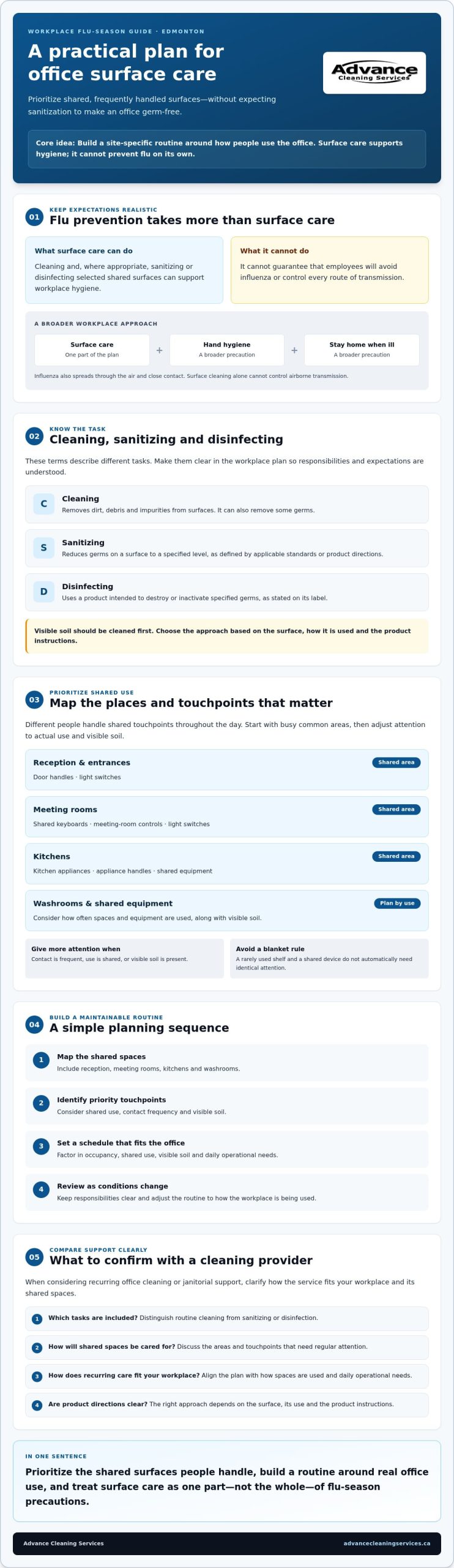
Sanitizing every surface may feel like the safest response to flu season, but it’s only one part of a practical workplace plan. For flu season office sanitization Edmonton workplaces can maintain, start with high-touch areas rather than an unrealistic goal of making every space germ-free. Shared doorknobs, light switches, kitchen appliances and equipment deserve attention, especially in busy common areas.
It’s understandable to want a clean office and fewer disruptions when staff are away sick. Surface cleaning and disinfection can support workplace hygiene, but influenza also spreads through the air and close contact. Sanitization alone can’t prevent flu transmission, so it should sit alongside measures such as regular handwashing and staying home when ill.
This guide explains which shared surfaces to prioritize, how to build a cleaning routine that fits your office, and what sanitization can and can’t achieve. You’ll also learn when recurring office cleaning or janitorial support may help keep shared spaces consistently cared for, and what to ask when comparing commercial cleaning providers in Edmonton.
Key Takeaways
- Use a site-specific plan for flu season office sanitization Edmonton workplaces can maintain, based on how spaces are used.
- Separate routine cleaning, sanitizing and disinfecting so tasks and expectations are clear.
- Map shared areas such as reception, meeting rooms, kitchens and washrooms to identify where regular attention is needed.
- Set a schedule by considering occupancy, shared use, visible soil and daily operational needs, then review it as conditions change.
- When comparing office cleaning support, confirm which tasks are included and how recurring care for shared spaces will fit your workplace.
Why Edmonton Offices Review Sanitization During Flu Season
The phrase flu season office sanitization Edmonton can mean different things to different providers. In this guide, office sanitization means a planned approach to cleaning shared surfaces and, where appropriate, reducing germs on them. It supports workplace hygiene, but it can’t guarantee that employees won’t catch or spread influenza.
What does office sanitization mean?
Terminology can vary, so it helps to distinguish three related tasks. Cleaning removes dirt, debris and some germs from a surface. Sanitizing reduces germs to a specified level, as defined by applicable standards or product directions. Disinfecting uses a product intended to kill germs on surfaces. It may be appropriate for particular situations, but it isn’t a substitute for first cleaning visible soil. The right approach depends on the surface, its use and the product instructions.
In everyday office conversations, “sanitization” may be used broadly to describe surface cleaning and germ reduction. Here, disinfection refers specifically to using a disinfectant as directed, rather than treating every routine cleaning task as disinfection.
Why shared office spaces need a considered routine
Shared equipment and frequently handled touchpoints are practical priorities because different people use them throughout the day. Consider door handles, light switches, shared keyboards, meeting-room controls and kitchen appliance handles. Reception areas, meeting rooms, kitchens and washrooms also benefit from a plan that reflects how staff use each space.
That doesn’t mean every surface carries the same risk or needs identical treatment. A rarely used shelf and a shared device shouldn’t automatically receive the same attention. Consider use, contact frequency and visible soil when setting priorities, then adjust the routine to suit the office.
Surface care is one part of a broader approach. Influenza can spread through the air and close contact, so cleaning alone can’t control every route of transmission. For a wider overview of influenza prevention strategies, including workplace measures, review the linked reference alongside current public-health guidance.
Office sanitization is a planned way to clean shared spaces and reduce germs on selected surfaces; it supports hygiene but can’t prevent flu on its own. For Edmonton workplaces, that distinction keeps expectations realistic and helps build a routine around actual use rather than blanket claims.
What Office Sanitization Can, and Cannot, Do During Flu Season
A clean office supports workplace hygiene, but it can’t eliminate flu risk. Influenza spreads primarily through the air and close contact, so surface care addresses only one part of the picture. For Edmonton workplaces, flu season office sanitization works best as one layer in a broader approach, alongside hand hygiene and staying home when ill. It isn’t a substitute for current public-health advice or a guarantee that staff won’t become sick.
| Task | What it means |
|---|---|
| Cleaning | Removing dirt and impurities from surfaces. This can also remove some germs. |
| Sanitizing | Reducing germs on a surface to a level considered safe under applicable standards or product directions. |
| Disinfecting | Using a product intended to destroy or inactivate specified germs, as stated on its label. |
How surface cleaning fits alongside other precautions
Cleaning shared surfaces is a practical workplace measure, not a stand-alone flu prevention strategy. Pair a consistent cleaning routine with broader precautions, including hand hygiene and guidance for employees who are ill. For current recommendations, check the Public Health Agency of Canada and Alberta public-health guidance, since advice can change. A facility plan should make cleaning responsibilities clear without suggesting that wiping surfaces controls airborne transmission.
When disinfection may be relevant
Disinfection may be appropriate for selected surfaces or circumstances, but product choice matters. Follow the label for the surface, application method and contact time. Don’t assume a product is effective against influenza unless its label supports that claim. The U.S. Centers for Disease Control and Prevention offers practical cleaning and disinfecting guidance for facilities; Canadian workplaces should also check relevant Canadian product directions and public-health advice.
Keep the distinction clear: routine cleaning removes soil, while sanitizing and disinfecting describe different levels or types of germ reduction. More intensive treatment isn’t automatically needed everywhere. Match the task to the surface and its use, and avoid promises that cleaning alone will prevent illness.
A site-specific routine can help keep recurring tasks and shared spaces consistently addressed. If your workplace is reviewing its ongoing needs, explore commercial office cleaning support as one option for maintaining that routine.
Which Edmonton Office Areas Should a Flu-Season Cleaning Plan Prioritize?
Build the plan around how people use the office. Areas shared throughout the day may need more regular attention than spaces used by one person, but this isn’t a ranking of infection risk. For practical flu season office sanitization Edmonton planning, map common touchpoints, note how often they’re handled and adjust tasks to fit your workplace.
Use this area-by-area checklist as a starting point. Adapt it to your layout, occupancy and existing cleaning responsibilities:
- Reception: Check shared counters, entry handles and other frequently handled surfaces.
- Meeting rooms: Include tables, door handles, light switches and shared controls or equipment.
- Shared devices: Note communal keyboards, phones and frequently used office equipment.
- Kitchens: Consider counters, taps and appliance handles used by staff throughout the day.
- Washrooms: Include commonly touched fixtures, handles and taps in the routine.
Shared touchpoints and work equipment
Start with items that pass between people or are handled by several staff members, such as shared keyboards, phones, door handles and switches. Follow manufacturer instructions when cleaning electronics. Avoid unsuitable moisture or chemicals, which may damage equipment. Individual workstations can have different arrangements, so communicate what staff should clean themselves and what falls within the shared-space routine.
Kitchens, washrooms, and meeting rooms
Pay attention to shared counters, taps, appliance handles and meeting-room tables according to their use. Address visible soil before sanitizing or disinfecting, where those steps are appropriate. Food-contact surfaces need particular care: use only products and methods suitable for that surface, and follow label directions, including any required rinsing instructions. Keep cleaning expectations clear for staff and anyone responsible for recurring office care.
A simple checklist helps teams avoid overlooking a shared area without treating every surface identically. Record the location, the surface or item, how it’s used and who is responsible for the task. Review the list when the layout or use of a space changes. For broader guidance on organizing recurring workplace cleaning, see this Alberta janitorial services guide.
How to Build a Practical Flu-Season Office Sanitization Schedule
A useful schedule is specific to the office, clear about responsibility and easy to review. For flu season office sanitization Edmonton workplaces can apply consistently, build the routine in four steps: assess spaces, identify touchpoints, assign tasks and review what’s working.
- Assess the space. Note the office layout, occupancy, public access and shared amenities. Consider how different areas are used during a typical workday.
- Identify touchpoints. List shared surfaces and equipment, and note visible soil or other site-specific needs.
- Assign responsibilities. Specify which tasks are covered by routine office cleaning or janitorial service, and which shared surfaces staff are expected to look after between visits.
- Review the plan. Adjust it if occupancy, room use or seasonal conditions change, and check current Alberta public-health guidance rather than assuming the same seasonal rules apply every year.
Set frequency and responsibilities
Don’t apply one schedule to every surface. Base frequency on occupancy, how often an area or item is shared, visible soil and operational needs. Separate routine tasks from periodic detail cleaning, then document them in a checklist that names the area, task and responsible person. A checklist supports consistency; it isn’t a health guarantee.
Be explicit about what happens between professional cleaning visits. If staff are responsible for a shared surface or device, communicate the expectation and make appropriate supplies available. Check those supplies regularly, and set out a clear procedure for reporting visible contamination so it can be addressed according to workplace instructions and relevant product directions.
Adapt the plan to an Edmonton workplace
A compact office with limited public access may need a different routine from a busy workplace with frequent visitors and shared amenities. Consider how people move through the space and where use is concentrated. Check Alberta public-health guidance for current advice, and revisit the schedule as workplace needs shift.
Keep office requirements distinct from clinical protocols. Medical environments may have specialized cleaning needs that don’t automatically apply to general workplaces; see the information on professional medical facility cleaning in Alberta for that separate context.
Advance Cleaning Services Inc. provides office cleaning and janitorial services, including day porter support. If recurring workplace cleaning would help your team maintain a site-specific schedule, ask about office cleaning support and confirm which tasks are included for your space.
Choosing Edmonton Office Sanitization Support That Fits Your Workplace
A suitable cleaning provider should be able to explain what’s included and how the proposed work fits your office. Compare the scope, communication process and practical arrangements, rather than relying on broad claims about sanitization. For flu season office sanitization Edmonton businesses are considering, confirm directly that the provider serves your location and can discuss your workplace’s specific needs.
Questions to ask a commercial cleaning provider
Use these questions to understand whether the service aligns with your priorities:
- What tasks are included? Ask how the proposed scope covers reception, meeting rooms, shared equipment, kitchens and other high-use areas.
- How will the work fit our schedule? Explain when spaces are occupied and ask how recurring cleaning can be coordinated with your operations.
- Who supplies the products? Confirm who provides cleaning products and how their directions are followed, including any surface-specific instructions.
- How will we communicate? Clarify how to raise questions, report a concern or discuss a change to the agreed scope.
- What access arrangements are needed? Discuss entry to the premises and any workplace requirements the provider should know before service begins.
Clear answers help prevent gaps between what your team expects and what the service actually covers. Ask for the scope in writing, especially if your office has shared amenities or areas with different use patterns. A provider should be able to discuss the work included without implying that cleaning can guarantee a flu-free workplace.
Plan next steps with Advance Cleaning Services
Advance Cleaning Services offers commercial office cleaning and janitorial services, including day porter support. To assess whether the service fits, be ready to describe your office size, shared spaces, occupancy patterns and cleaning priorities. Confirm current Edmonton availability and the exact tasks included for your site before making arrangements. A suitable scope should reflect the workplace, not assume that every office needs the same plan.
If you’re reviewing recurring cleaning support, discuss office cleaning for your Edmonton workplace. A clear conversation about your space and priorities is a practical starting point for determining whether the service is a good fit.
Make Your Office Cleaning Plan Work for Your Team
A practical flu-season routine starts with the spaces people share most. Identify frequently used touchpoints, set responsibilities and adjust the schedule to match occupancy and day-to-day needs. Consistent surface care supports workplace hygiene, but it can’t eliminate flu risk on its own, so keep expectations realistic and follow current public-health guidance.
For flu season office sanitization Edmonton workplaces should focus on a clear, site-specific plan rather than treating every surface the same way. Review the routine as office use changes, and make sure everyone understands which tasks are included and who handles shared spaces.
Advance Cleaning Services offers commercial office cleaning and routine janitorial services in communities including Calgary, Edmonton, Red Deer, Okotoks, Lethbridge, Strathmore, Chestermere, Airdrie, Vancouver, Richmond, Burnaby, Surry, New Westminster, Coquitlam, Abbotsford and Cochrane. Confirm current availability and the scope that fits your workplace. Discuss office cleaning for your Edmonton workplace and take a considered next step toward a cleaner, well-maintained office.
Frequently Asked Questions
Does office sanitization prevent the flu from spreading?
No, office sanitization alone can’t prevent flu from spreading. Influenza is primarily transmitted through the air and close contact, while contaminated surfaces are a secondary route. Cleaning and disinfecting selected shared surfaces can support workplace hygiene, but they don’t remove every route of transmission or guarantee a flu-free office. Combine a sensible cleaning routine with hand hygiene and current public-health guidance for a more complete approach.
Which office surfaces should be sanitized most often during flu season?
Prioritize surfaces and equipment that are shared or handled frequently, rather than treating every surface identically. Examples include reception counters, door handles, light switches, meeting-room controls, shared keyboards and phones, kitchen appliance handles, taps and washroom touchpoints. Consider how often each area is used and whether visible soil is present. Follow manufacturer instructions for electronics, and use cleaning or disinfecting products only as directed for the surface.
How often should an Edmonton office be sanitized during flu season?
There isn’t one frequency that suits every Edmonton office. Set a schedule based on occupancy, shared use, visible soil and operational needs. A busy meeting room or shared kitchen may need attention at a different interval from a private workstation. Document who handles each task, including shared surfaces between professional cleaning visits, and review the routine if office use or current Alberta public-health guidance changes.
Is sanitizing the same as disinfecting?
No. Cleaning removes dirt and impurities from a surface and may also remove some germs. Sanitizing reduces germs to a specified level, while disinfecting uses a product intended to destroy or inactivate the germs named on its label. These terms aren’t interchangeable. Clean visible soil first where appropriate, and follow product directions, including surface compatibility and contact time, before making any claim about a product’s effectiveness.
Can professional office cleaning help during flu season?
Yes. Professional office cleaning can support a consistent routine for shared spaces and recurring tasks, such as caring for meeting rooms, kitchens and other commonly used areas. It’s one part of workplace hygiene, not a guarantee against flu transmission. Agree on the service scope, frequency and responsibilities with the provider, and clarify what staff should do between visits so routine care remains practical for your workplace.
What should I ask before hiring an Edmonton office cleaning company?
Ask which tasks and areas are included, how the proposed scope addresses high-use shared spaces, and how it fits your workplace schedule. Confirm who supplies products and how product directions are followed, especially for electronics or food-contact surfaces. Also discuss communication, access arrangements and how to request a scope review. Before making arrangements, confirm the provider’s current Edmonton coverage and the specific service details for your site.
Should an office use the same cleaning plan as a medical clinic?
No. A general office shouldn’t assume that clinic-specific cleaning protocols apply to its workplace. Medical and dental facilities may have specialized requirements based on their setting and activities. For an office, build a routine around its layout, occupancy, shared amenities and operational needs, and check current public-health guidance. If your organization operates a clinical facility, seek guidance suited to that setting rather than relying on a standard office plan.