A certification label alone doesn’t show whether a cleanup plan fits the situation. When choosing a certified biohazard cleanup company, look beyond the credential: understand who issued it, what it covers and how the company plans to protect people’s privacy and limit disruption.
It’s reasonable to want clear answers when dealing with a sensitive incident. The right response depends on the site, the materials involved and the people who may be affected. This guide explains how to assess qualification claims and safety planning, compare proposed services and prepare useful details about the location and incident.
Advance Cleaning Services Inc. provides biohazard cleanup and specialized remediation for residential and commercial clients in Alberta and the Vancouver area. Read on for practical ways to evaluate a cleanup plan and prepare for a respectful, site-specific conversation.
Key Takeaways
- Certification claims are most useful when you know who issued the credential, what it covers and how it applies to the cleanup.
- Compare a company’s relevant qualifications, proposed scope and safety planning, not just its label.
- Look for clear explanations of responsibilities, communication and how access to the work area will be managed.
- To prepare, keep people away from visibly affected areas where practical and note the property type, area of concern and access constraints.
- Advance Cleaning Services provides biohazard cleanup and specialized remediation for residential and commercial clients in Alberta and the Vancouver area.
When a Certified Biohazard Cleanup Company Is the Right Call
Contamination can be difficult to assess without specialized support, especially when the situation is sensitive or the affected area is unclear. You don’t need to determine the full scope yourself. If bodily fluids or other potentially hazardous materials are present, routine cleaning may not be appropriate. A biohazard cleanup company should explain how it assesses the situation and what factors shape the proposed work.
Biohazard cleanup differs from routine janitorial work, which focuses on everyday cleanliness, and from general disaster restoration, which may address damage caused by events such as water or fire. These services can overlap during a larger property recovery, but they don’t automatically address the same concerns. The appropriate scope depends on the materials involved, the area affected and how the property is used.
A residence, shared building and commercial space can each have different access needs and occupants to consider. Advance Cleaning Services provides biohazard cleanup and specialized remediation for residential and commercial clients. The work is tailored to the situation rather than treated as a standard cleaning visit.
Situations that may need specialized cleanup
Specialized support may be appropriate after a trauma scene, when bodily-fluid contamination is present, or in severe property conditions where contamination may affect more than one visible surface. These examples don’t establish the cause or extent of an incident. They indicate that a professional assessment may be needed to understand the work involved.
The visible area may not define the full scope of an assessment. Materials, nearby surfaces, access and property use can all affect what needs attention. The general overview of crime scene cleanup provides context for this specialized field, but each property and incident needs to be considered on its own terms.
What to do before arranging professional help
Keep people away from visibly affected areas where practical, and don’t treat the situation as ordinary cleaning. You can make the initial conversation more useful by sharing concise, factual details. There’s no need to speculate about the cause or determine technical details yourself.
- Describe the property type, such as a residence or commercial space.
- Identify the area that appears to be affected and any known access constraints.
- Share what is known about the material or incident without guessing.
These details help frame a discussion about the site and the service required. Advance Cleaning Services provides biohazard cleanup and specialized remediation for residential and commercial properties in Alberta and the Vancouver area. The information you share helps guide a respectful response suited to the situation.
What ‘Certified’ Means When Choosing a Biohazard Cleanup Company
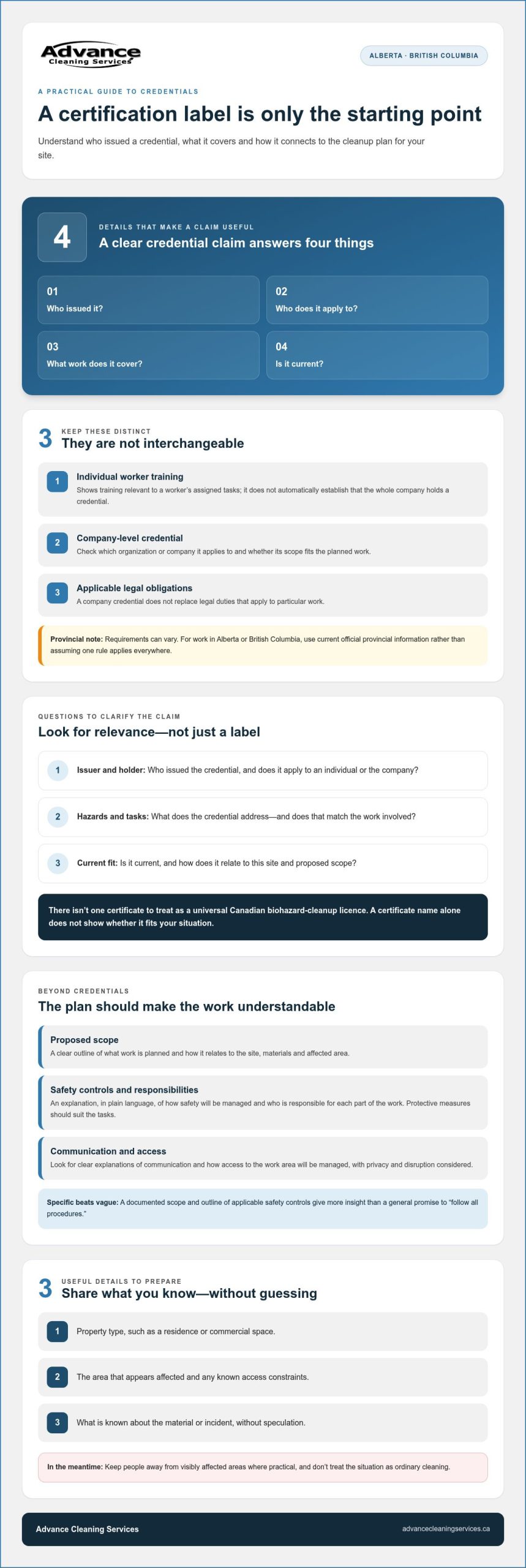
The word “certified” can sound definitive, but it doesn’t explain who was assessed, what the credential covers or whether it fits the work at your property. Evaluate the issuing organization, the credential’s scope and how it relates to the hazards and tasks involved.
Keep three things distinct: an individual worker’s training, a company-level credential and regulatory obligations that apply to particular work. They aren’t interchangeable. A trained employee doesn’t automatically establish that a whole company holds a credential, and a company credential doesn’t replace applicable legal duties. Requirements can vary by province, so for a cleanup in Alberta or British Columbia, use current official provincial information rather than assuming one rule applies everywhere.
How to assess a credential claim
A clear credential claim should identify its issuer, the person or organization it applies to, the work it covers and whether it’s current. These details help you assess relevance. For example, training that addresses one type of hazard may not cover every task involved in a different cleanup. The name of a certificate alone doesn’t show whether it applies to your situation.
There isn’t one certificate that should be treated as a universal Canadian biohazard-cleanup licence. Look for a direct explanation of how the claimed qualification connects to the planned work. If a description uses broad terms such as “certified team” without clarifying the issuer or scope, the label gives you little basis for understanding the provider’s qualifications.
Useful questions include:
- Who issued the credential, and does it apply to an individual or the company?
- What hazards or tasks does it address?
- Is it current, and how does it relate to the site and proposed scope?
Training, PPE and documented procedures
Relevant training helps workers understand the hazards and responsibilities associated with their assigned tasks. Protective measures should suit the work, rather than be described only as a generic promise of “full protection.” You don’t need to assess technical details yourself. You should be able to understand, in plain language, how the provider plans to manage safety and who is responsible for each part of the work.
Documentation can make that explanation clearer. A proposed scope, an outline of applicable safety controls and an explanation of responsibilities help you assess whether the approach is specific to the site. “We follow all procedures” offers less insight than a straightforward account of what work is planned and how the team will manage it.
For a property in Calgary or elsewhere in Alberta, the discussion should connect qualifications and procedures to the actual work, rather than rely on a credential as a substitute for explaining the plan. Advance Cleaning Services provides biohazard cleanup and specialized remediation for residential and commercial clients. Learn more about its biohazard cleanup services.
How to Compare Biohazard Cleanup Companies Beyond the Certification Label
A credential can be one part of your decision, but the service plan shows whether a company understands the job in front of it. Compare how each provider connects the reported concern to the proposed scope, explains safety planning and communicates about the property. A long service list tells you less than a clear description of the work relevant to your site.
Use the same criteria for each conversation. Note where answers are specific and where details remain unclear. This makes it easier to compare providers without trying to assess technical procedures yourself.
Does the provider explain how the affected area, reported material and property use shape the proposed work?
Can the provider describe how workers’ training relates to the tasks involved, rather than relying on a broad credential label?
Is there a plain-language explanation of how the work area and access will be managed?
Are responsibilities, updates and the expected handover explained clearly?
A practical company comparison checklist
Consider more than the number of services a company advertises. Look for a response shaped around the reported situation, with clear boundaries around what the proposed work includes. For a residence, discretion and consideration for occupants may be central. In a commercial setting, access, affected areas and coordination with the person responsible for the site may also matter.
A professional, respectful approach should be evident in how the situation is discussed. Notice whether the company communicates calmly, handles sensitive information carefully and explains who will be involved. These practical details can affect how manageable the process feels for residents, staff and others using the property.
Questions that clarify scope and safety
Ask questions that help you understand the plan, not questions that require you to judge technical methods. Useful prompts include:
- What does the site assessment cover, and what information will shape the proposed scope?
- How will access to the work area be managed during the service?
- Who will coordinate access, provide updates and explain the site handover?
- What is included in the proposed work, and what falls outside its boundaries?
Pay attention to how directly the company answers. Unsupported guarantees, vague claims about credentials or unclear service boundaries are reasons to seek a more specific explanation before proceeding. A capable biohazard cleanup company should explain its proposed work in terms you can understand, without overstating what a credential or service promise means.
Also consider whether the provider’s communication suits the sensitivity of the site. Clear expectations, respectful handling of concerns and defined responsibilities can make it easier to coordinate a residential or commercial cleanup. Compare the quality of those explanations alongside qualifications, so your decision reflects the property’s needs rather than a label alone.
Preparing for Biohazard Cleanup in Alberta or the Vancouver Area
A few practical details can make an initial conversation clearer and help a professional understand the site. You don’t need to assess contamination or decide the cleanup scope yourself. Focus on keeping people away from the visibly affected area where practical, noting basic facts and arranging professional guidance.
- Restrict access where practical. Keep occupants, staff and visitors away from the affected area. Consider who may need access, but don’t put yourself or others at risk to secure it.
- Record basic details. Note the property type, location, area of concern and any known access limitations. Keep the description factual and non-graphic.
- Arrange professional guidance. Share the information you have so the provider can discuss the situation and explain appropriate next steps.
Information to have ready when arranging service
Before contacting a biohazard cleanup company, gather details that can help frame the conversation. You don’t need to know the technical nature of the material. A concise description of what you’ve observed is enough to start.
- The property location and whether it’s a residence, commercial space or another type of site.
- The area that appears to be affected and a non-graphic description of the concern.
- Whether occupants, staff, property representatives or other contractors need coordinated access.
- Any immediate access or privacy considerations, such as shared entrances or sensitive areas of the property.
Be clear about what you know and what you don’t. For instance, identify the room or area involved without assuming how far contamination may extend. If access needs to be coordinated with a building representative or another person, mention that early so those arrangements can be included in planning.
Local coordination and related cleanup needs
Site conditions can differ between a home in Calgary, a commercial property in Edmonton or Red Deer, and a location in Vancouver or nearby communities. Access, building use and the people who need updates can all shape coordination. Applicable provincial requirements can also affect planning, so consider the property’s location rather than assuming the same requirements apply everywhere.
Advance Cleaning Services provides biohazard cleanup and specialized remediation for residential and commercial clients in Alberta and the Vancouver area. Mention related needs when they apply. For example, if severe accumulation is also part of the situation, specialized hoarding cleanup may be relevant alongside the contamination concern. A trauma or crime-scene context matters when it describes the actual situation.
Advance Cleaning Services serves local clients in Calgary, Edmonton, Red Deer, Okotoks, Lethbridge, Strathmore, Chestermere, Airdrie, Cochrane, Vancouver, Richmond, Burnaby, Surry, Surrey, New Westminster, Coquitlam and Abbotsford. Share the property type, affected area and known access constraints to help guide a respectful, site-specific conversation. Read about biohazard cleanup.
Arrange Biohazard Cleanup with Advance Cleaning Services
Advance Cleaning Services provides biohazard cleanup and specialized remediation for residential and commercial clients in Alberta and the Vancouver area. When evaluating a certified biohazard cleanup company, it’s reasonable to want a clear, respectful conversation about the situation before discussing next steps. Share what you know so the team can understand the property context and the cleanup needs you’re describing.
What to expect from a professional service discussion
The first discussion establishes where the property is, what type of site is involved and what has been reported. You can describe the affected area in straightforward, non-graphic terms and note concerns about access, occupants or privacy. This gives the conversation a practical starting point without requiring you to assess the hazard or decide what work is needed.
Clear scope-setting matters. The discussion can clarify the situation, relevant site context and appropriate next steps. Each property is different, so details about the location and reported concern help shape the conversation. You should feel comfortable raising questions and receiving a professional, considerate response.
Local support for residential and commercial needs
Cleanup needs can arise in a home, commercial property or another occupied space. Advance Cleaning Services serves residential and commercial clients in Alberta and the Vancouver area, including Calgary, Edmonton and Vancouver. The location and site circumstances inform coordination, so sharing the property’s address or general location early helps keep the discussion grounded in your situation.
Some situations may involve related specialized remediation, such as crime scene cleaning or extreme hoarding cleanup. Mention these when they’re relevant to the property and reported concern. The aim is to discuss the work that fits the situation, not to assume that every service applies or turn a sensitive call into a broad service catalogue.
Before you get in touch, it may help to have a few basic details ready:
- The property’s location and whether it’s residential or commercial.
- A brief description of the concern and the area involved.
- Any known access, privacy or coordination considerations.
You don’t need to have every answer prepared. Start with what you know and raise anything you’re unsure about. A calm, factual conversation can clarify what information is useful and what next steps may be appropriate for your site.
If you need professional biohazard cleanup in Alberta or the Vancouver area, contact Advance Cleaning Services to discuss your cleanup needs. Share the location and a brief description of the situation to start a respectful conversation about the support your property requires.
Move Forward with a Clear Next Step
A difficult cleanup can make it hard to know what to do first. You don’t need to arrive with every detail settled. A short, factual description of the property and concern is a practical starting point, and you can raise questions as they come up. Choosing a certified biohazard cleanup company means looking for a professional conversation that helps you understand the next step without adding pressure.
Sharing what you know can help frame a discussion around the property and your needs.
Discuss your biohazard cleanup needs with Advance Cleaning Services when you’re ready to talk through the situation.
Frequently Asked Questions
Is biohazard cleanup certification the same across Canada?
No. Certification claims and applicable requirements can differ. A credential may apply to an individual, a company or a particular type of work, so its meaning depends on who issued it and what it covers. For a site in Alberta or British Columbia, consider the location as well as the cleanup tasks. Check current official provincial information for requirements that apply to the specific situation.
Can a regular cleaning company handle biohazard cleanup?
Not every company that handles routine cleaning has the training or procedures suited to biohazard remediation. Everyday janitorial work and specialized cleanup involve different tasks and safety considerations. Look for a clear explanation of how the service applies to the reported concern and property. Advance Cleaning Services provides both routine cleaning and specialized biohazard cleanup, with the work tailored to the situation.
What information should I provide when arranging biohazard cleanup?
Share the location, property type and a brief, factual description of the concern. If useful, mention which floor or room is involved, whether the area is accessible, and who can coordinate entry, such as a building manager or site contact. You can also note privacy needs or areas that must remain available to occupants or staff. You don’t need to identify the material yourself.
Does biohazard cleanup include disposal of contaminated materials?
That depends on the materials involved and the agreed scope of work. Before work begins, ask what the proposed service covers, including whether handling or removal of affected materials is part of the plan and what falls outside it. Requirements can vary by location and material, so the approach should account for applicable rules. Don’t assume disposal is included without a clear explanation.
Can a property remain occupied during biohazard cleanup?
Possibly, but occupancy depends on the site assessment and how the affected area relates to the rest of the property. A home may have different access needs from a workplace with staff or customers on site. Discuss who uses the space and whether people need access to nearby rooms. The professional assessment can clarify what areas should be avoided while the work is planned or underway.
How do I choose a biohazard cleanup company in Alberta or the Vancouver area?
Look for a clear explanation of the proposed scope, relevant qualifications, safety planning and communication. Advance Cleaning Services provides biohazard cleanup and specialized remediation for residential and commercial clients in Calgary, Edmonton, Red Deer, Okotoks, Lethbridge, Strathmore, Chestermere, Airdrie, Cochrane, Vancouver, Richmond, Burnaby, Surry, Surrey, New Westminster, Coquitlam and Abbotsford. Share your location and site details to discuss a response suited to your situation.