
Why does construction dust return after you’ve just cleaned it? Fine particles can remain on higher or sheltered surfaces, then drift down when disturbed, leaving fresh dust on floors, furniture and vent covers. That’s why post-construction dust settlement cleaning is rarely a one-pass job, and why repeated wiping can feel frustrating.
Cleaning in the wrong order can stir particles back into the air or leave finished surfaces dusty. This guide explains why dust resurfaces, where it tends to linger and how to work from higher surfaces down to the floor. You’ll also find practical ways to decide whether a follow-up is manageable on your own or better handled as a professional cleanup.
Advance Cleaning Services Inc. provides residential and commercial post-construction cleanup across Alberta and the Vancouver area, including Calgary, Edmonton, Red Deer, Okotoks, Lethbridge, Strathmore, Chestermere, Airdrie, Cochrane, Vancouver, Richmond, Burnaby, Surrey, New Westminster, Coquitlam and Abbotsford. If dust keeps returning or the project spans several rooms, a professional cleanup can help prepare the space for its next use.
Key Takeaways
- Visible dust alone doesn’t reveal its source or composition, so avoid assumptions based on appearance.
- Consider how activity and airflow affect dust movement. A dusty surface and a system that may circulate air are different things.
- Reserve DIY follow-up cleaning for limited, accessible dust after dusty work has stopped.
- Clean in sequence: start with higher surfaces, then move down and finish with the floor to reduce unnecessary redistribution.
- Recurring dust, wide coverage or hard-to-reach areas can make professional cleanup a practical option. The plan should reflect the space, surfaces and intended use.
Why Does Post-Construction Dust Keep Settling After Cleaning?
A surface can look clean after the first pass, then show a faint coating of dust later. That doesn’t necessarily mean the cleaning failed. Fine particles can remain on elevated or sheltered surfaces and become airborne again when people move through the space, doors open or work continues nearby. Post-construction dust settlement cleaning is a follow-up pass to capture particles after they have resurfaced and settled again.
Construction residue can differ from the dust that builds up during everyday living. It may come from materials or tasks used during a project, but appearance alone can’t reliably identify its source or composition. Settled construction dust is project residue redistributed around a space, not simply ordinary household dust accumulated through daily use. For general background on how dust varies and settles, see Understanding Dust Composition and Settlement.
Where fine construction dust can collect
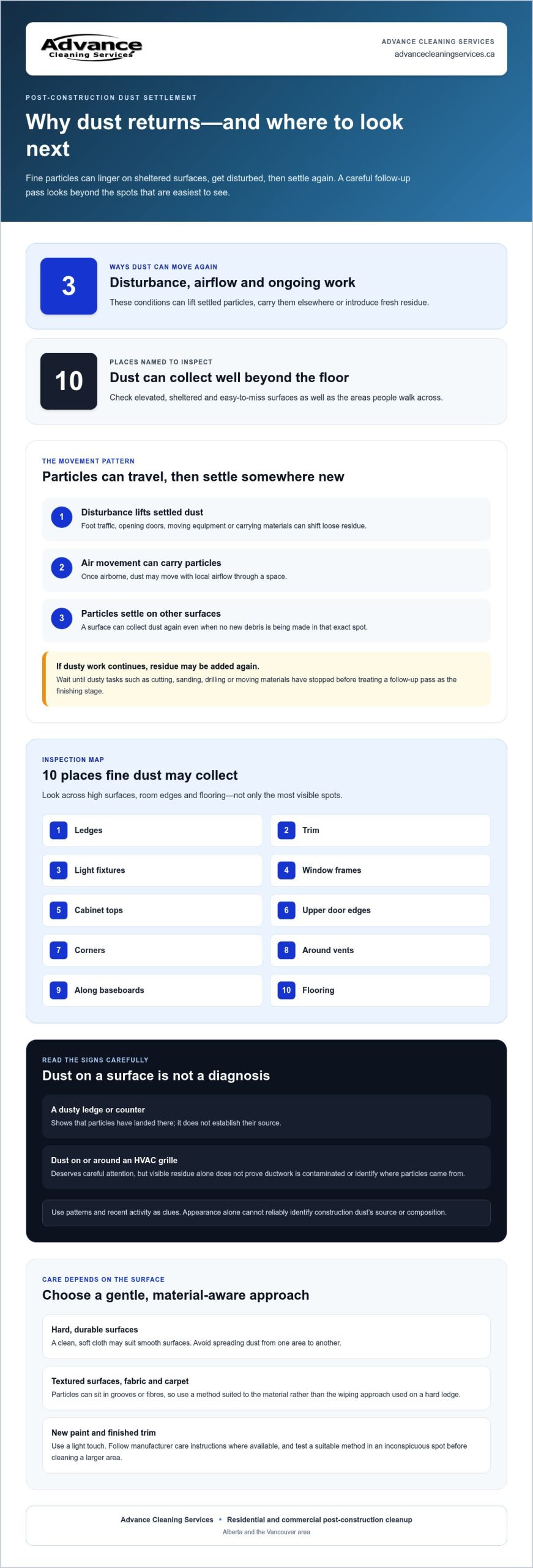
Dust often lands on horizontal surfaces where it can rest undisturbed: ledges, trim, light fixtures, window frames, cabinet tops and upper door edges. It can also gather in corners, around vents, along baseboards and on flooring. These areas are easy to overlook when attention is focused on the most visible surfaces.
What can make dust reappear
Small disturbances can lift settled particles. Foot traffic may stir dust from floors; opening and closing doors can create movement; and equipment or stored materials can shift residue from ledges and corners. Air movement may carry particles before they settle somewhere else. A clean surface can therefore collect dust again even when no new debris is being made in that exact spot.
Look for patterns, not just one dusty patch. A light film across several surfaces may reflect particles settling after movement or ongoing work. Dust near a vent doesn’t, by itself, diagnose a problem with the building’s air system. Note where residue appears, consider what activity may have disturbed it, and include those areas in the next careful pass.
How Construction Dust Moves Through a Space
It helps to distinguish surfaces that collect settled dust from systems that may circulate air. A dusty counter or ledge shows that particles have landed there. Dust on or around an HVAC grille deserves careful attention, but it doesn’t prove that ductwork is contaminated or identify where the particles came from. Visible dust alone can’t confirm a particular source.
How activity and airflow redistribute dust
Walking across a dusty floor can stir particles into the air. Opening a door, moving equipment or carrying materials through a room can shift loose residue. Once airborne, particles may travel with local airflow and settle on nearby shelves, trim, furniture or other surfaces. Their route depends on the conditions at the time, not on a single fixed pattern.
Disturbance can lift settled particles, airflow can carry them, and their next landing place may need another dusting. This helps explain why residue can show up after an initial cleanup without assuming that a particular vent or system is responsible. A grille is one place to inspect and clean carefully as appropriate; it isn’t, by itself, evidence of a problem inside the air system.
Use observations as clues, not diagnoses. If dust appears near a doorway after materials have been moved, that activity offers one possible pathway. If it appears around a grille, airflow may have played a part, but visible residue can’t establish its source. In post-construction dust settlement cleaning, tracking recent activity helps direct attention without making unsupported assumptions about the building.
Why materials and finishes need different care
Smooth, durable surfaces can often be approached with a clean, soft cloth, while textured surfaces may hold particles in grooves or edges. Fabric-covered furniture and carpet need a method suited to their fibres, rather than the wiping approach used on a hard ledge. Choose tools and techniques for the material, and avoid spreading dust from one surface to another.
New paint and finished trim call for a light touch. Don’t scrub aggressively to remove a faint film, since abrasion or excess moisture may mark a delicate finish. Follow the manufacturer’s care instructions where available, and test a suitable method in an inconspicuous spot before treating a larger area. A careful approach protects the finish while addressing residue.
For a renovation spanning several rooms or surfaces that need different care, professional post-construction cleanup can be a practical option. Advance Cleaning Services provides residential and commercial post-construction cleanup across Alberta and the Vancouver area.
DIY Dust Settlement Cleaning or Professional Post-Construction Cleanup?
The right choice depends on how much dust remains, how widely it has spread and how easily you can reach the affected surfaces. A small, accessible area after all dusty work has stopped may be manageable at home. A larger project, recurring residue or a mix of delicate and hard-to-reach surfaces can make professional cleanup more practical.
| Consideration | DIY follow-up | Professional cleanup |
|---|---|---|
| Project scale | A limited area or one small room. | Several rooms or a broad renovation area. |
| Dust recurrence | A light, isolated film after work has ended. | Dust keeps returning across multiple areas. |
| Access | Surfaces are easy to reach safely. | High, awkward or difficult-to-access areas need attention. |
| Time | You can set aside time to clean and reassess. | The volume of detail makes a thorough pass difficult to manage alone. |
| Surface variety | There are a few familiar, durable surfaces. | The space includes varied finishes, flooring, fixtures or furnishings. |
For a wider project or a more detailed cleanup, Explore post-construction cleaning services from Advance Cleaning Services. The company provides residential and commercial post-construction cleanup.
When a careful DIY pass may be enough
A DIY pass can suit a small, accessible area once construction activity has stopped. Use a clean microfibre cloth on appropriate surfaces and a vacuum suited to the material and task. Work carefully around new finishes, and follow any manufacturer care instructions for delicate materials.
Keep expectations realistic. If dust returns after activity resumes, or you notice residue in additional areas, pause and reassess the scope. One small pass may not address every surface affected by the project. Further cleaning may be needed once the space is fully quiet.
When professional cleanup may be more practical
A multi-room renovation can leave many surfaces to inspect and clean, from ledges and fixtures to floors and detailed finishes. Recurring dust, limited access or a wide mix of materials can add time and make it harder to keep the work consistent. These are useful signs to consider professional help, especially when another round of cleaning would be difficult to fit into your schedule.
Advance Cleaning Services handles residential and commercial post-construction cleanup across Alberta and the Vancouver area. The cleaning plan can reflect the project’s size, surfaces and intended use, since every space doesn’t need the same approach. For carpeted areas, let the surface and the dust present guide the appropriate care.
How to Clean After Construction Dust Has Settled
- Prepare the room. Check that work is complete, then clear accessible loose debris without dragging it across finished surfaces. Gather clean microfibre cloths, a vacuum with suitable filtration and supplies appropriate for the materials you’ll clean. Follow care instructions for new or delicate finishes, and avoid dry sweeping, which can send fine dust back into the air.
- Start with high, reachable surfaces. Carefully dust ledges, upper trim, fixture exteriors and other elevated surfaces you can reach safely. Use a clean cloth or a suitable vacuum attachment, and change or clean your cloth as it picks up residue. Don’t reach precariously or use a tool that could scratch a finish.
- Move to lower details. Continue with window frames, doors, counters and baseboards, working methodically around the room. Give corners and edges attention, since they can be missed during a quick wipe-down. Use a light touch on fresh paint, and follow the manufacturer’s instructions where available.
- Attend to vents and grilles carefully. Remove visible dust from accessible exterior surfaces using a suitable cloth or vacuum attachment. Don’t push debris into openings or assume dust on a grille means ductwork needs cleaning. This step addresses visible surface residue, not the inside of the air system.
- Finish with the floor. Vacuum hard floors and carpet with equipment suited to the surface, then use a compatible damp-cleaning method on hard flooring if appropriate. Avoid excess moisture on new floors and follow their care guidance. If the project included broad, multi-room work, a post-construction cleaning guide can help you consider the wider cleanup beyond settled dust.
Once the pass is complete, let the room settle and check the surfaces again before putting items back or treating the cleanup as finished. If dust continues to return across several rooms, or surfaces are difficult to access, Advance Cleaning Services provides residential and commercial post-construction cleanup. Explore professional post-construction cleanup as a practical next step for a larger or more detailed project.
When to Arrange Professional Post-Construction Dust Cleaning
A professional follow-up may be worthwhile if dust keeps returning after work has stopped, appears across several rooms or has settled on surfaces that are difficult to reach safely. Another sign is a space with many different finishes, where each surface needs careful attention. A small patch on an accessible surface may be manageable on your own; widespread residue or repeated cleaning can call for a more coordinated plan.
What to consider before arranging a cleanup
Before arranging a cleanup, make a concise note of the affected areas and any dusty work that has taken place since the initial cleaning. Identify where dust reappears, whether it spans one room or the wider property, and which surfaces need attention. Note details such as carpeted areas, delicate finishes, high ledges or fixtures that are hard to access. This gives the cleaning plan a useful starting point.
A local cleanup option for Alberta and the Vancouver area
Advance Cleaning Services provides residential and commercial post-construction cleanup across Alberta and the Vancouver area. Service communities include Calgary, Edmonton, Red Deer, Okotoks, Lethbridge, Strathmore, Chestermere, Airdrie and Cochrane, as well as Vancouver, Richmond, Burnaby, Surry, New Westminster, Coquitlam and Abbotsford. A project that covers multiple rooms or includes a mix of floors, fixtures and finished surfaces can be approached with those specific needs in mind.
Keep the next step straightforward: outline the rooms affected, describe where dust is recurring and note the intended use of the space. That information helps frame the work without needing to diagnose the dust’s source from appearance alone. The aim is to choose a practical level of cleanup for the property and its next stage.
If another thorough pass would make the transition easier, Arrange professional post-construction cleanup with Advance Cleaning Services.
Set a Clear Next Step for Your Space
If another detailed pass feels difficult to manage, professional post-construction dust settlement cleaning can help you move forward with a plan suited to the property. Advance Cleaning Services provides post-construction cleanup for residential and commercial spaces across Alberta and the Vancouver area.
Choose the next step that fits your project and priorities. Arrange professional post-construction cleanup with Advance Cleaning Services to prepare the space for what comes next.
Frequently Asked Questions
Can construction dust settle again after the space has been cleaned?
Yes, construction dust can settle again after cleaning. Particles may remain on concealed surfaces or in places that weren’t part of the first pass, then become visible after someone uses the room. For post-construction dust settlement cleaning, note where dust returns and when you notice it. For example, dust appearing after furniture is moved may help you decide whether another targeted pass is needed.
How long should I wait before cleaning after construction or renovation?
Can I use a regular vacuum to remove construction dust?
A regular vacuum may not capture fine construction particles effectively, and some models can release dust back into the room. A vacuum with HEPA filtration is better suited to fine particles, provided it’s appropriate for the surface and used according to its instructions. For a hard surface, a lightly damp microfibre cloth may help collect residue. Don’t use a vacuum if its filter or bag is damaged or full.
Should I clean air vents after a renovation?
Is construction dust harmful to breathe?
It can be, depending on what the dust contains. Construction dust may include particles from materials such as wood or drywall, and some work can produce respirable crystalline silica. You can’t identify composition or risk by appearance alone. Avoid stirring up visible residue, keep people away from active dusty work and use appropriate precautions. If someone has breathing concerns after exposure, they should seek advice from a health professional.
Can I move furniture into a renovated room before the dust is gone?
It’s better to wait until dusty work has ended and the room has had a careful cleaning. Furniture can block access to baseboards and corners, making those areas harder to address later. Upholstered pieces can also collect dust on their surfaces. If furniture must be moved in sooner, keep it covered during remaining work and leave enough access to clean the surrounding floor and surfaces afterwards.