What if a clinic’s biggest cleaning gap isn’t a missed surface, but the route contaminants may take between surfaces? Cross-contamination prevention in clinics means looking beyond visible dirt to how contaminants can move through shared spaces, on hands, equipment and frequently touched surfaces.
In a busy clinic, patient rooms, reception areas and shared equipment all deserve consideration. Routine cleaning needs to account for the ways staff and patients move through the space. A coordinated approach helps make environmental cleaning more consistent and supports the clinic’s own infection-prevention protocols.
This guide explains common transfer pathways and offers a practical way to organize cleaning tasks. You’ll learn how regular attention to high-touch points can fit into a broader routine, and how professional medical facility cleaning can support that work. Advance Cleaning Services Inc. provides clinic cleaning that includes frequent touch-point sanitation, with dedicated management and monthly site evaluations to support service quality.
Key Takeaways
- Trace how people, reusable items and shared spaces can connect separate clinic interactions.
- Understand how cleaning, sanitizing and disinfecting differ, and why the right approach depends on the task.
- Build a repeatable workflow to identify priority areas, prepare, clean, review and document.
- Support cross-contamination prevention in clinics with coordinated environmental cleaning that follows facility procedures.
- See how professional medical facility cleaning can complement a clinic’s routine with suitable products and equipment.
What cross-contamination prevention in clinics means, and why transfer matters
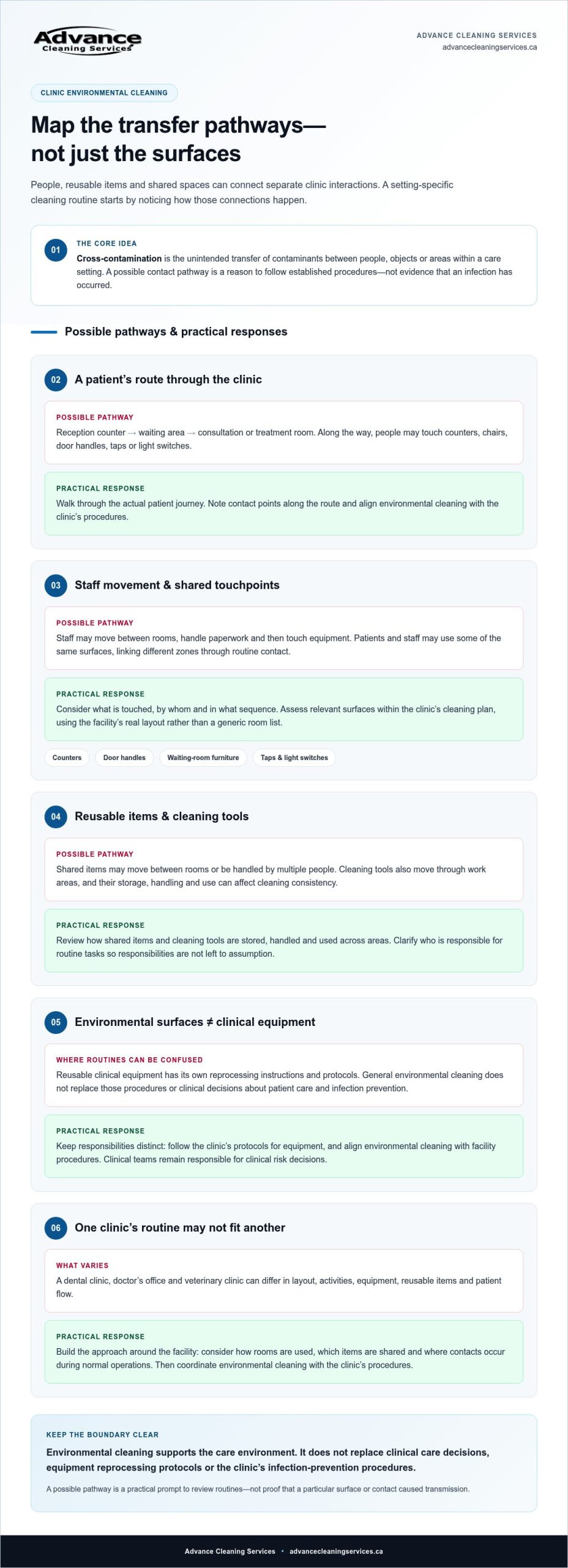
Cross-contamination prevention in clinics starts with recognizing that contaminants can move as people, objects and reusable items pass through a facility. A patient touches a reception counter, a staff member handles paperwork, and a reusable item travels into a treatment room. Each contact may create a possible link between people or areas. That doesn’t mean a particular contact has caused an infection. It does mean the route deserves attention as part of a coordinated prevention approach.
Clinic cross-contamination is the unintended transfer of contaminants between people, objects or areas within a care setting. The definition is simple, but applying it requires attention to how the clinic operates. Patients and staff share spaces, while equipment and supplies may be used, moved or handled during different interactions. Environmental cleaning addresses surfaces and surroundings. It doesn’t replace clinical decisions about patient care or infection prevention.
How contaminants can move through a clinic
Hands can connect one surface to another. Someone might touch a reception counter, then a door handle; staff may handle paperwork before touching equipment. Frequently touched surfaces, such as treatment-room handles and waiting-room furniture, can be part of these pathways. Shared items may also move between rooms or be handled by multiple people.
Movement matters, too. A patient’s visit may involve reception, a waiting area and a consultation or treatment space. Staff may move between rooms as they work. These examples show why it helps to consider the sequence of contacts across a clinic, rather than treating each surface as an isolated task. A possible pathway isn’t evidence that a specific infection has occurred. It’s a practical prompt to follow the clinic’s established cleaning and care procedures.
For a broader overview of measures such as hand hygiene, cleaning and disinfection, see Infection Control Principles. Clinic-specific decisions should still follow applicable professional guidance and the facility’s own procedures.
Why a clinic needs a setting-specific prevention approach
No two care settings have exactly the same layout, activities or patient flow. A dental clinic, doctor’s office and veterinary clinic may use different rooms, equipment and reusable items. Each facility’s routines also shape how people and items move. A prevention approach should reflect those practical differences instead of relying on one generic checklist for every space.
Start by considering the clinic’s rooms, how they’re used, which items are shared and where contacts occur during normal operations. Then align environmental cleaning with the facility’s procedures. Clinical teams should make decisions about patient care and infection prevention using applicable protocols and current professional guidance. Clear boundaries matter: cleaning supports the care environment, while clinical staff remain responsible for clinical risk decisions. This makes cross-contamination prevention in clinics a setting-specific effort to recognize and address possible transfer pathways without overstating what any one cleaning task can achieve.
Where cross-contamination risks arise in clinic routines
A clinic visit often follows a route: a patient enters, checks in, waits, then moves to a consultation or treatment space. Staff follow their own routes between work areas, rooms and shared supplies. These movements are part of normal operations, not evidence of a lapse. They can help a clinic identify contact points and align environmental cleaning with its routines.
Movement links people, objects and clinic zones, creating possible transfer pathways that a well-planned cleaning routine can address. Mapping those links is more useful than focusing only on isolated surfaces. Consider what is touched, by whom, and how items travel between spaces. That local picture can guide a practical review without assuming that contact inevitably causes transmission.
Patient flow, staff movement, and shared touchpoints
Walk through the patient journey from reception to the waiting area and into a consultation or treatment room. Note surfaces people may touch along the way, such as door handles, counters, chairs, taps and light switches. Staff may use some of the same touchpoints as they move between zones or complete tasks. Repeated contact makes these surfaces worth assessing in the clinic’s cleaning plan.
Use the clinic’s actual layout rather than a generic room list. A counter near check-in may be handled differently from a tap in a treatment space. A chair may be used by several visitors, while a door handle connects one room to a corridor. These examples help teams identify which environmental surfaces need attention under their procedures. They don’t establish that a particular surface has transferred contaminants.
Reusable items and cleaning equipment
Shared items are worth reviewing when they move between rooms or are handled by different people. Cleaning tools also need attention: how they’re stored, handled and used across areas can affect the consistency of environmental cleaning. Review these practices against the clinic’s procedures, and clarify responsibilities so routine tasks aren’t left to assumption.
A useful review can trace a few routine journeys: a patient from entrance to room, a staff member moving between work areas, and a shared item travelling between locations. Note where environmental surfaces are touched and where clinic procedures assign cleaning or handling tasks. The aim isn’t to label ordinary movement as unsafe. It’s to make responsibilities and possible transfer routes visible, then use that information to support cross-contamination prevention in clinics.
Advance Cleaning Services provides medical facility cleaning that includes frequent touch-point sanitation, supporting clinics as they manage environmental surfaces alongside their own procedures. Learn about professional clinic cleaning for shared spaces and high-touch areas.
Cleaning, sanitizing, and disinfecting: what each can, and cannot, do
These terms describe different actions, not interchangeable labels for a surface that looks clean. Understanding the distinction helps clinic teams match environmental tasks to their procedures and the product’s intended use. For cross-contamination prevention in clinics, the right approach depends on the surface, the purpose of the task and the directions that apply.
How to understand the three terms in a clinic context
In practical terms, cleaning removes visible soil and impurities; sanitizing reduces germs to a level considered safe for a particular use; and disinfecting uses a product to kill germs on surfaces. The comparison below summarizes their general purpose. It doesn’t determine which method is appropriate for every clinic surface or situation.
| Method | Purpose | What it doesn’t establish on its own |
|---|---|---|
| Cleaning | Physically removes dirt, soil and impurities from a surface. | A surface that looks clean isn’t proof of a particular microbial outcome. |
| Sanitizing | Reduces the number of germs to a level considered safe for the intended use. | It doesn’t automatically mean the surface has been disinfected. |
| Disinfecting | Uses a chemical product to kill germs on a surface. | The term alone doesn’t show that a product is suitable for every surface or task. |
Choose products according to their intended use and follow label directions and clinic procedures. Labels provide product-specific instructions. Don’t assume a product intended for one surface or purpose is appropriate for another. This table is a plain-language guide, not a substitute for those instructions or applicable Canadian professional guidance.
Where environmental cleaning ends and clinical protocols begin
Environmental cleaning applies to a facility’s surfaces and surroundings. It can support an orderly routine for counters, floors and other environmental surfaces, but it doesn’t make decisions about patient care or replace clinical infection-prevention measures. A surface’s appearance alone can’t confirm that every required step has been completed.
Clinical staff should follow the facility’s applicable procedures for patient care and reusable clinical equipment. Equipment handling and reprocessing are distinct from routine cleaning of the surrounding environment. Keep roles clear so environmental tasks complement, rather than replace, the clinic’s clinical protocols.
A reliable process starts with the facility’s procedures, then uses the product and method specified for the task. Avoid assuming that one product or cleaning method covers every surface, room or clinical need. For broader context on how facility cleaning can support clinic routines, see this professional medical facility cleaning guide. Environmental cleaning is one coordinated part of prevention, alongside the clinical measures the facility directs its staff to follow.
A practical clinic workflow for reducing cross-contamination opportunities
An environmental cleaning routine is easier to carry out when the steps, areas and responsibilities are clear. Use the sequence below as a planning aid, not as a clinical standard. Adapt it to the clinic’s layout, operations, procedures and applicable guidance. It can help make cross-contamination prevention in clinics more consistent without replacing clinical judgement or equipment-specific protocols.
Plan the sequence around clinic spaces and touchpoints
Begin with the facility’s assessment of its rooms, activities and cleaning needs. Map the areas included in environmental cleaning, identify touchpoints and assign responsibilities. Consider how staff will move between spaces so used materials aren’t carried into areas that have already been cleaned.
- Identify priority areas. Review the clinic’s spaces and operations. Note which environmental surfaces and shared touchpoints are included in the cleaning plan, and use facility procedures and applicable guidance to set priorities.
- Prepare for the task. Gather the equipment and products specified for the work. Read and follow product labels, including directions for intended use and any instructions that apply during use. Don’t improvise contact times or assume products are interchangeable.
- Clean the planned areas. Follow the clinic’s assigned sequence and use the designated materials for each task. Plan room-to-room movement so used materials aren’t brought back into cleaned spaces. Keep environmental surfaces separate from reusable clinical equipment, which follows its own procedures.
- Review the work. Use a consistent check to confirm assigned environmental tasks were completed and record missed areas or issues for follow-up. A visual review supports task consistency; it doesn’t establish a clinical outcome.
- Document and refine. Record completion according to the facility’s process. Use the record to clarify outstanding tasks, responsibilities or adjustments to the plan. Set cleaning frequencies based on facility needs and applicable guidance, rather than applying one schedule to every clinic.
Check the work and keep responsibilities clear
Consistency depends on knowing who handles each task and how completion is reviewed. Make the environmental cleaning plan clear to the people responsible for carrying it out, and keep clinical staff responsible for patient-care protocols and equipment-specific procedures. If operations or room use change, review the plan to ensure the assigned areas and responsibilities still fit.
This workflow is a practical framework for organizing environmental tasks. It doesn’t prescribe a universal order, frequency or product for every clinic. The facility’s own procedures and product directions remain central. For a broader look at janitorial planning, the Alberta janitorial services guide offers related facility-management context.
Advance Cleaning Services provides medical facility cleaning that includes frequent touch-point sanitation, professional equipment and eco-friendly cleaning products. Learn how clinic cleaning can support your environmental cleaning routine.
How professional clinic cleaning supports cross-contamination prevention
A professional cleaning partner can make environmental cleaning a defined part of clinic operations. Advance Cleaning Services provides medical facility cleaning for dental, doctor and veterinary clinics. The service supports a facility’s own plan by addressing assigned environmental cleaning tasks, including frequent touch-point sanitation. This helps keep responsibilities clear across shared areas while leaving clinical decisions with the clinic’s care team.
What a cleaning partner can contribute to the facility routine
Coordination starts with defining which spaces and environmental surfaces are included in the cleaning scope. The clinic’s identified priorities can guide attention to shared touchpoints, while its own procedures guide clinical work. Clear task boundaries also help staff understand which responsibilities belong to environmental cleaning and which remain part of patient care.
Advance Cleaning Services uses eco-friendly cleaning products and professional equipment as part of its medical facility cleaning. A professional cleaning partner can work alongside a clinic’s established routines, rather than replacing them. Patient-care decisions, clinical infection-prevention procedures and the reprocessing of clinical equipment remain governed by the clinic’s protocols and applicable instructions.
How Advance Cleaning Services provides ongoing oversight
Consistent service benefits from a clear way to review the work. Managers conduct monthly site evaluations through a dedicated quality-assurance program. These evaluations provide an opportunity to review cleaning service at the facility, while clinical teams continue to manage clinical protocols and patient-care decisions. The evaluations support service oversight; they aren’t a clinical assessment or a guarantee of infection prevention.
Some facilities may also benefit from an additional environmental cleaning option. Fogging sanitization is offered monthly or weekly and is recommended for high-traffic locations or larger facilities. It’s an optional facility-cleaning service, not a substitute for routine cleaning, product directions or the clinic’s infection-prevention procedures. The cleaning plan should remain aligned with the facility’s needs and established protocols.
For clinic managers, the value of a professional partner is practical: assigned environmental tasks, suitable equipment and products, and ongoing service oversight can support a coordinated routine. This work contributes to cross-contamination prevention in clinics by helping address environmental touchpoints, without suggesting that cleaning alone controls every transfer pathway or replaces other prevention measures.
For a broader overview of facility cleaning considerations, explore this professional medical facility cleaning guide. Advance Cleaning Services provides clinic cleaning support that works alongside your facility’s procedures. Learn about medical facility cleaning.
Keep prevention moving with your clinic’s needs
Clinic routines change as rooms, schedules and services evolve. Make cross-contamination prevention in clinics an ongoing part of facility planning, not a task to revisit only when something goes wrong. A periodic review can help your team identify when responsibilities or cleaning priorities need to adapt, while keeping environmental cleaning aligned with current procedures.
Choose a manageable next step: bring the people responsible for clinic operations and environmental cleaning together to discuss what’s working and where coordination could be clearer. Practical adjustments can help maintain a consistent routine without blurring the line between facility cleaning and clinical responsibilities. Keep decisions about patient care and infection prevention within the clinic’s established protocols.
Professional cleaning can support that effort as part of a coordinated facility routine. Advance Cleaning Services serves facilities in Calgary, Edmonton, Red Deer, Okotoks, Lethbridge, Strathmore, Chestermere, Airdrie, Vancouver, Richmond, Burnaby, Surry, New Westminster, Coquitlam, Abbotsford and Cochrane. Explore medical facility cleaning for your clinic.
Frequently Asked Questions
Can cross-contamination happen even when a clinic looks clean?
Yes. A tidy appearance can’t confirm whether a surface was cleaned or treated using the method required for its intended use. For cross-contamination prevention in clinics, staff should rely on assigned procedures and product directions rather than appearance alone. For example, a counter may look spotless but still need attention under the clinic’s cleaning plan. Keep task records so completed work is easier to distinguish from work that still needs attention.
Is fogging a replacement for routine clinic cleaning?
No. Fogging is an optional addition to a facility’s cleaning plan, not a replacement for routine tasks or clinic procedures. It doesn’t remove the need to clean environmental surfaces as assigned or follow product instructions. Clinic managers should consider how the service fits the facility’s operations, then keep routine responsibilities clear. Clinical infection-prevention measures and patient-care decisions remain guided by the clinic’s own protocols.
How should a clinic handle shared pens and other frequently touched items?
Include shared items in the clinic’s local cleaning plan and assign responsibility for them. A reception pen, clipboard or shared keyboard may be handled by different people, so the plan should explain how these items are managed and when staff should attend to them. Where practical, the clinic can reduce unnecessary sharing or provide a designated place for used items. Follow product directions to ensure the chosen method suits the item.
What should clinic staff do if a cleaning product is used incorrectly?
Stop the task and follow the clinic’s procedures for reporting and addressing the error. Don’t continue using the product or mix it with another product. Check the label and the facility’s product-safety instructions, and notify the person responsible for the cleaning task. If someone may have been exposed, follow the clinic’s established response process and seek appropriate professional guidance. Record the incident and any follow-up according to facility procedures.
Who is responsible for preventing cross-contamination in a clinic?
Responsibility is shared, but each role needs defined boundaries. Clinic leadership can establish procedures and assign responsibilities; environmental cleaning staff can complete their assigned facility tasks; and clinical staff can follow the clinic’s patient-care and equipment procedures. Staff should know whom to notify when they see an unaddressed surface or unclear task. Clear handoffs help the team respond consistently without assuming one role can cover every part of prevention.
How can a clinic check whether its environmental cleaning routine is working?
Review completed task records alongside periodic observations of the areas included in the plan. Look for missed assignments, unclear ownership or recurring issues, then update the workflow where needed. Staff feedback can reveal practical gaps, such as a task that’s difficult to complete during normal room turnover. Keep the review focused on whether the routine is being followed and remains workable; it doesn’t by itself confirm clinical outcomes.