One cleaning plan can cover an entire municipal building or coordinate recurring work across several sites. Municipal building cleaning in Red Deer is easier to manage when the schedule identifies the areas to clean, the tasks included and when each site is serviced.
A clear schedule matters in busy public facilities. It helps staff know what to expect and gives cleaning teams a practical way to organize routine work around each building’s needs. The plan should reflect how spaces are used, from offices and shared areas to public-facing rooms.
This article explains what municipal building cleaning can include, how to plan schedules across one or more sites and which factors affect service scope and cost. You’ll also learn how to assess a cleaning provider’s approach and what information helps shape a practical cleaning plan for Red Deer facilities.
Key Takeaways
- Plan cleaning across one or multiple municipal buildings by matching tasks to how each space is used.
- For downtown concerns involving needle debris that someone isn’t equipped to pick up, call Red Deer Parks & Public Works at 403-342-8238.
- Build a janitorial schedule around recurring tasks, site priorities and clear reporting so staff know what has been completed.
- Choose floor care methods according to the flooring material, condition and level of use before planning cleaning or waxing.
- Use a written scope and schedule to identify where professional cleaning support can help keep municipal spaces orderly.
Commercial cleaning in Red Deer
Commercial cleaning in Red Deer can cover one municipal facility or several sites under a coordinated plan. Start by mapping each building’s public areas, staff spaces, washrooms, kitchens and operating hours.
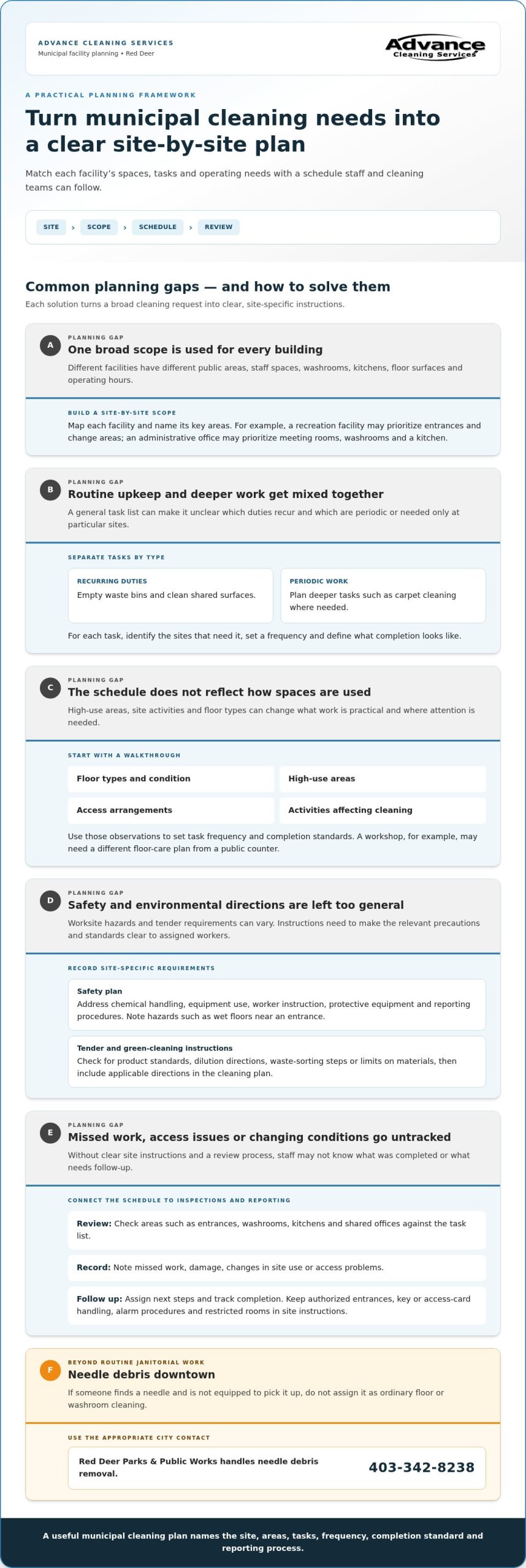
For municipal building cleaning in Red Deer, define the work by room and task instead of relying on a broad description. A recreation facility may need attention to entrances and change areas, while an administrative office may prioritize meeting rooms, washrooms and a kitchen. A site-by-site scope clarifies what the service includes and where priorities differ.
Commercial and janitorial cleaning in Red Deer and Central Alberta can be organized around routine visits, periodic tasks and site-specific needs. Separate recurring duties, such as emptying waste bins and cleaning shared surfaces, from deeper work, such as carpet cleaning. Then note which sites need each task and how staff can report an issue between scheduled visits.
A practical walkthrough is a useful starting point for a commercial cleaning plan. Record floor types, high-use areas, access arrangements and activities that affect cleaning. A workshop, for example, may need a different floor-care plan from a public counter. Assign a frequency and clear completion standard to each task, then review the schedule against actual site conditions.
Commercial cleaning providers may serve municipal offices, retail spaces, medical facilities, educational settings and industrial workplaces. The work can range from common-area upkeep to detailed cleaning of kitchens, washrooms and floors. Compare providers by reviewing their proposed scope, staff orientation, communication process and ability to coordinate service across multiple buildings.
Contractor Qualifications and Insurance
There isn’t one qualification, insurance limit or certification that applies to every Red Deer municipal cleaning contract. The tender documents set the criteria, so review them for required insurance evidence, experience with comparable facilities and any named training or certifications. Match each requested document to the work scope, such as kitchen cleaning or service across several sites.
Safety and Green-Cleaning Requirements
For Alberta occupational health and safety, contractors should plan around the hazards and tasks at each worksite. A practical review covers safe chemical handling, equipment use, worker instruction, protective equipment and reporting procedures. Identify specific risks during the site walkthrough, such as wet floors near an entrance, and document how the work plan addresses them.
For City of Red Deer cleaning contracts, use the applicable tender and scope to identify environmental or green-cleaning requirements. Check for specified product standards, dilution directions, waste-sorting steps or limits on materials. Record those instructions in the cleaning plan and make them clear to the workers assigned to each facility.
Cleaning service locations around Red Deer
Map each Red Deer facility before setting cleaning routes. A municipal office, transit terminal and industrial building differ in their access points, floor surfaces and public traffic. Group nearby sites only when their operating hours and cleaning needs allow practical coordination. The location plan should name each building, its key areas and the tasks assigned there.
Downtown locations need clear procedures for concerns that fall outside routine janitorial work. If someone finds a needle and isn’t equipped to pick it up, Red Deer Parks & Public Works handles needle debris removal at 403-342-8238. Record the concern’s location and use the appropriate city contact rather than assigning it as ordinary floor or washroom cleaning.
Inspections connect the written scope with conditions at the facility. A site lead can review an entrance, washroom, kitchen and shared office area against the task list. Record missed work, damage or changes in site use, then assign follow-up and track completion. After construction, for example, an inspection can note dust on ledges and residue near newly finished floors.
Define a security process for cleaning access. Identify authorized entrances, key or access-card handling, alarm procedures and restricted rooms in the site instructions. Keep directions specific to each facility, especially when a route includes both an administrative office and a public building. Inspection records can note when a door or access issue prevents a task.
Day porter coverage and matron duties address needs that arise during a facility’s operating hours. A porter may monitor visible conditions in a lobby, refill washroom supplies or respond to a spill under the agreed scope. Define which areas receive attention and how staff report issues. A transit facility, for instance, may need more frequent checks near public washrooms than in a staff-only room.
Residential cleaning follows a different site plan from municipal or industrial work. A home’s occupied rooms, personal belongings and requested tasks shape its cleaning scope, while a public facility needs task instructions suited to shared access. Keep the two scopes distinct. For a residential property affected by renovation, post-construction cleaning should be planned around remaining dust and debris, not treated as routine upkeep.
For downtown cleaning concerns, call 403-342-8238. For planned work at a facility, outline its location, access arrangements and priority areas before discussing municipal building cleaning Red Deer options through Advance Cleaning Services Inc. That information helps connect the site’s needs with a clear scope and practical inspection steps.
Experienced facility managers often note they have been responsible for office cleaning in various roles for over 20 years. That accumulated experience can help inform a clear office scope, including room priorities, recurring tasks and site-specific access instructions.
Janitorial services
Janitorial services keep municipal and public buildings ready for staff and visitors through routine, clearly assigned tasks. A plan can cover offices, entrances, meeting rooms, washrooms and shared kitchens. A Red Deer community facility, for example, may need separate instructions for its public lobby and staff-only rooms. Define each area so workers know what to clean and what to report.
Public buildings bring specific risks, including wet floors, chemical exposure, waste handling and unexpected hazards. A practical safety plan identifies site hazards, safe work procedures, worker instruction, protective equipment and incident reporting. In Alberta, cleaning employers and workers must follow applicable occupational health and safety requirements. Write procedures for the actual tasks and products used at each building rather than relying on a generic checklist.
Routine janitorial work supports building maintenance, but it doesn’t replace repairs or specialized response. Ask cleaners to report issues such as a leaking tap, damaged flooring or a blocked washroom fixture. Keep maintenance concerns separate from completed cleaning tasks. This helps facility staff direct repairs to the right team and preserves a useful record of what the cleaning crew observed.
For a municipal building, organize instructions around the flow of public use. A written task sheet can identify priority areas, supplies to replenish, surfaces to clean and conditions that need escalation. Include access instructions and restricted areas for each facility. Red Deer sites can have different layouts, so site-specific directions are more useful than copying one broad checklist across every building.
Professional janitorial services should make responsibilities clear. Set out the expected result for each task, then record completion and exceptions consistently. A washroom check, for example, can note that the room was serviced and flag a supply shortage. Supervisors can use inspection notes to identify repeat issues, adjust assignments and distinguish a missed duty from a maintenance problem.
Local knowledge can help a cleaning company understand building layouts and service expectations, but it’s also important to assess how the work will be managed. Review the written scope, staff training process, supervisor communication and approach to site-specific hazards. Ask how the plan handles public access, secured rooms and changes in building use. These details show how the service will work inside a municipal facility.
Red Deer also has clear routes for concerns outside ordinary janitorial work. If someone finds a needle and isn’t equipped to pick it up, Parks & Public Works handles needle debris removal at 403-342-8238. Call 911 for a police, fire or ambulance emergency. These contacts should appear in site instructions, so workers can distinguish routine cleaning from situations requiring a different response.
Use a facility walkthrough to turn these points into a workable plan: identify rooms, note hazards, assign recurring duties and define how staff report issues. For city-specific questions, the City of Red Deer’s general contact number is 403-342-8111. Clear roles help janitorial teams support public access while keeping cleaning, maintenance and emergency response separate.
Cleaning schedules and reporting
Red Deer municipal facilities need schedules tied to actual use, not a generic calendar. The task list should name each area, the work required, its frequency and who records completion. A building plan, for example, can separate entrance checks, washroom servicing, waste removal and periodic deep cleaning. The contract scope and facility use determine tasks and frequencies; one schedule won’t suit every municipal building.
Set the schedule by reviewing public traffic, room function, surface condition and operating hours. Sorensen Station Transit Terminal washrooms are open daily from 8 a.m. to 6 p.m. and operate year-round. A facility schedule can use those published hours to plan cleaning access and identify when checks should happen during public use. Its washroom facility has five private stalls, including one wheelchair-accessible stall, which can be listed as separate inspection points.
Flexible scheduling arranges task timing around building operations and access. A meeting room used for public events, for instance, may need service after an event rather than during setup. Keep routine duties separate from periodic work, such as a deep clean of floor edges or carpeted areas. This makes it clear which tasks belong to the regular plan and which need separate scheduling.
A 24/7 schedule describes coverage planning across a full operating day; it does not itself establish that a cleaning contractor works around the clock. For a facility with continuous access, map the hours when cleaning can occur, the areas that remain open and the process for urgent issues. Red Deer’s Sorensen Station washrooms, by contrast, have stated public opening hours of 8 a.m. to 6 p.m. daily, giving that site a defined public-use window.
Reporting should make attention to detail visible without creating a complicated record. Use a consistent log that includes the site, date, completed tasks, exceptions and follow-up owner. Record a missed supply refill separately from a maintenance concern, such as a leaking tap. Across Central Alberta locations, a shared format helps building contacts compare completed work and spot recurring issues.
- Routine work: record each completed task and any access issue.
- Periodic work: note the area treated and the next planned service.
- Exceptions: describe the issue, location and assigned follow-up.
Review the log with facility staff and adjust the plan when room use changes. If a public counter becomes a temporary event space, update its task list and access window. Clear records keep cleaning services in Red Deer aligned with each facility’s operating needs and prevent routine duties from being confused with repairs or specialized response.
Tasks may include entrance checks, washroom servicing, waste removal and periodic deep cleaning, with completed work and exceptions recorded. Each facility’s traffic, room function, surface condition, operating hours and access needs, along with the contract scope, determine service frequencies. No single schedule applies to every building.
Floor cleaning and waxing
Floor care starts with identifying the surface, its condition and how people use the room. A municipal entrance exposed to tracked-in grit needs a different approach from a quiet office with resilient flooring. Before setting a plan, record the floor material, visible wear, previous finish and areas with frequent foot traffic. These details guide the method and help protect the surface.
Routine care removes soil before it becomes harder to manage. Use entrance mats to capture debris, then match the cleaning method to the floor’s manufacturer guidance and existing finish. Damp mopping may suit some hard surfaces, while carpeted areas need a different approach. Keep grit, excess water and unsuitable products away from flooring, since they can affect its appearance or condition.
Waxing isn’t suitable for every floor. First determine whether the surface accepts a finish and whether an existing coating needs maintenance or removal. For suitable resilient flooring, a planned finish can support a consistent appearance and make routine cleaning more manageable. In a public corridor, schedule the work around access so the area can be safely closed while the floor is treated and dries.
Floor refinishing addresses worn or damaged finish rather than simply adding another layer. Assess dull patches, uneven coating, embedded soil and areas where the finish has worn through. The work plan should explain preparation, finish removal where needed, reapplication and reopening procedures. A municipal office, for example, can be treated by zone so unaffected areas remain available during planned work.
Document the floor’s condition before service to set clear expectations. Note scratches, stains, seams, loose tiles or existing discolouration. After cleaning or refinishing, compare the same areas and record any remaining conditions. This prevents ordinary wear from being mistaken for incomplete work and gives facility staff a useful reference when deciding whether the next step is routine care, spot treatment or repair.
Build a floor-care plan around how the building operates. An entrance, public washroom and staff office may need different task frequencies because traffic and soil levels vary. List dry debris removal, damp cleaning, spot response and periodic floor assessment as separate tasks. Schedule a deep clean when routine methods no longer address accumulated soil; base waxing or refinishing on an assessment of the surface.
For municipal flooring in Red Deer, keep the scope specific: name the rooms, surfaces, preparation steps, access limits and completion standard. If carpeted areas also need attention, request carpet cleaning support as part of a coordinated facility plan. Clear instructions help cleaning teams address each floor type without applying one method across every surface.
Advance Cleaning Services: Medical Facility Cleaning
Advance Cleaning Services Inc. provides medical facility cleaning for medical, dental and veterinary clinics, alongside office cleaning, janitorial services and carpet cleaning. If your Red Deer facility needs recurring cleaning or support across different spaces, identify the rooms, priorities and schedule you want covered. A clear scope helps align cleaning tasks with how staff and visitors use each area.
For a municipal office, janitorial services can support routine upkeep, while carpet cleaning addresses carpeted areas as a separate need. For clinics, medical facility cleaning is the relevant service. Share the facility type and areas that need attention to start a practical conversation about the work.
Visit Advance Cleaning Services Inc. to discuss your facility’s cleaning needs.
Set a Clear Plan for Your Facility
Planning municipal building cleaning in Red Deer is an opportunity to make responsibilities easier to manage. Start with the facility’s priorities, identify areas that need consistent attention and keep the agreed scope clear as needs change. A practical plan gives staff and cleaning teams a shared reference for routine work and follow-up.
Advance Cleaning Services offers medical facility cleaning, office cleaning and janitorial services. These services can support facilities seeking professional cleaning for clinics, offices or recurring janitorial needs. Share the type of space and the work you want addressed to start a focused conversation about your cleaning requirements.
Contact Advance Cleaning Services Inc. to discuss your facility’s cleaning needs and plan a clear next step. With priorities defined and responsibilities understood, you can move forward with greater confidence in how your building will be cared for.
Frequently Asked Questions
Can you clean entire buildings or multiple buildings?
Yes. A coordinated scope can cover an entire building or several facilities, with duties organized by site and room. One plan can separate a municipal office’s staff areas from its public service counters, while another assigns distinct instructions to each building. Office cleaning and janitorial services can support these needs. A room-by-room scope clarifies access, responsibilities and the work expected at each location.
What municipal buildings in Red Deer require cleaning services?
Municipal buildings with public access, staff work areas or shared facilities may include administrative offices, community or recreation facilities and transit buildings. Service needs depend on each building’s function. A public service counter may need attention to visitor-facing surfaces, while a staff office may prioritize workstations and meeting rooms. Identify the rooms used by staff and visitors, then set priorities for each space.
What Alberta occupational health and safety rules apply to municipal building cleaners?
Municipal building cleaners must follow applicable Alberta occupational health and safety requirements. Work plans should address site hazards, safe chemical handling and equipment use, worker instruction, protective equipment and incident reporting.