A low quote doesn’t tell you whether a cleaner is right for your facility. To decide how to hire a commercial cleaning company, compare its staff training, experience with similar buildings, references, quote details, communication, and fit with your cleaning needs. Choose a provider whose scope and schedule suit the way your workplace operates.
It’s reasonable to weigh cost closely, but price alone won’t show what’s included or how service will be managed. A clear scope, reliable communication, and relevant experience help you judge a proposal’s value and whether it meets your day-to-day requirements.
This guide explains what to look for in training and experience, how to review references and compare quotes, and which communication and service-fit details to consider. Use it as a practical framework for evaluating commercial cleaners and choosing an arrangement that supports your facility’s priorities.
Key Takeaways
- Look for cleaners trained in sanitation, safety procedures, and cleaning chemical handling, and clarify how staff screening is managed.
- Prioritize experience with facilities like yours, then use relevant references and reviews to assess reliability and service quality.
- Compare detailed quotes by scope and accountability, including insurance, inspections, and how staff absences are covered.
- Discuss communication, issue resolution, and response to special requests so expectations are clear from the start.
- Match the cleaning schedule and services to each area’s use, traffic, and specific facility requirements.
Cleaner training, certification and background checks
Training, screening, and supervision affect how safely and consistently a cleaning team works. Assess each area separately and ask for examples that relate to your facility’s tasks.
Training and Credentials
Cleaner training covers sanitation techniques, safety procedures, and handling cleaning chemicals. Ask how candidates prepare staff for each task and assess their understanding. For example, a cleaner assigned to washrooms should know the site’s procedures for products, equipment, and safe work practices. Ask what credentials staff hold, what they cover, and how training stays relevant to assigned duties.
Should you hire an in-house cleaning team or outsource to a commercial cleaning company? An in-house team gives you direct control over hiring, daily priorities, and supervision. Outsourcing may suit facilities that want a contracted cleaning service. Compare the provider’s training and supervision plan with the level of control you need.
Background and Social Media Checks
Background checks are screening steps used to assess whether a candidate is suitable to work at your facility. Ask what screening the company conducts, when it takes place, and how building access is managed. When reviewing candidates’ social media, consider only publicly available, role-relevant information, and don’t treat a post as proof of conduct. Apply consistent criteria focused on professional behaviour, reliability, and information directly related to the work.
What workplace health and safety rules apply to commercial cleaning companies in Canada? Requirements depend on where the facility operates, so ask how the provider follows applicable workplace procedures. Discuss chemical handling, personal protective equipment, equipment use, and incident reporting. Ask for practical examples, such as how staff are instructed to follow product labels and report spills.
What questions should you ask before hiring a commercial cleaning company? Ask who trains and supervises cleaners, what screening is used, how staff learn site procedures, and how work quality is checked. Use a specific task, such as cleaning a shared kitchen, to understand how the provider prepares staff and handles concerns.
Team supervision means directing and reviewing cleaners’ work. Ask who oversees the site and how missed tasks are addressed. A quality check should compare completed work with the agreed scope, such as confirming that listed touchpoints were cleaned. Clarify how findings are recorded, shared, and followed up. This makes expectations visible instead of relying on general assurances.
Relevant facility experience and references
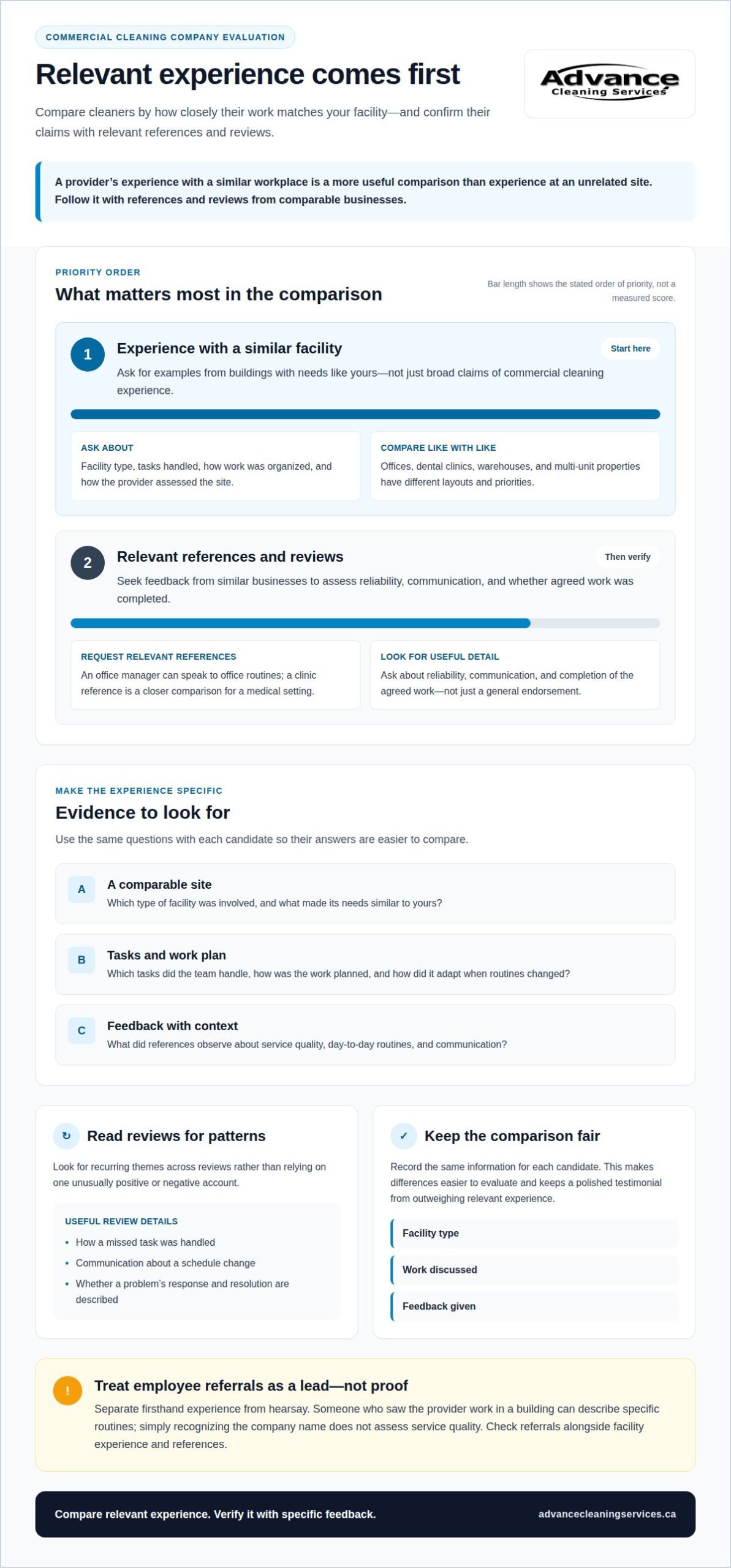
Relevant experience shows whether a cleaning provider understands the routines and demands of your type of facility. Compare examples from similar workplaces, not just general claims of commercial experience.
Relevant Facility Experience
Relevant facility experience means having worked in buildings with needs similar to yours. Offices, dental clinics, warehouses, and multi-unit properties have different layouts, traffic patterns, and priorities. Ask candidates to describe comparable sites they’ve cleaned and the tasks their teams handled. For a dental clinic, ask about experience with treatment rooms, reception areas, staff spaces, and the agreed cleaning scope.
Use the same short set of questions for each candidate. Ask how they assess a site, plan the work, and adapt when routines change. A provider familiar with occupied offices may explain how it coordinates around staff activity. A clinic-focused candidate should describe how it organizes work around the areas and schedule you identify.
Client References and Reviews
Client references and reviews are feedback from businesses that have used a cleaning provider. Request references from similar businesses and ask about reliability, communication, and whether the agreed work was completed. An office manager can speak to daily office routines; a clinic reference offers a closer comparison for a medical setting.
Online reviews and testimonials offer another way to assess a company’s reliability. Look for concrete details, such as how the provider handled a missed task or communicated about a schedule change. Consider recurring themes across reviews rather than relying on one unusually positive or negative account. If a review describes a problem, note whether it also explains the response and resolution.
Keep your comparison consistent: record each reference’s facility type, the work discussed, and the feedback given. That makes differences easier to evaluate and keeps a polished testimonial from outweighing relevant experience. If you’re assessing a clinic’s needs, compare your priorities with this overview of medical facility cleaning.
Employee Referrals
Employee referrals are recommendations from staff who know a cleaning provider through work or professional contact. Treat them as a useful lead, not a substitute for checking facility experience and references. Ask what the employee observed directly, such as punctual communication or careful work in a shared space.
Separate firsthand experience from hearsay. A staff member who worked in a building cleaned by a candidate can describe specific routines; someone who only recognizes the company name cannot assess service quality. Ask referrals and other candidates the same questions, then compare answers with your facility’s requirements. A consistent process helps you choose based on relevant evidence, not familiarity alone.
Comparing quotes and accountability
A useful comparison gives each candidate the same facility details and requested tasks. Review the scope, price breakdown, and accountability terms together before choosing.
Insurance and Liability Coverage
Insurance and liability coverage describe financial protection for accidents, damage, or theft connected with cleaning work. Ask for proof of the company’s insurance and review the coverage details against the work and property involved.
What insurance and liability coverage should a commercial cleaning company have in Canada? Request proof of insurance and clarify what the policy covers, including how it addresses accidents or damage at your facility. Insurance and bonding can help protect a business from liability for accidents, damage, or theft.
Ask who handles a reported incident and how it is documented. For example, if equipment damages a doorway, establish who receives the report and how the issue is followed up. Keep relevant contact and coverage information with your contract records.
Contract Scope, Pricing, and Cancellation
A cleaning contract is the written agreement that defines the work, charges, and terms for ending the service. It should identify tasks, locations, schedule, included services, exclusions, and how either party can cancel.
What should a commercial cleaning contract include, including scope, pricing, and cancellation terms? Look for a task-by-task scope, a clear pricing breakdown, payment terms, and cancellation conditions, including any notice requirements. The price depends on the case and is given after a quote request. Facility size, cleaning frequency, requested tasks, and schedule can affect the quote.
Compare quotes using the same scope. If one proposal includes washrooms and floor care while another excludes them, the totals aren’t comparable. Ask how additional tasks are approved and documented. Before signing, clarify how complaints are handled, who records inspections, and what happens when service falls short. Put agreed changes in writing.
Risks of Unlicensed or Uninsured Companies
An unlicensed or uninsured company may leave gaps in local compliance or financial protection. Licensing requirements depend on the jurisdiction, while insurance details determine how particular incidents may be covered.
What are the risks of hiring an unlicensed or uninsured commercial cleaning company? Without appropriate insurance, your business may face greater exposure to costs related to accidents, property damage, or theft. If a municipal licence applies, hiring a company without the required licence can also create a compliance concern.
Make the checks separately: request proof of insurance, then identify which local licensing rules apply to the cleaning business. Don’t treat a verbal assurance as a substitute for reviewing documents. Keep licence information and coverage details with the signed agreement.
Regional Costs and Requirements
Regional costs and requirements are local factors that shape a quote and the rules a cleaning business must follow. Cleaning scope, building layout, service frequency, and schedule affect the work being priced; licensing rules can also depend on the municipality.
How do commercial cleaning costs and requirements vary by Canadian province or city? Costs depend on the facility and requested work, so compare quotes for the same scope and location. Requirements can differ by jurisdiction. In Calgary, cleaning services are among the businesses that require municipal licensing.
For a Calgary business licence, applicants have been responsible for obtaining and submitting their police security clearance since January 1, 2025. Calgary accepts a previously completed clearance if obtained within 60 days of the business licence application. Use your municipality’s requirements as a separate comparison point from the quote itself.
Evaluating candidate communication and culture fit
Clear communication helps prevent small service issues from becoming recurring frustrations. Assess how a provider listens, shares updates, handles requests, and fits your workplace routines.
A communication protocol is the agreed process for sharing instructions, updates, and concerns. Ask who your main contact will be, which channel they use, and how service notes reach the cleaning team. For example, confirm where your office manager should report a missed task and how the provider will acknowledge and track it. A clear process gives staff a consistent way to raise concerns.
Culture fit is how well a provider’s working style aligns with your facility’s expectations and routines. Consider whether cleaners need to work around employees, visitors, patients, or deliveries. A busy reception area may require quiet, discreet service, while a shared office kitchen may call for careful coordination with staff. Explain these routines during the walkthrough and note how each candidate responds.
Responsiveness is a provider’s ability to acknowledge and address requests through an agreed process. Ask how it handles special requests or emergencies, and who is responsible for each. A request to clean a spill, for example, differs from a schedule adjustment. Discuss how urgent issues are prioritized, how updates are shared, and what information to include when reporting a problem.
Use the same practical questions with each candidate so their answers are easy to compare:
- Who is the day-to-day contact for our facility?
- How should staff report a missed task or access issue?
- How are schedule changes shared with cleaners?
- How do you handle a special request that falls outside the regular scope?
- What happens when the usual contact is unavailable?
Listen for specific steps, not just a promise to communicate well. A useful answer names the contact role, reporting channel, and how an issue is assigned for follow-up. If a candidate says staff should tell the cleaner directly, ask how management learns about unresolved concerns. This matters when the cleaner and your facility contact work different shifts.
Culture fit also depends on respectful conduct and predictable routines. Describe a realistic scenario, such as a meeting running late in a room scheduled for cleaning. Ask how the team would handle the change in access and communicate any resulting adjustment. Compare the answer with your facility’s priorities, such as minimizing disruption or keeping a particular area available.
Before service begins, document the contact process, priority areas, access arrangements, and agreed scope. A walkthrough can surface practical details, such as a locked storage room or busy entrance. Clear notes give the provider and your staff a shared reference when routines change or a concern needs follow-up.
Matching cleaning services to facility needs
Facility fit means matching cleaning tasks and timing to how each area is used. Compare the proposed scope with your building’s actual priorities, not a generic service package.
A facility needs assessment reviews the spaces, surfaces, traffic, and routines that shape cleaning work. Walk through the building and record priorities by area. An office may need attention to meeting rooms, kitchens, washrooms, and entrances, while a medical practice has distinct clinical and public areas. Warehouses and condominium properties have different layouts and patterns of use.
A customized schedule assigns cleaning tasks and frequency according to each area’s needs. Ask whether the proposed schedule can account for traffic and use. For example, a busy entrance may need more frequent attention than a low-use meeting room. A shared kitchen may require a different routine from an office corridor. Make the task and timing for each area clear in the scope.
Build a practical scope by grouping requirements into areas:
- Workspaces: identify desks, meeting rooms, and shared surfaces that need attention.
- Public areas: note entrances, reception spaces, and high-traffic floors.
- Shared facilities: specify kitchens, washrooms, and staff rooms.
- Special tasks: list carpet care, upholstery cleaning, or other periodic work separately.
Product and equipment fit concerns whether the proposed tools and cleaning solutions suit your facility’s needs. Ask whether the provider uses eco-friendly cleaning solutions, hospital-grade disinfectants, or HEPA filter vacuums, where relevant to your requirements. Tie each question to a real use case, such as the surfaces in a clinical area or the flooring in a busy lobby. Avoid selecting a product or tool simply because it appears in a proposal.
Use the walkthrough to test the scope against real operating conditions. Note locked rooms, access restrictions, busy periods, and spaces that must remain available. Then compare the written task list with your notes. If a high-traffic entrance appears in the plan without a clear task or schedule, ask for the scope to address it before signing.
For a facility-specific discussion, share your cleaning requirements and use the walkthrough to define priorities, areas, and timing.
Advance Cleaning Services: Medical Facility Cleaning
Advance Cleaning Services provides medical facility cleaning for dental, doctor, and veterinary clinics. Share the areas requiring attention, access arrangements, and preferred schedule so the scope reflects how your clinic operates. For offices, the company provides Commercial & Office Cleaning and Janitorial and Day Porter Services. Carpet and Tile Cleaning can be included where floor care is part of the scope.
Use the evaluation steps in this guide to discuss your facility’s requirements and compare them with the work you need. A clear conversation about priorities helps identify a suitable service approach. Contact Advance Cleaning Services Inc. to discuss cleaning for your facility.
Set Your Facility Up for Consistent Care
The next step is to turn your facility’s priorities into a practical service plan. Consider how the cleaning arrangement will support daily routines as your space, staffing, or use changes. Knowing how to hire a commercial cleaning company means choosing a working relationship that can address your needs clearly, not simply selecting a name from a quote.
Advance Cleaning Services offers medical facility cleaning, Commercial & Office Cleaning, and Janitorial and Day Porter Services. If one of these fits your facility, discuss the areas and tasks you want included. A focused conversation can help you move from evaluation to a defined next step without losing sight of what matters in your workplace.
Contact Advance Cleaning Services Inc. to discuss your facility’s cleaning needs. A thoughtful service plan is a strong place to begin.
Frequently Asked Questions
How do you hire a commercial cleaning company in Canada?
To decide how to hire a commercial cleaning company in Canada, start by defining the work your facility needs. Identify priority areas, access arrangements, and preferred service times. Then compare providers using the same requirements and review their proposed scope, communication process, and accountability terms. Before service begins, document who can approve changes and how staff should report concerns. This gives your team a clear reference when routines or facility needs shift.
What services do commercial cleaning companies offer, and how do you compare them?
Commercial cleaning companies may provide routine janitorial work, office or retail cleaning, floor and upholstery care, and specialized services such as post-construction cleaning. The right combination depends on the building and the work required. Compare providers by matching each proposed task to a specific area or need. For example, list carpet cleaning separately from recurring floor care, and distinguish routine cleaning from a one-time post-construction job.
How much does commercial cleaning cost in Canada per square foot or hour?
Commercial cleaning costs vary by facility and scope, so there isn’t one useful rate per square foot or hour for every Canadian building. The price depends on the case and is given after a quote request. Factors include the areas to be cleaned, task list, service frequency, and schedule. Compare quotes using the same requirements, and check that each price covers the same work before weighing the totals.
How can you verify a cleaning company’s references, reviews, and experience?
Verify experience by speaking with references from facilities similar to yours and comparing their feedback with public reviews. Ask a reference about a specific situation, such as how the provider handled a change in access or a concern about completed work. Compare that account with the company’s proposed process. In reviews, look for detailed comments about communication and follow-through rather than relying only on an overall rating.