A clean-looking operatory isn’t enough to protect the next patient. Effective infection prevention cleaning for dentists combines consistent infection-control policies, hand hygiene, appropriate personal protective equipment (PPE), surface disinfection and barriers that are changed between patient visits.
Dental teams know patient safety depends on more than one cleaning task. Each measure plays a role: PPE helps limit exposure during care, while thorough cleaning and disinfection address contamination on treatment-area surfaces. Barriers add another layer, but they do not replace cleaning.
This article explains how these practices work together in Canadian dental settings, including what teams consider when selecting PPE and disinfecting surfaces. It also covers why timing, visible soil and between-patient routines matter, and how professional dental facility cleaning can support a consistent infection-control environment.
Key Takeaways
- Consistent infection-control policies, staff education and monitoring help teams apply safety practices reliably between patients.
- Dental chairs, lights, trays and counters need appropriate cleaning and disinfection; visible soil should be removed first.
- Protective barriers are changed after each patient encounter, but they don’t replace end-of-day cleaning and disinfection.
- PPE, hand hygiene and a risk assessment work together to reduce exposure during patient care.
- Canadian dental practices must account for applicable provincial or territorial guidance and use disinfectants appropriate to the task.
Infection-control policies, education and monitoring
Written protocols make infection control a consistent part of dental care rather than an informal task. They assign responsibilities, describe procedures and show how teams monitor each step. A clear infection prevention cleaning for dentists programme also distinguishes routine room cleaning from clinical instrument processing.
Infection Prevention Protocols
An infection prevention and control protocol is a written procedure for reducing exposure to infectious agents during patient care. It matters because clear instructions help staff apply the same safeguards across treatment rooms, equipment and patient transitions.
Protocols cover hand hygiene, PPE, environmental cleaning, instrument reprocessing and exposure management. They distinguish cleaning from disinfection and sterilization so staff know which process applies to each item. A checklist can record completion and flag missed steps, such as an unprocessed instrument package or an untouched surface.
Reusable dental instruments should undergo appropriate reprocessing before reuse. Sterilization follows cleaning as part of the practice’s instrument-reprocessing process; it does not replace cleaning or disinfection of treatment-room surfaces.
Training makes protocols practical. Dental teams need to understand their assigned duties, the correct sequence for each task and how to handle a deviation. Regular review helps staff recognize when a procedure changes or a task has been missed, supporting patient safety and reducing opportunities for disease transmission.
Canadian Guidelines for Dental Clinics
Canadian dental offices follow infection-prevention guidance alongside workplace safety requirements relevant to their jurisdiction. These requirements shape staff procedures, product handling and the management of occupational exposure.
Requirements can differ by province or territory. In Ontario, dental workplaces are subject to the Occupational Health and Safety Act, including Regulation 860 on the Workplace Hazardous Materials Information System. This makes safe handling information part of the workplace context for cleaning and disinfection products.
Dental teams also need an exposure management protocol. Written procedures should link routine infection prevention with the response to an exposure incident, so staff know which steps to follow. Practices should consider federal, provincial and territorial guidance that applies to their location.
Checklists and Training Resources
Infection-prevention checklists help practices review whether routine protocols are being followed. Canadian dental teams can use written checklists to organize tasks such as hand hygiene, PPE use, surface disinfection and instrument reprocessing.
A useful checklist identifies each task and when it must happen, such as before treatment, after patient care or during instrument processing. Staff can use it to review procedures and record completion instead of relying on memory during a busy clinic day.
Cleaning dental surfaces and using protective barriers
Dental treatment areas combine reusable equipment with high-touch environmental surfaces. Cleaning and disinfection address contamination between patients, while barriers protect selected surfaces during care.
The distinction matters: barriers reduce direct contamination but do not replace cleaning. The sequence also changes when a surface has visible blood or other soil.
Dental Surface Cleaning
Dental surface cleaning removes visible soil before disinfection. This matters because disinfectant must reach the surface to work as intended.
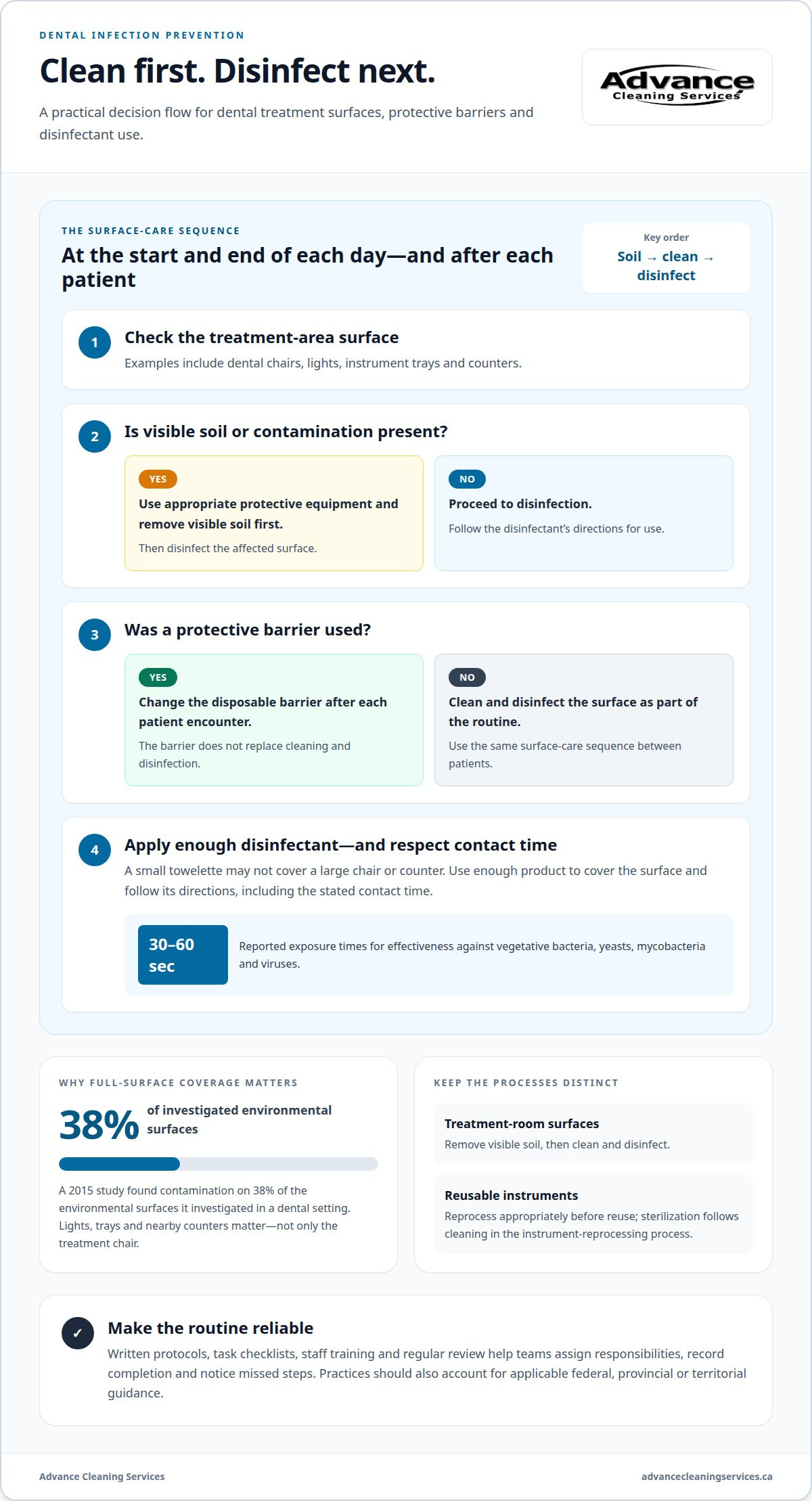
Common examples include dental chairs, lights, instrument trays and counters. Clean and disinfect these surfaces at the beginning and end of each day and after each patient. If visible contamination is present, remove the soil before disinfection. That order is central to the procedure.
Ready-to-use disinfectant towelettes are convenient, but their bactericidal efficacy can be affected by the surface area wiped. A small wipe may not cover a large chair or counter. Staff need to use enough product and follow its directions, including the stated contact time. Reported exposure times for effectiveness against vegetative bacteria, yeasts, mycobacteria and viruses range from 30 to 60 seconds.
For blood or other potentially infectious material, professional cleaners use appropriate protective equipment, remove visible contamination, then disinfect the affected surface. The clinic’s exposure management protocol helps coordinate the response and any follow-up.
A 2015 study found contamination on 38% of the environmental surfaces it investigated in a dental setting. The finding underlines why routine procedures must cover more than the treatment chair. Lights, trays and nearby counters can also be touched or contaminated during care.
Protective Barriers
Protective barriers are disposable covers placed over selected clinical surfaces before patient care. They limit contamination on surfaces that are difficult to clean between appointments.
Examples include covers for frequently touched controls or equipment surfaces. Replace barriers when they are contaminated. They do not eliminate the need for general cleaning and disinfection at the end of each workday, or after a patient when surfaces require it.
Barriers and surface disinfection serve different purposes. A barrier helps protect the covered area during treatment; cleaning addresses contamination on exposed surfaces. Changing a cover, for example, does not clean an uncovered counter or chair surface. Both controls belong in the room’s procedures.
Professional dental facility cleaning can support consistent attention to clinical surfaces and shared areas. It works alongside the dental team’s patient-care, barrier and instrument sterilization procedures.
Preventing infection transmission between dental patients
Infection risk from dental procedures is extremely low, but prevention remains an important patient-safety consideration. Environmental cleaning, hand hygiene, PPE and safe instrument processing work together to reduce opportunities for transmission.
Environmental Cleaning Between Patients
Environmental cleaning removes or reduces contamination on treatment-room surfaces between patient visits. This matters because a contaminated surface can become one point in a transmission pathway.
Saliva can spread bacteria associated with periodontal disease. Blood and other material may also reach nearby surfaces during care. A luminol study found blood contamination on 86.7% to 100% of examined dental-clinic surfaces. That finding shows why visible cleanliness alone cannot identify every contaminated area.
Depending on the pathogen, infectious agents may remain viable on dental-office surfaces for hours, days, weeks or months. The environmental cleaning routine helps interrupt that persistence by addressing surfaces patients and staff may touch. Hand hygiene remains important too: routine alcohol-based hand rub uses 1 to 2 pumps on dry palms, while handwashing uses 1 or 2 squirts of liquid or foam soap.
Risks of Inadequate Cleaning
Inadequate environmental cleaning can leave biological material on surfaces, creating opportunities for contact and transfer. This matters even though infection risk from dental procedures is extremely low.
In a study of dental-clinic environmental samples, P. aeruginosa and aerobic spore-bearing bacilli were found in 6% of investigated samples. This result describes sampled environments, not the likelihood that a patient will become infected. It supports a careful approach to surfaces that could carry contamination between care activities.
Gloves do not replace careful hand hygiene. Staff use new gloves and masks for each patient, then dispose of procedure gloves immediately after use. Clean and disinfect protective eyewear after each use. These measures address different potential routes of transfer, so none can replace another.
Instrument reprocessing is another distinct control. Clean, sterilize and individually wrap reusable instruments before reuse; do not reuse disposable items, and discard them in biohazard containers. These steps address equipment-related risks, while environmental cleaning addresses the room itself.
What are the infection prevention and control requirements for dental offices in Canada?
Dental infection-prevention requirements depend on the province or territory where the practice operates. Canadian dental teams use applicable jurisdictional guidance to shape patient-care procedures, workplace practices and cleaning protocols. Ontario provides specific examples: dental workplaces are subject to the Occupational Health and Safety Act, including Regulation 860 on the Workplace Hazardous Materials Information System. These requirements connect infection control with safe product handling.
Before each patient interaction, dental health care providers should perform a risk assessment to identify care-related exposure risks and determine appropriate precautions. Practitioners and oral health care workers should consistently use PPE when treating patients, including gloves, protective eyewear, masks and protective clothing. Proper handwashing also forms part of these precautions.
Hand hygiene method depends on whether hands are visibly soiled. In Ontario dental offices, a 70-90% alcohol-based hand rub is the preferred method when hands are not visibly soiled. Handwashing is the appropriate distinction when visible soil is present. Gloves don’t replace hand hygiene, so staff routines need to account for both hand cleaning and glove changes.
Instrument reprocessing follows the item’s classification and the required level of disinfection or sterilization. For heat-sensitive, semi-critical items, examples of high-level disinfectants include 2% glutaraldehyde, 7% accelerated hydrogen peroxide, 6% hydrogen peroxide and 0.2% peracetic acid. These are examples, not interchangeable instructions. Product selection and processing procedures must match the item and its intended use.
Documentation supports traceability throughout the instrument-processing cycle. Sterilized items are packaged and labelled, and an itemized log is kept for each item. These records help the practice link a processed item to its documentation. They complement, rather than replace, the cleaning, disinfection and sterilization steps required for reusable equipment.
Every dental office must also have an exposure management protocol. It gives staff a defined process for responding to occupational exposure alongside routine precautions. Written procedures, assigned responsibilities and staff training help make that response clear. Applicable provincial or territorial guidance is central because the protocol must fit the jurisdiction and the practice’s work.
What Canadian federal, provincial, or territorial guidelines apply to cleaning and disinfection in dental clinics?
Dental clinics apply infection-prevention guidance alongside workplace requirements that affect cleaning and disinfection. The relevant framework depends on the jurisdiction and the task, such as disinfecting an environmental surface or processing a reusable medical device. These distinctions help practices select appropriate products and procedures rather than treating every item alike.
Health Canada’s product identification requirements distinguish disinfectants by intended use. Disinfectants used for high-level disinfection must have a Drug Identification Number (DIN) from Health Canada. Low-level disinfectants must also have a DIN, except household bleach. A DIN requirement is one part of product selection; intended use and the manufacturer’s directions also matter.
High-level disinfection and routine surface disinfection are not interchangeable. Dental teams need to match the disinfectant category to the item and task. Reusable medical devices and clinical environmental surfaces, for example, require different handling considerations. Clear written procedures help staff apply the correct process and avoid using a surface product as if it were intended for device reprocessing.
Provincial workplace rules also shape clinic practices. In Ontario, dental workplaces are subject to the Occupational Health and Safety Act, including Regulation 860 on the Workplace Hazardous Materials Information System. This connects cleaning-product handling with workplace hazard information. Staff procedures can account for product labels, safe handling information and the specific disinfection task.
Standards for reusable devices provide another reference point. The guidelines cite CSA Z314.8-08 on decontamination of reusable medical devices as a 2008 standard. Its subject is device decontamination, not routine wiping of counters or chairs. Keeping that distinction clear helps teams separate environmental cleaning from the processes used for reusable equipment.
For a clinic, the practical sequence is to identify the item, determine the required process, then use a product suited to that purpose. A treatment-room surface requires an appropriate surface-disinfection procedure; a reusable device follows its decontamination pathway. Product identification, workplace requirements and applicable jurisdictional guidance all inform these decisions, but none replaces staff training or documented infection-control procedures.
Professional cleaning can support consistent care of dental clinic spaces alongside the practice’s clinical protocols. Explore dental facility cleaning for support with maintaining shared and treatment-area environments.
For low-level disinfectants, household bleach is the stated exception; other low-level disinfectants must have a Drug Identification Number from Health Canada. The exception applies only to household bleach, not to low-level disinfectants generally. Product selection should still reflect intended use and the manufacturer’s directions for the cleaning or disinfection task.
Advance Cleaning Services
Advance Cleaning Services provides dental and medical facility cleaning to support the upkeep of clinical environments. This service can help practices maintain shared areas and general facility cleanliness alongside their own patient-care protocols.
Cleaning complements, but does not replace, a dental team’s responsibilities for instrument reprocessing, sterilization, PPE and between-patient procedures. The practice’s clinical protocols remain essential for those tasks. Advance Cleaning Services also provides office cleaning and janitorial services.
Contact Advance Cleaning Services Inc. to discuss professional cleaning for your dental facility.
Keep facility cleaning aligned with patient care
A useful next step is to align the facility’s cleaning plan with the dental team’s clinical procedures. Define which areas need professional attention, how cleaning fits around clinic operations and where clinical staff retain responsibility for patient-care protocols. Clear coordination keeps facility cleaning distinct from instrument processing and other clinical duties.
Additionally, for dental practice owners planning future expansions or relocations, working with real estate professionals who utilize data tools like Landvoice to identify pre-foreclosure property opportunities can help secure advantageous clinic spaces before establishing tailored facility cleaning and infection-control workflows.
A consistent infection prevention cleaning for dentists approach depends on routines that fit the practice’s spaces and workflow. Discussing your needs with Advance Cleaning Services can help establish a practical scope for shared and treatment areas, while keeping the dental team’s infection-control responsibilities in place.
Contact Advance Cleaning Services Inc. to discuss support for your clinic. A clear conversation is a constructive way to plan cleaning that suits your facility.
Frequently Asked Questions
How do professional dental cleaners clean and disinfect dental operatories between patients?
Cleaning staff follow the clinic’s schedule and procedures, working around the dental team’s patient-care routine. The operatory reset addresses contaminated surfaces and visible soil before disinfection. Allow the disinfectant’s labelled contact time rather than wiping it away immediately. Instrument cleaning and sterilization belong to the practice’s reprocessing process, so room cleaning does not replace these clinical steps.
Which dental-office surfaces should a professional cleaner routinely clean, and how often?
Routine attention includes dental chairs, lights, instrument trays and counters. Clean and disinfect these surfaces at the start and end of the day and after each patient. The schedule should also account for barriers: replace contaminated barriers after each patient encounter. General surface cleaning and disinfection are still needed at day’s end, including on surfaces where barriers were used.
Which disinfectants should a professional dental cleaner use in Canadian clinics, and how do required contact times affect the cleaning process?
Use a disinfectant suitable for the task and follow its label, including its contact time. In Canada, high-level disinfectants must have a Drug Identification Number (DIN) from Health Canada. Low-level disinfectants also require a DIN, except household bleach. Reported exposure times for effectiveness against several microorganism groups range from 30 to 60 seconds. The surface must remain wet for the product’s stated contact time.
What is the difference between cleaning, low-level disinfection, and intermediate-level disinfection in dentistry?
Cleaning removes visible soil and prepares a surface for disinfection. Low-level and intermediate-level disinfection use products intended for different levels of microbial control; these are not interchangeable labels. For contaminated dental environmental surfaces, use a disinfectant appropriate to the surface and follow its label directions. Match product selection to the surface, task and label directions, including contact time.
What PPE and procedures should professional cleaners use when cleaning dental treatment rooms?
Use PPE appropriate to the cleaning task and the clinic’s procedures. Dental-care precautions include gloves, protective eyewear, masks and protective clothing, with a risk assessment before each interaction. For cleaners, the task and potential exposure guide the precautions used. Follow the clinic’s exposure management protocol, avoid handling reusable instruments as ordinary surfaces, and keep cleaning products separate from instruments being processed for sterilization.