High-use spaces often need more attention than the rest of an office. The right cleaning schedule depends on how the workplace is used, including foot traffic, shared washrooms and visitor activity. The benefits of professional office cleaning include consistent care for restrooms and shared areas, plus a polished welcome for clients and visitors.
Compare outsourced cleaning with in-house staffing by looking beyond wages to supplies, equipment and the time needed to manage the work. A professional cleaning plan can reflect your facility’s size and operating needs, while keeping routine cleaning tasks off employees’ workloads.
This article explains how to set cleaning priorities, compare in-house and outsourced approaches, and maintain the shared spaces people use throughout the day. It also shows how regular care for restrooms, kitchens, reception areas and workstations can support a more orderly, welcoming workplace.
Key Takeaways
- Compare outsourced cleaning with hiring an employee by considering staffing costs, supplies, equipment and the time needed to manage the work.
- Set a cleaning schedule around how often people use your office, especially its restrooms and shared spaces.
- Keep reception areas and visitor spaces clean to support a welcoming, professional impression.
- Routine care can help protect carpets, floors and furniture from dirt and premature wear.
- Learn how professional equipment, including HEPA filtration, can support a cleaner workplace, and when office cleaning or janitorial services may fit your needs.
1. Cleaning service costs compared with hiring an employee
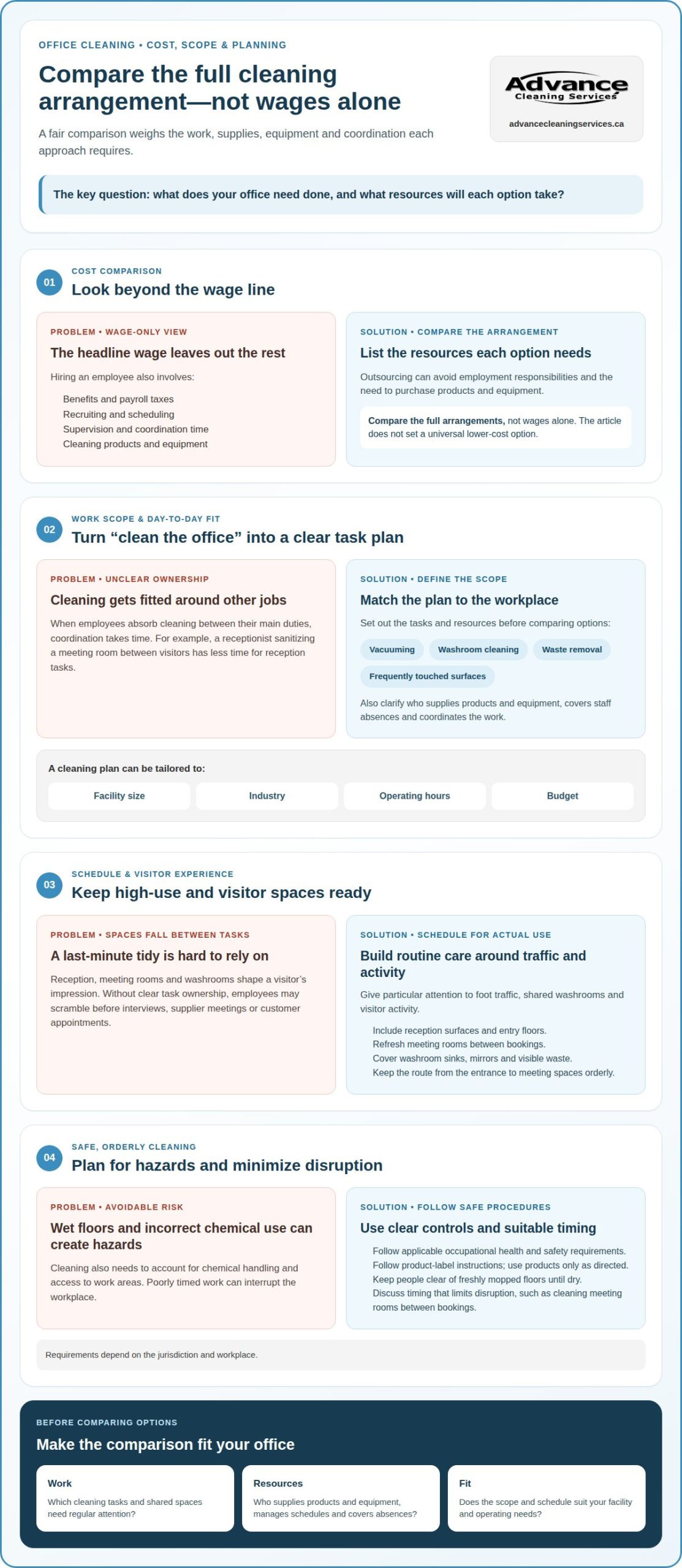
Hiring an employee to clean an office involves more than wages. Your business also takes on associated benefits and payroll taxes, as well as recruiting, scheduling and supervision. Outsourcing can avoid those employment responsibilities and the need to purchase cleaning products and equipment. Compare the full arrangements, not wages alone.
Build a fair comparison by listing the work your office needs and the resources each option requires. Include vacuuming, washroom cleaning, waste removal and cleaning frequently touched surfaces. Then consider who supplies products and equipment, who covers staff absences, and how much employee time goes into coordination. A commercial cleaning plan can be tailored to the facility’s size, industry, operating hours and budget, so scope matters as much as schedule.
When choosing a professional office cleaning company in Canada, look for a clear task scope, a schedule suited to your workplace and procedures that address shared spaces and surfaces. Discuss how the work will be organized to limit disruption, such as cleaning meeting rooms between bookings. These details help you assess whether the service fits your office’s day-to-day needs.
Canadian workplace cleaning procedures should account for hazards such as wet floors, chemical handling and access to work areas. Requirements depend on the jurisdiction and workplace, so follow applicable occupational health and safety requirements and product-label instructions. For example, keep staff away from a freshly mopped corridor until the floor is dry.
A key benefit of professional office cleaning is regular attention to workstations and shared spaces. Cleaning keyboards, phones, countertops and washrooms can help reduce dirt and germs on frequently touched surfaces. Tidy desks and clear meeting tables also mean fewer mess-related distractions. Clean surroundings can support employee well-being, though cleaning alone doesn’t determine health or work performance.
Work quality can suffer when employees have to fit cleaning around their main duties. A receptionist asked to sanitize a meeting room between visitors has less time for reception tasks. A planned routine assigns cleaning consistently, helping employees focus on their roles. A cared-for workplace can also show that employee and visitor comfort matters.
Poor cleaning can leave grime on frequently touched surfaces, while incorrect chemical use can expose people to irritating products or create unsafe conditions. Follow product labels, use products only as directed, and keep people clear of wet floors during cleaning. These steps make routine cleaning more orderly and help reduce avoidable disruption.
2. First impressions on clients and visitors
Visitors begin forming an impression before a meeting starts. The reception desk, entry floor, meeting-room table and washroom all shape how a business appears. A clean table and neatly arranged chairs suggest preparation, while overflowing bins can detract from the welcome. Clients experience the workspace as part of their visit, not as a separate backstage area.
Cleanliness can reinforce the qualities a business wants to convey. A tidy boardroom, clear reception counter and cared-for shared spaces can signal organization and attention to detail. These signs don’t replace good service or sound work, but they help create a comfortable setting for conversation. In a law office, for example, a neat meeting room keeps attention on the discussion rather than dust or floor marks.
Visitors notice whether common areas feel ready to use. A client arriving early may sit in reception, use the washroom or wait near a kitchen. Each space is an opportunity to show consistent care. A practical routine can cover reception surfaces, meeting-room touchpoints, washroom sinks and mirrors, and visible waste. Keeping the route from the entrance to the meeting space orderly gives guests a clear, welcoming path.
Consistency matters more than a last-minute tidy. If clients visit on different days, a cleaning schedule can keep their usual spaces ready. Meeting rooms can be refreshed between bookings, and reception can be included in routine office care. Clear task ownership also prevents employees from scrambling to tidy before interviews, supplier meetings or customer appointments.
A clean office matters to employees as well as guests. An organized workspace can feel more welcoming at the start of a shift and easier to use during a busy day. Shared-room users benefit when tables are ready for the next meeting and kitchen surfaces are clean. Sick days have many causes, so a tidy reception should not be treated as a measure of employee health. Its value is the professional impression it helps maintain.
To keep that impression consistent, identify the spaces visitors see and use, then include them in the regular cleaning plan. Businesses that need support maintaining these areas can explore professional office cleaning as part of their workplace routine. A clean entry, prepared meeting room and well-kept washroom help visitors focus on the people and work in front of them.
3. What are the benefits of a clean office environment?
A clean, organized office can help employees feel that their work environment is valued and give clients a more welcoming setting. Clear reception surfaces, tidy seating and a clean meeting table create an orderly impression. Morale and client opinions depend on more than cleanliness, but visible care helps the office feel ready for people.
Carpets collect grit carried in on shoes, especially near entrances and busy walkways. Regular vacuuming removes loose soil before it gets ground deeper into the fibres. Periodic deep carpet cleaning can address embedded dirt that vacuuming leaves behind. Together, these steps help limit fibre wear and keep carpets presentable.
Flooring needs care suited to its material. Entry mats catch some outdoor dirt before it reaches hard floors, and prompt spill removal helps prevent residue from spreading. Dust and grit under chairs can scratch flooring as furniture moves. Sweeping or vacuuming regularly, followed by appropriate floor cleaning, helps protect the finish.
Furniture also benefits from regular attention. Dust can build up on desks, shelves and chair frames, while upholstery spills may become harder to remove if left unattended. Use products suited to each surface to avoid unnecessary wear. A desk-cleaning routine, for example, should include edges and shared work surfaces, not just the clear centre of the desktop.
Equipment needs careful handling. Dust around computer vents can restrict airflow and contribute to overheating or malfunction. Keep cleaning liquids away from electronics, and use a dry or lightly dampened cloth as appropriate for the surface. Regularly clearing dust from equipment exteriors and nearby surfaces supports upkeep without treating delicate devices like ordinary furniture.
Long-term value comes from preventing routine dirt from becoming avoidable damage. Embedded grit can wear carpet fibres, neglected spills can stain upholstery, and dusty equipment may need attention sooner. A maintenance plan can separate routine surface care from periodic deep cleaning, with extra focus on high-traffic areas. This helps businesses manage upkeep before visible wear prompts repair or replacement.
Clutter can make cleaning harder. A crowded floor gets in the way of vacuuming carpet edges and cleaning beneath desks, while stacked items can hide dust on shelves. Keep walkways clear and store frequently used supplies in a consistent place. This lets routine cleaning reach more surfaces and helps employees maintain an orderly workspace between visits.
4. Professional equipment and cleaning products
Professional equipment helps match the cleaning method to the surface and soil. A commercial vacuum can collect dust from carpet, while a microfibre cloth lifts dust from desks and shelves. Using the right tool for each task supports thorough regular cleaning and reduces the chance of spreading dirt from one area to another.
According to Health Canada, HEPA filters remove at least 99.97% of particles at or above 0.3 mm, including dust, mould, bacteria and viruses. In an office, a vacuum fitted with this type of filter can support dust control during carpet cleaning. Filtration is one part of a cleaning process, not a substitute for cleaning surfaces or addressing spills.
Products also need to suit the surface and task. A countertop cleaner, for example, may not be appropriate for a computer screen, painted wall or finished wood desk. Read each label, follow its directions and avoid mixing products. Keeping products in their original containers helps staff identify them and follow the correct instructions.
Cleaning and disinfecting are different steps. Cleaning removes soil from a surface; disinfecting uses a product as directed to address germs. A shared telephone, for instance, needs a cleaning method suited to its material, while product directions guide any disinfection step. Correct use helps avoid residue and the mistaken assumption that every cleaner disinfects.
Eco-friendly cleaning products may suit businesses seeking to reduce their environmental impact. The term alone doesn’t explain a product’s ingredients, performance or suitable uses. Review its label and directions, then match it to the task and surface. A product intended for floors, for example, shouldn’t automatically be used on a desk or food-contact surface.
Equipment care matters, too. A vacuum with a full or poorly maintained filter may not perform as intended. Reusable cloths and mop heads need suitable laundering between tasks so soil isn’t carried from a washroom into a meeting room. Separating tools by area gives cleaning teams a practical way to limit cross-contamination.
For a thorough result, sequence the work. Remove loose debris first, clean from higher surfaces toward lower ones, and finish with the floors. Dust shelves before vacuuming beneath them, for example. Keep people clear of wet floors until they are dry, and store supplies securely after use. These steps help make product use consistent across offices and shared spaces.
5. Restroom and common-area cleaning
Restrooms need attention to hygiene and appearance. Cleaning sinks, taps, counters, toilets and door handles addresses frequently touched surfaces. Mirrors and floors matter too: smudges and tracked-in dirt can make an otherwise tidy workplace look neglected. A practical checklist can also include refilling soap and paper dispensers.
Give high-touch points deliberate attention. Include door handles, light switches, shared equipment and reception surfaces in the cleaning plan. In a busy office, these points connect different rooms and users, so overlooking them can undermine care for larger surfaces. Cleaning from less soiled areas toward heavier-use areas and using appropriate cloths for each task helps limit the spread of dirt.
Floors can show where a routine needs adjustment. Mud near an entrance, crumbs under a break-room table or water around a washroom sink each calls for a suitable cleaning step. A checklist that separates washrooms, kitchens, reception and meeting rooms makes tasks visible and repeatable. It also helps the cleaning team notice less obvious details, such as corners and the areas around waste bins.
Set cleaning frequency according to how the office is used. A shared washroom in a busy workplace may need more attention than a lightly used meeting room. A professional schedule can prioritize high-use spaces while accounting for operating patterns and visitor traffic. This targeted approach helps maintain cleanliness without treating every room as if it gets the same use.
For a consistent routine across washrooms, kitchens and shared work areas, schedule professional office cleaning to match the needs of your workplace.
Regular cleaning and disinfecting of public areas, workstations and restrooms can help reduce the spread of germs. Professional cleaners can help maintain a cleaner workplace by sanitizing frequently touched surfaces.
Advance Cleaning Services: Office cleaning
Advance Cleaning Services provides office cleaning to keep workspaces, restrooms and shared areas consistently cared for. Consider a planned cleaning service when routine tasks take time away from employees’ core work or high-use areas need dependable attention.
Tell Advance Cleaning Services which areas need attention, which tasks matter most and how your office operates. The team can discuss a cleaning approach suited to those needs. Contact Advance Cleaning Services to talk about office cleaning for your workplace.
Make a practical plan for your workplace
Choose a cleaning approach that fits how your office is used. Identify which rooms need regular attention, where employees and visitors share space, and which tasks are taking staff away from their main responsibilities. A clear scope gives you a practical basis for planning and keeps cleaning aligned with workplace needs.
The benefits of professional office cleaning extend beyond appearance when the routine is built around the spaces people use every day. Advance Cleaning Services provides office cleaning and janitorial services for workplace upkeep, along with Medical Facility Cleaning for clinical environments. Choose the service that fits your setting and cleaning needs.
Take the next step by sharing the areas that need attention and the routine you have in mind. Contact Advance Cleaning Services Inc. today to discuss a cleaning approach for your workplace. A considered plan can help make a cleaner, more welcoming office part of your regular operations.
Frequently Asked Questions
How Often Should a Commercial Property Be Cleaned?
Set the cleaning schedule according to foot traffic, room use and the work taking place. A busy reception area or shared washroom may need attention more often than a rarely used meeting room. Divide tasks by frequency, with routine care for regularly used spaces and periodic deep cleaning for carpets or upholstery. Adjust the plan when occupancy or business activity changes.
What are the benefits of a clean office environment?
A clean office can support focus, comfort and a more welcoming experience for staff and visitors. The benefits of professional office cleaning also include more consistent upkeep. Clear walkways make shared spaces easier to use, while orderly workstations can reduce visual distractions. Employees can spend less time managing office mess and more time on their assigned work.
How does professional office cleaning reduce germs, allergens, and sick days?
How often should Canadian offices be professionally cleaned?
High-traffic offices may benefit from daily cleaning, while smaller offices may need weekly or bi-weekly service. Daily attention can suit offices with busy washrooms or frequent visitors; a professional office with fewer shared spaces may use a less frequent schedule. Set the routine around occupancy, traffic and the areas in use, then revise it when those conditions change.
Is hiring a professional office cleaning company more cost-effective than in-house cleaning?
It depends on the cleaning scope and staffing needs. In-house cleaning involves wages, benefits, payroll taxes, supplies, equipment and supervision. Outsourcing can avoid hiring a dedicated cleaner and buying cleaning tools, while giving the business a defined service scope. Compare the work required and the resources each approach uses, including employee time spent managing supplies and schedules.