What if the safest first step in a biohazard situation is to leave the affected area alone? When people are nearby, it’s natural to worry about possible exposure and wonder whether ordinary cleaning will be enough. With biohazard cleanup Burnaby residents and businesses can rely on, the right approach starts with understanding the incident and affected area, not treating every situation the same way.
Professional remediation may involve more than visible cleaning. The work can include decontamination, disinfection and appropriate handling of affected materials. Advance Cleaning Services Inc. provides biohazard cleanup in Burnaby using specialized training and equipment. Keep occupants, staff and visitors away from the area while next steps are planned, and avoid touching or moving potentially affected items.
This article explains what professional cleanup generally involves, how the incident and location shape the service needed, and what information to share when arranging remediation. You’ll also learn how to plan for access and disruption so you can take a clear, informed next step.
Key Takeaways
- Learn how specialist remediation differs from ordinary surface cleaning and why the incident and affected area matter.
- Get an overview of the cleanup process, from the initial discussion through a review of the completed work.
- See how property type, incident context, affected areas and access considerations help define the scope of biohazard cleanup Burnaby properties need.
- Prepare for cleanup by considering safety and access, and avoid touching or disposing of potentially affected items before receiving specialist guidance.
- Find out how Advance Cleaning Services’ specialized remediation work, training and equipment support biohazard and crime scene cleaning in Burnaby.
When Burnaby properties need professional biohazard cleanup
A biohazard incident can be upsetting, and it isn’t always easy to tell what kind of cleanup is appropriate. If bodily fluids or other potentially hazardous contamination may be present, use caution rather than judging the risk by appearance alone. Keep people away from the affected area and avoid disturbing it while you arrange specialist guidance.
Biohazard cleanup is specialist remediation of an affected area. It may involve assessing the incident and materials, then carrying out appropriate cleaning and decontamination with specialized training and equipment. It differs from routine surface cleaning, which is intended for everyday dirt and soil. Routine janitorial cleaning maintains a space; specialist remediation addresses an area that may be affected by a biohazard.
When specialist cleanup may be appropriate: Consider professional assessment when an incident may have left bodily fluids or other potentially hazardous contamination on surfaces, materials or parts of a property. This general guidance isn’t a diagnosis. The scope depends on the incident and affected area.
What situations can call for specialist cleanup?
Crime scene and trauma cleanup are examples of situations that can require specialized remediation. The term Crime scene cleanup describes work that may follow an incident after the scene is released for cleanup. Advance Cleaning Services provides crime scene cleaning as part of its remediation work in Burnaby.
The required work isn’t determined by a label alone. The affected materials, their location and the extent of the area all help shape what needs attention. A limited area and a larger affected space can involve different considerations, including how the team can access the location. A professional assessment helps establish the scope instead of relying on assumptions.
What should you do before cleanup is arranged?
Keep occupants, visitors and pets away from the affected area. Don’t touch, move or attempt to clean potentially contaminated materials. Handling items or starting cleanup may spread contamination or make it harder to assess what has been affected. Wait for specialist guidance before deciding what to keep or dispose of.
If you can do so without entering the area, note its location and any access details that could help explain the situation. Share what you know about the incident and which rooms or materials may be affected. You don’t need to determine the hazard yourself. Clear, factual information helps the cleanup team understand the circumstances and plan an appropriate assessment.
If there’s immediate danger or an urgent medical concern, contact emergency services. Once the immediate concern has been addressed, a professional biohazard cleanup Burnaby service can assess the affected area and determine the remediation required. Until then, keep the space undisturbed and limit access.
What to expect from the biohazard cleanup process in Burnaby
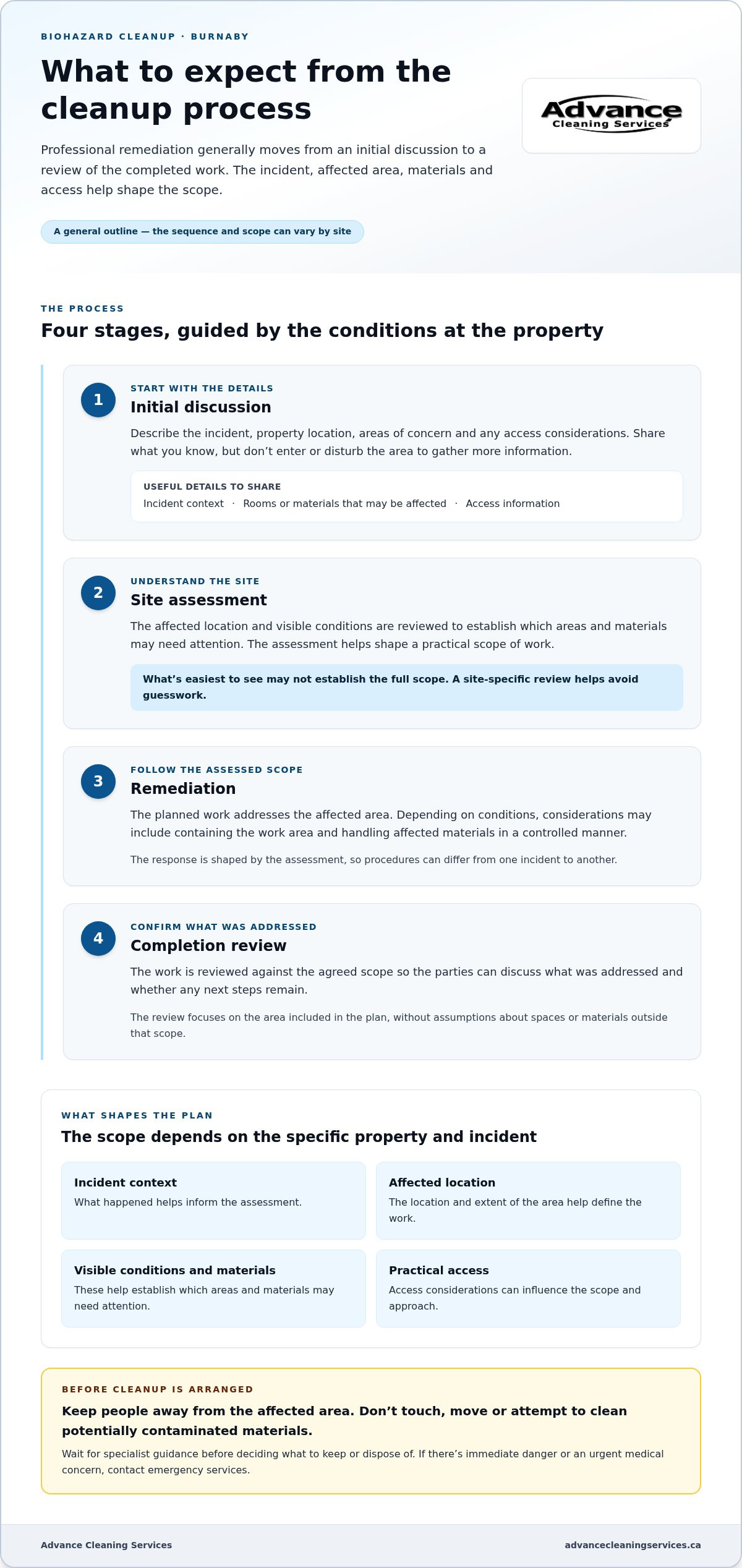
Knowing the usual stages can make professional remediation feel more manageable. The outline below describes a general process, not a fixed sequence for every job. The incident, affected location, visible conditions, materials and access all influence the scope. This overview can help you understand what may happen, but it can’t replace an assessment of the specific site.
Cleanup scope depends on the affected area and materials involved. A professional plan is based on conditions at the property, rather than a generic service label. For biohazard cleanup Burnaby properties may need, the process generally includes these stages:
- Initial discussion. Describe the incident, property location, areas of concern and any access considerations. Clear details help the team understand the situation and discuss next steps. Share what you know, but don’t enter or disturb an area to gather more information.
- Site assessment. The affected location and visible conditions are reviewed to establish which areas and materials may need attention. This assessment helps shape a practical scope of work. The specific approach and timing depend on the site.
- Remediation. The planned work addresses the affected area. Depending on conditions, general considerations may include containing the work area and handling affected materials in a controlled manner. The response is shaped by the assessment, so procedures can differ from one incident to another.
- Completion review. The work is reviewed against the agreed scope so the parties can discuss what was addressed and whether any next steps remain. The review focuses on the area included in the plan, without making assumptions about spaces or materials outside that scope.
How assessment shapes the cleanup plan
An assessment connects the reported incident to conditions at the property. The location, visible impact, materials involved and practical access help define the work area and inform appropriate remediation steps. What’s easiest to see may not establish the full scope. A site-specific review helps avoid guesswork and the use of routine cleaning methods where specialist remediation may be needed.
How cleanup differs from routine cleaning
Standard janitorial work is intended to maintain everyday cleanliness. Specialist remediation addresses an area that may involve hazardous contamination and calls for appropriate training, equipment and handling considerations. Worker safety is an important part of this work. The appropriate precautions and remediation steps depend on site conditions and affected materials.
Advance Cleaning Services provides specialized biohazard remediation in Burnaby, using specialized training and equipment for this work. When arranging cleanup, share a clear account of the incident, affected location and access conditions. You can learn more about biohazard cleanup services and remediation support for affected properties.
How to match biohazard cleanup to your Burnaby property
Property type is only one part of deciding what remediation may involve. The incident context, affected location and access conditions help build a more useful picture of the work. Use this comparison as a starting point, not a diagnosis or final cleanup plan. A site-specific assessment determines the actual scope.
| Property type | Incident context | Affected area | Access considerations |
|---|---|---|---|
| Home or residential property | An incident that may call for biohazard or trauma cleanup | A room, a portion of a room, or another identified area | Whether occupants or pets are nearby, and how the area can be kept separate |
| Workplace or commercial property | An incident that may require specialist remediation, including crime scene cleaning | A specific room, work area, or other location within the property | How people enter the site and how access to the affected area can be restricted |
| Residential or commercial property | Crime scene cleanup, which is a type of specialist biohazard remediation | The location and materials that may have been affected | Whether the team can reach the area without disturbing it or disrupting access to other spaces |
The table helps organize the facts, but it can’t establish how much work is needed. Visible impact alone may not show the full scope, and a room’s size doesn’t determine which materials need attention. The assessment connects the incident and observed conditions to a work plan. For biohazard cleanup Burnaby properties may require, a clear description of the location and access helps make that assessment more useful.
Residential and commercial cleanup considerations
At home, focus on protecting occupants and keeping family members, visitors and pets away from the affected area. In a workplace, coordinate access and clearly communicate any temporary area restrictions to the people who use the space. These are practical planning steps, not promises about business continuity, reopening approval or regulatory clearance.
What details help describe the cleanup need?
Share concise, practical information when arranging an assessment. Note whether the property is residential or commercial, the affected room or area, and the general incident context. Mention access constraints and whether occupants, staff or visitors remain nearby. There’s no need to provide graphic details, and you shouldn’t enter the area, move items or inspect materials to gather more information.
For example, “commercial property, one identified room, access through a shared corridor” gives a clearer starting point than a broad label alone. The assessment can establish the work area and appropriate remediation steps based on site conditions. This keeps the discussion focused and useful while avoiding assumptions about what the visible area may represent.
How to prepare for professional biohazard cleanup in Burnaby
A few practical steps can make it easier to arrange the right support without disturbing the affected area. Focus on safety, access and clear communication. You don’t need to investigate or determine the hazard yourself. Keep potentially affected materials undisturbed, and share only what you can observe safely.
A practical checklist before arranging service
Before discussing biohazard cleanup Burnaby service needs, gather basic details from a safe location. This information can help the team understand the property and plan an assessment.
- Note the property address and type of space. Identify whether it’s a home or commercial property.
- Describe the general incident context. Keep it factual and brief; graphic details aren’t necessary.
- Identify the affected room or area. Don’t enter or inspect it to collect more information.
- Share access arrangements. Note entrances, locked areas or other practical access constraints.
- Mention occupancy concerns. Explain whether people or pets are nearby and keep unnecessary visitors away.
- Leave items undisturbed. Don’t touch, move, clean or dispose of anything potentially affected before receiving specialist guidance.
Where practical, restrict access to the area while preserving a clear route for the remediation team. Avoid placing belongings or obstacles in that route, but don’t move potentially affected items to make space. If you can’t restrict access safely, explain the situation so the team understands the limitation.
If you’re considering insurance, remember that coverage and claim requirements depend on your policy and the circumstances. Review your policy or speak with your insurer about the information they need. Don’t delay safe handling or disturb the affected area to document it; ask your insurer how to proceed if you’re unsure.
How to communicate the situation clearly
Use straightforward descriptions of the location and visible conditions. For example, identify the room, the general area of concern and whether access is through a shared space. Avoid guessing about contamination or making claims you can’t verify. A clear account helps establish what needs assessment without requiring you to handle materials or provide graphic details.
Also mention relevant timing constraints, access needs and whether anyone remains nearby. If the affected area is in a workplace, share how people currently access it so temporary restrictions can be communicated appropriately. For a home, explain whether occupants need to use nearby rooms or routes. These details make the initial discussion more useful.
Once you’ve gathered the safe, practical details, Discuss biohazard cleanup for your Burnaby property with Advance Cleaning Services. The team provides specialized remediation in Burnaby, including crime scene cleaning, using specialized training and equipment.
Arrange biohazard cleanup in Burnaby with Advance Cleaning Services
After an incident, deciding what to do next can feel difficult. Advance Cleaning Services provides biohazard cleanup and remediation in Burnaby, including crime scene cleaning. This specialized work uses training and equipment suited to remediation. A clear description of the property and general incident context is a practical way to begin.
What Advance Cleaning Services brings to remediation
Biohazard cleanup and crime scene cleaning address situations that call for more than routine cleaning. Advance Cleaning Services approaches this work as specialized remediation, with specialized training and equipment for the task. The precise scope depends on the affected location, materials and site conditions, so the situation is considered in relation to the particular property and incident.
That distinction matters when you’re unsure what service to arrange. A general category can start the conversation, but it doesn’t establish the full work plan. Share what you know without disturbing the area. The location, visible conditions and practical access details help frame what needs to be discussed next.
How to take the next step
To start, provide the Burnaby property location and a brief, factual account of the incident. Include the room or area involved, whether the property is residential or commercial, and any access considerations that could affect reaching the space. You don’t need to diagnose contamination or provide graphic details. If some information is unknown, say so rather than entering the area to investigate.
Keep the affected space undisturbed while you arrange the conversation. If people remain nearby, explain how the area is currently accessed and what practical restrictions are in place. These details keep the discussion focused on the property and the work that may be needed. The service scope can then be considered in light of the specific situation, rather than assumed from the incident label alone.
Advance Cleaning Services provides specialized biohazard remediation in Burnaby, including crime scene cleaning. Its work is supported by specialized training and equipment, with the response shaped by the conditions at each property. The next step is to share where the incident occurred, the general context and any relevant access needs.
Contact Advance Cleaning Services about biohazard cleanup to begin a conversation about your Burnaby property. A clear account of the location and circumstances gives the team a useful starting point for discussing next steps.
Take the next step with confidence
You don’t need to have every answer before starting a conversation. The purpose of the first step is to share what you know and establish a practical way forward, not determine the full scope of remediation on your own. If it helps, write down the key details and ask one person to coordinate communication and access arrangements.
For biohazard cleanup Burnaby property owners can arrange through Advance Cleaning Services, begin with the property location and a brief description of the situation. A calm, straightforward conversation can help turn an unsettling event into a clear next step. Explain what you know, note what remains uncertain, and discuss the affected area without disturbing it.
Advance Cleaning Services provides cleaning services in Burnaby and communities including Calgary, Edmonton, Red Deer, Okotoks, Lethbridge, Strathmore, Chestermere, Airdrie, Vancouver, Richmond, Surrey, New Westminster, Coquitlam, Abbotsford and Cochrane. Contact Advance Cleaning Services about biohazard cleanup in Burnaby to discuss the affected area and arrange your next step.
Frequently Asked Questions
Can I clean up a biohazard myself?
If you suspect an area may be contaminated, avoid attempting the cleanup yourself and seek specialist guidance. Household cleaning methods and equipment may not be suitable for remediation, and handling affected materials could increase exposure or spread contamination. Keep the area undisturbed while you arrange professional support. If someone faces immediate danger or needs urgent medical attention, contact emergency services first.
What should I do before biohazard cleanup arrives?
Keep the affected area undisturbed and prevent unnecessary entry. Let other occupants, staff or building visitors know which space to avoid, and identify someone who can meet the cleanup team or explain access arrangements. Don’t clean, move or discard potentially affected belongings. If the situation presents immediate danger or a medical emergency, contact emergency services rather than waiting for a cleanup appointment.
How long does biohazard cleanup take?
There isn’t one timeframe that applies to every cleanup. The duration depends on the incident, the area and materials involved, and the work identified after assessment. A contained area may require a different scope than several affected spaces or materials that need careful handling. Share any scheduling constraints during the initial discussion, then use the site-specific work plan for a more relevant expectation.
Does insurance cover biohazard cleanup?
Coverage depends on your policy and the circumstances of the incident, so it can’t be assumed. Contact your insurer to ask whether the policy applies, what claim steps to follow, and what records they require. Keep relevant claim details together and avoid disturbing the affected area to collect evidence. Your insurer can explain any applicable limits, exclusions or deductible under your policy.
Is biohazard cleanup different from regular cleaning?
Yes. Regular cleaning addresses everyday dirt and routine maintenance, while biohazard remediation is intended for areas that may involve hazardous contamination. It calls for specialized training and equipment, with the work shaped by the affected site and materials. A standard cleaning routine shouldn’t be treated as a substitute when contamination is suspected. A professional assessment helps establish an appropriate scope for the situation.
What information should I provide when arranging biohazard cleanup in Burnaby?
Share the property address, whether it’s a home or workplace, the affected room or area, and a brief description of the general incident context. Mention access restrictions, whether people are still using nearby spaces, and any timing constraints. You don’t need to provide graphic details or determine the type of contamination. Advance Cleaning Services uses this information to begin a conversation about the situation.
Can a business arrange biohazard cleanup for an affected workplace?
Yes. A business can arrange remediation for an affected workplace with Advance Cleaning Services. It helps to identify a workplace contact who can describe the affected space and coordinate practical access information. The business can also communicate temporary restrictions to staff and visitors to reduce unnecessary entry. The cleanup scope depends on the specific site and incident, so avoid assuming the entire workplace requires the same response.