
Being bonded and insured matters, but the terms are not interchangeable. A bonded and insured cleaning company in Vancouver should explain what each protection covers and where its limits apply. The label alone does not show whether a particular loss or injury is covered. For residential, condo, apartment, or office cleaning, clear answers help you understand the service before booking.
Look beyond the cleaning checklist. Understand what happens if a task is missed, how product choices are handled, how appointments are scheduled, and what affects the quote. These details help you decide whether the service fits your space and expectations.
This guide explains how bonding and insurance fit into a cleaning decision in Vancouver. It also covers re-clean policies, product safety, scheduling, pricing transparency, and cleaning options, so you can compare practical details and decide what matters most for your home, condo, apartment, or workplace.
Key Takeaways
- Compare bonding and insurance by understanding what each is intended to protect, rather than relying on labels alone.
- Look for a clear written re-clean policy that explains how missed work is reported and addressed.
- Discuss product use and safety needs for your household, including the presence of children or pets.
- Understand how the scope of work, space, and cleaning frequency shape a quote and scheduling plan.
- Match the cleaning option to your setting, from a home or apartment to an office or medical facility.
What is the best cleaning service in Vancouver in 2026?
The right cleaning service depends on your space, the work required, and the provider’s coverage. A Downtown Vancouver apartment, a Kitsilano house, and a Mount Pleasant office have different needs. Compare the written scope, service area, insurance details, and process for addressing missed tasks before choosing.
Start with location. Vancouver neighbourhoods include Downtown, Kerrisdale, East Vancouver, and Kitsilano. Nearby service areas include Burnaby, Richmond, New Westminster, and Coquitlam. A provider’s stated coverage matters because it determines whether your address fits its schedule. Ask for your specific neighbourhood or municipality to be included in the service agreement.
Metro Vancouver is not one uniform service area. A company may serve Vancouver but not every surrounding municipality. If your home is in Richmond or your office is in Burnaby, match the address to the provider’s stated coverage. This helps prevent a mismatch between the location you need cleaned and the area the company serves.
For renters, a typical Vancouver one-bedroom rental deposit ranges from C$2,000 to C$4,000. That makes clear move-out expectations especially useful. Compare the requested cleaning scope with the lease requirements, and keep written records of agreed tasks. A cleaning appointment doesn’t replace documenting the unit’s condition before moving out.
Insurance and worker coverage deserve a separate review. An injured cleaner who is not WorkSafeBC-registered may leave a Vancouver homeowner liable. Ask how worker coverage applies to the service arrangement, and understand what the provider’s insurance covers. A bonded and insured cleaning company in Vancouver should explain these terms clearly, without treating them as interchangeable.
For a locally owned Downtown Vancouver cleaning service, local ownership is one detail, not a complete measure of fit. Compare the actual scope, communication process, and coverage for your address. An apartment may need recurring house cleaning, while a shared office may require scheduled cleaning outside its busiest periods.
Residential and commercial cleaning differ in practical ways. House cleaning may focus on kitchens, bathrooms, floors, and commonly used rooms. Commercial work can involve offices, retail spaces, or shared areas, with priorities shaped by the workplace. Identify the rooms, surfaces, and tasks you need covered before comparing service proposals.
Use this short comparison process:
- Match your address to the provider’s stated Vancouver or Metro Vancouver coverage.
- Write down the rooms, tasks, and frequency you need.
- Compare residential or commercial scopes against those needs.
- Clarify worker coverage, insurance, and how missed work is handled.
For cleaning in Vancouver, the strongest fit is the one whose written scope suits your space and whose stated coverage includes your address. A home in Kerrisdale, a condo near Downtown, and a workplace in Coquitlam call for different service plans. Comparing these specifics gives you a practical basis for choosing, rather than relying on a broad label such as “best.”
Satisfaction guarantee and re-clean policy
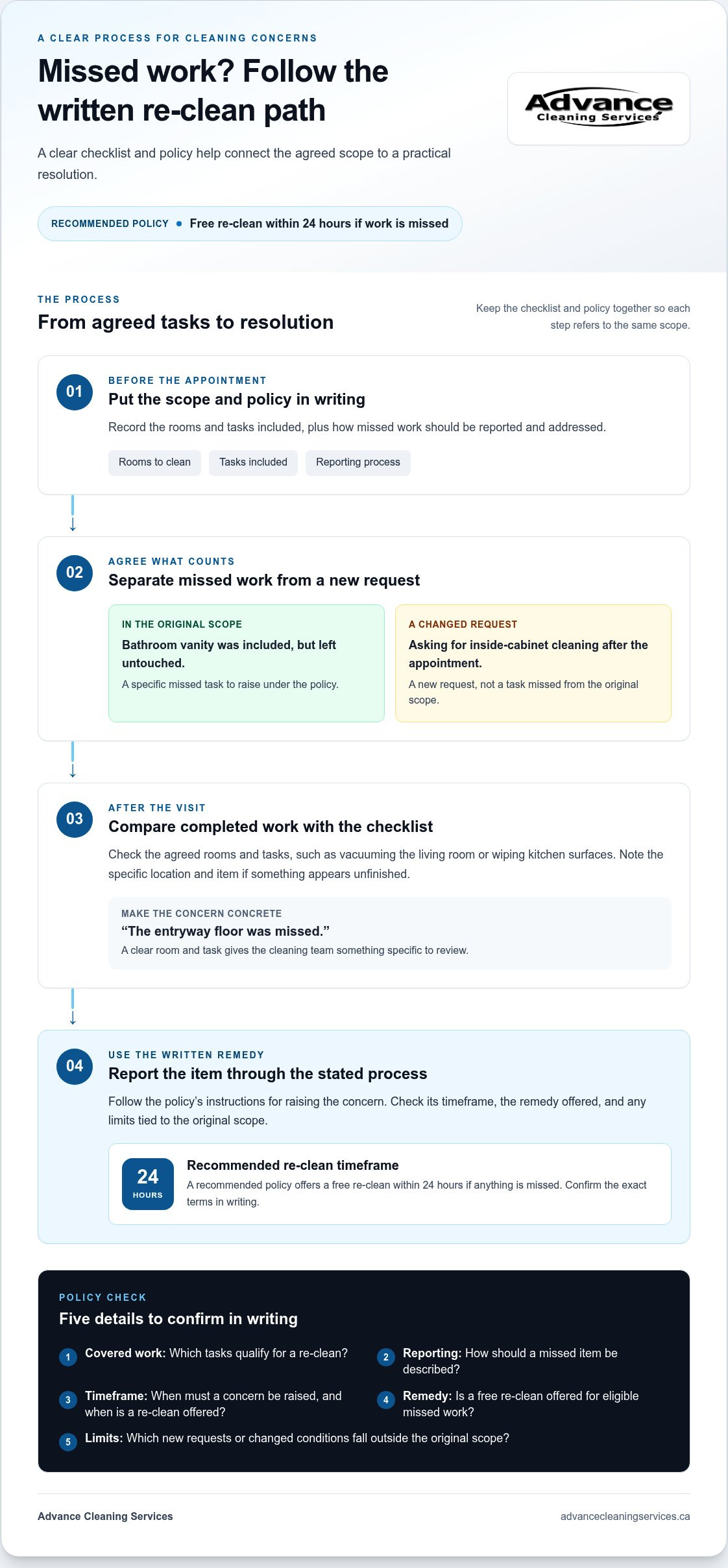
A written satisfaction guarantee turns a general promise into a clear process. For professional cleaning, the policy should describe what counts as missed work, how to report it, and what remedy follows. A recommended policy offers a free re-clean within 24 hours if anything is missed. That gives both the customer and cleaning team a practical timeframe and a specific way to resolve an identified gap.
Read the conditions before booking. A residential customer in Coquitlam, for example, can compare the agreed checklist with the completed work and identify a specific missed task, such as an unwiped counter. The policy should explain how to raise the concern and how the company will arrange a re-clean. Friendly service matters, but clear steps make satisfaction easier to assess.
Distinguish missed tasks from changed requests. If the original scope includes cleaning the bathroom vanity, an untouched vanity is a clear example of missed work. Adding an inside-cabinet clean after the appointment is a different request. A written policy should define the scope so the re-clean addresses the original agreement rather than expanding it.
Before a weekly appointment begins, keep the service checklist and policy together. Record the rooms and tasks included, such as vacuuming the living room or wiping kitchen surfaces. After the visit, compare the completed work with the list. If a task appears unfinished, report the specific room and item through the process described in the policy.
Check these details in writing:
- Covered work: Which tasks qualify for a re-clean?
- Reporting process: How should a missed item be described?
- Timeframe: When must a concern be raised, and when is the re-clean offered?
- Remedy: Does the policy provide a free re-clean for eligible missed work?
- Limits: Which new requests or changed conditions fall outside the original scope?
Keep feedback factual and specific. “The entryway floor was missed” gives the cleaning team a clear location and task to review. “The whole visit wasn’t satisfactory” describes a feeling but doesn’t identify what needs attention. A concrete example links the concern to the checklist and the stated resolution process.
For recurring residential cleaning, revisit the checklist when household needs change. A weekly plan may need a different room focus if a home office becomes a child’s study area. Agree on the new scope before the next visit, then use the written satisfaction terms for work covered by that appointment. This keeps expectations practical and gives the re-clean policy a defined role.
Are your cleaning products safe for pets and children?
Safety depends on the products used, the surfaces treated, and how the work is managed. Before booking, identify pets, young children, and the areas they use, such as a playroom or feeding space. Review product labels and the cleaning plan so everyone understands where products will be applied and what directions to follow afterward.
A deep cleaning visit can involve more rooms and surfaces than routine maintenance. For example, a home after construction may need attention to settled dust and multiple surfaces. A clear process identifies the work area, products, and handling instructions. Staff training should cover following product labels, using supplies as directed, and keeping cleaning materials separate from children’s belongings and pet items.
Bonding and liability insurance are different protections. A bond can address specific losses under its terms, while liability insurance responds to covered claims under its policy. Neither label proves that every incident is covered. Understand a bonded and insured cleaning company in Vancouver by its actual terms and limits, not by the phrase alone.
How do bonded and insured cleaning companies compare with independent cleaners in Vancouver? A company may have written procedures and coverage arranged for its business, while an independent cleaner’s arrangements can differ. Compare the documentation, responsibility for staff, and stated coverage for the specific work.
Are cleaning companies in Vancouver required by law to be bonded or insured? Don’t assume one blanket rule applies to every cleaning arrangement. Requirements depend on the work and employment relationship, so distinguish legal duties from protections a business chooses to provide.
What questions should I ask before hiring a bonded and insured cleaner in Vancouver? Ask what the bond covers, which liability situations the policy addresses, and how worker injuries are handled. Also ask how staff are trained and whether background checks are part of the hiring process.
Does a cleaning company’s insurance cover damage, theft, or worker injuries in my home? Coverage depends on the policy wording, exclusions, and circumstances of the claim. Damage, theft, and worker injuries are distinct issues, so one general insurance label cannot answer all three.
- Read the product directions and cleaning plan for your home’s specific surfaces.
- Tell the cleaning team about pets, children, and areas requiring extra care.
- Review written details for bonding, insurance, staff screening, and training.
- Keep the agreed scope and any written guarantee with your booking details.
For a home in Burnaby or New Westminster, write down concerns before the appointment. Note the room, surface, or household routine involved. This gives the cleaning team a practical basis for planning safe product use and consistent staff procedures.
Flexible scheduling and transparent pricing
A useful cleaning plan aligns the appointment, task list, and quote with your property. For a home in Richmond or Coquitlam, start by describing the space and preferred visit pattern.
Cleaning Quotes and Pricing Factors
The quote depends on the property and requested work. Key factors include the space’s size and condition, requested tasks, visit frequency, and whether the work calls for a thorough one-time clean or recurring home cleaning. Give a clear description so the quote reflects the work, not an assumed checklist.
A home with carpeted bedrooms, for example, may need a different scope from one with hard floors throughout. List priority rooms, areas needing extra attention, and any requested add-ons. Ask the quote to separate included tasks from optional work. That makes it easier to compare the proposed scope with your needs and understand what could affect the quote.
Free Quotes
A free quote, when offered, should explain the proposed work before you decide. Look for the property details it uses, the tasks included, and any conditions that could affect the final amount. A clear written estimate helps you compare the planned service with your own room-by-room list.
Prepare for a quote request by noting the property type, rooms, floor surfaces, and preferred schedule. Mention whether you want a one-time visit or regular appointments. If a quote uses an unclear term such as “standard clean,” ask for the actual tasks in writing. This turns a broad label into a useful scope.
Scheduling also affects how practical a plan feels. A weekly visit may suit a household that wants regular upkeep, while a one-time appointment can address a defined need. Share access instructions, preferred days, and any rooms that must remain undisturbed. A cleaning team can then follow a consistent task list instead of relying on assumptions.
Build flexibility into the plan without leaving the scope vague. If your schedule changes, understand the booking process and any notice terms before setting a recurring appointment. For instance, note whether a visit should focus on the kitchen when guests are expected or follow the usual room rotation. Record approved changes so the appointment and quote remain aligned.
Use this checklist before accepting a proposal:
- Confirm the service address, including the municipality.
- List the rooms, surfaces, and tasks requested.
- Separate regular cleaning from one-time or add-on work.
- Review the schedule, access arrangements, and written scope.
- Ask which changes could affect the quoted charge.
Transparent pricing means understanding what the quote covers, not simply seeing a total. Whether the property is in Richmond or Coquitlam, compare the same tasks and visit pattern. A thorough scope makes scheduling clearer and helps you judge whether the proposed home cleaning fits your priorities.
Residential, condo, apartment, and office cleaning
Cleaning plans work best when they reflect how each space is used. A rental apartment in Richmond needs a different task list from a family home in Coquitlam or a shared office. Define the rooms, surfaces, and priorities first. Then compare the proposed scope with the work your household or team actually needs.
Office cleaning depends on the workplace routine. A small office may prioritize desks, meeting areas, washrooms, and kitchen surfaces. A retail space may need attention to customer-facing floors and counters. Identify which areas see regular use and which tasks should happen during each visit. A clear list helps staff understand the work without disrupting normal operations.
Use this planning checklist before setting the service scope:
- Choose the rooms and surfaces that need attention.
- Separate regular tasks from occasional detail work.
- Identify sensitive areas, equipment, or surfaces requiring specific care.
- Share access instructions for the building or unit.
- Set priorities for each visit, such as washrooms or shared kitchens.
Frequency should follow the space’s use, not a generic template. A busy family home may prioritize kitchens and entryways, while an office may focus on shared surfaces. Tell the provider which tasks matter most and how the space changes between visits. That makes the plan easier to maintain and adjust as needs shift.
For a Coquitlam apartment or Richmond workplace, write the requested tasks in plain language. Specify whether the service covers floors, washrooms, or shared areas, and note any exclusions. This gives both sides a practical reference for each appointment. If your workplace needs a defined cleaning plan, discuss office cleaning needs as a next step.
Advance Cleaning Services: Medical Facility Cleaning
Advance Cleaning Services Inc. provides Medical Facility Cleaning for medical, dental, and veterinary clinics. If your facility needs a defined cleaning plan, this service is a practical next step for maintaining work areas and shared spaces. The right scope depends on the rooms, surfaces, and tasks your team needs addressed.
As a trusted bonded and insured cleaning company Vancouver businesses rely on, Advance Cleaning Services Inc. also provides office cleaning, janitorial services, and carpet cleaning for other professional spaces. These options suit workplaces that need attention to common areas, floors, or carpets as part of their cleaning requirements. Describe the setting and priorities to shape a discussion around your needs.
For details about cleaning support for your facility or workplace, visit Advance Cleaning Services Inc..
Make your next cleaning decision with confidence
Choose a bonded and insured cleaning company in Vancouver by matching its written scope and protections to your space. A clear conversation about your priorities can help turn a general cleaning request into a practical plan for your property or workplace.
For clinic cleaning, Advance Cleaning Services offers Medical Facility Cleaning. Its services also include Office cleaning and Janitorial Services for workplaces that need ongoing care. Share the type of space and the work you need addressed to start a focused discussion about suitable cleaning support.
Contact Advance Cleaning Services today to discuss your cleaning needs. A thoughtful next step can help you move forward with a plan that fits your setting and priorities.
Frequently Asked Questions
Are you insured and bonded?
Bonding and insurance are separate protections, and a company’s status should be supported by current documents. A service label alone doesn’t establish what protection applies to a particular visit. Review the written terms for the cleaning arrangement and the scope of any bond or insurance. Don’t assume either protection covers every type of loss, damage, or injury.
Do you bring your own cleaning supplies, products, and equipment?
Advance Cleaning Services uses professional equipment and eco-friendly cleaning products, and can supply chemical and paper products. The products and supplies used depend on the service scope and facility’s needs. A clinic and an office, for example, may require different cleaning plans. Include product or supply requirements in the service discussion so they align with the areas being cleaned.
What if I’m not happy with the clean?
Describe the concern by naming the room, surface, and task, such as an unwiped meeting-room table. Advance Cleaning Services has a quality-assurance program that includes manager site evaluations. Quality assurance is distinct from a promise of a re-clean, so rely on the written terms for the specific service to understand how a concern is handled.
What does bonded and insured mean for a cleaning company in Vancouver, BC?
“Bonded” refers to protection under a bond’s stated terms, while liability insurance responds to claims covered by its policy. The terms are not synonymous, and neither guarantees payment for every incident. For a Vancouver cleaning arrangement, consider the specific work, who is performing it, and the wording that describes covered events and exclusions.
How can I verify a Vancouver cleaning company’s liability insurance and bonding?
Request current proof that identifies the business and relevant coverage. Compare the named business, policy dates, and description of covered work with the service agreement. Review a bond’s terms and covered events separately from the insurance documents. Keep copies with your booking records so you can refer to the same documents if a question arises.
How much does a bonded and insured cleaning service cost in Vancouver?
The quote depends on the property and requested work. It can reflect the property type, size and condition, requested tasks, and visit frequency. A one-time clean and recurring office service, for instance, involve different scopes. Compare the written tasks and schedule alongside the quoted amount rather than comparing totals without checking what each includes.
What does a cleaning company bond cover, and what exclusions apply?
A bond responds only to events and conditions stated in its terms. It may define who can make a claim, what evidence is needed, and which losses are excluded. Don’t treat a bond as general insurance for accidental damage or worker injuries. Read the bond wording alongside liability coverage, since each document addresses a different form of protection.
Where can I find reputable bonded and insured cleaning companies in Vancouver, BC?
Start with providers’ service information and written details about the work and protections they describe. Advance Cleaning Services provides cleaning services in Vancouver, including Medical Facility Cleaning, Office cleaning, and Janitorial Services. Review the service scope for your property type, then consider the documentation that applies to the arrangement. A clear written scope helps you understand what work is being discussed.