Why does a fine layer of grey film keep reappearing on your bookshelves and countertops days after you have scrubbed every surface? It’s a common frustration for homeowners and project managers who realize that standard wiping isn’t enough to tackle the microscopic debris left behind after a renovation. You have invested significant resources into your project, yet the persistent coughing and dusty air make it difficult to enjoy the final results. Professional construction dust removal is not just about aesthetics. It’s a vital step in preventing respiratory irritation and protecting your HVAC system from long-term damage.
Key Takeaways
- Understand why microscopic dust behaves like a gas. This explains why it drifts through your home and settles long after you’ve finished wiping surfaces.
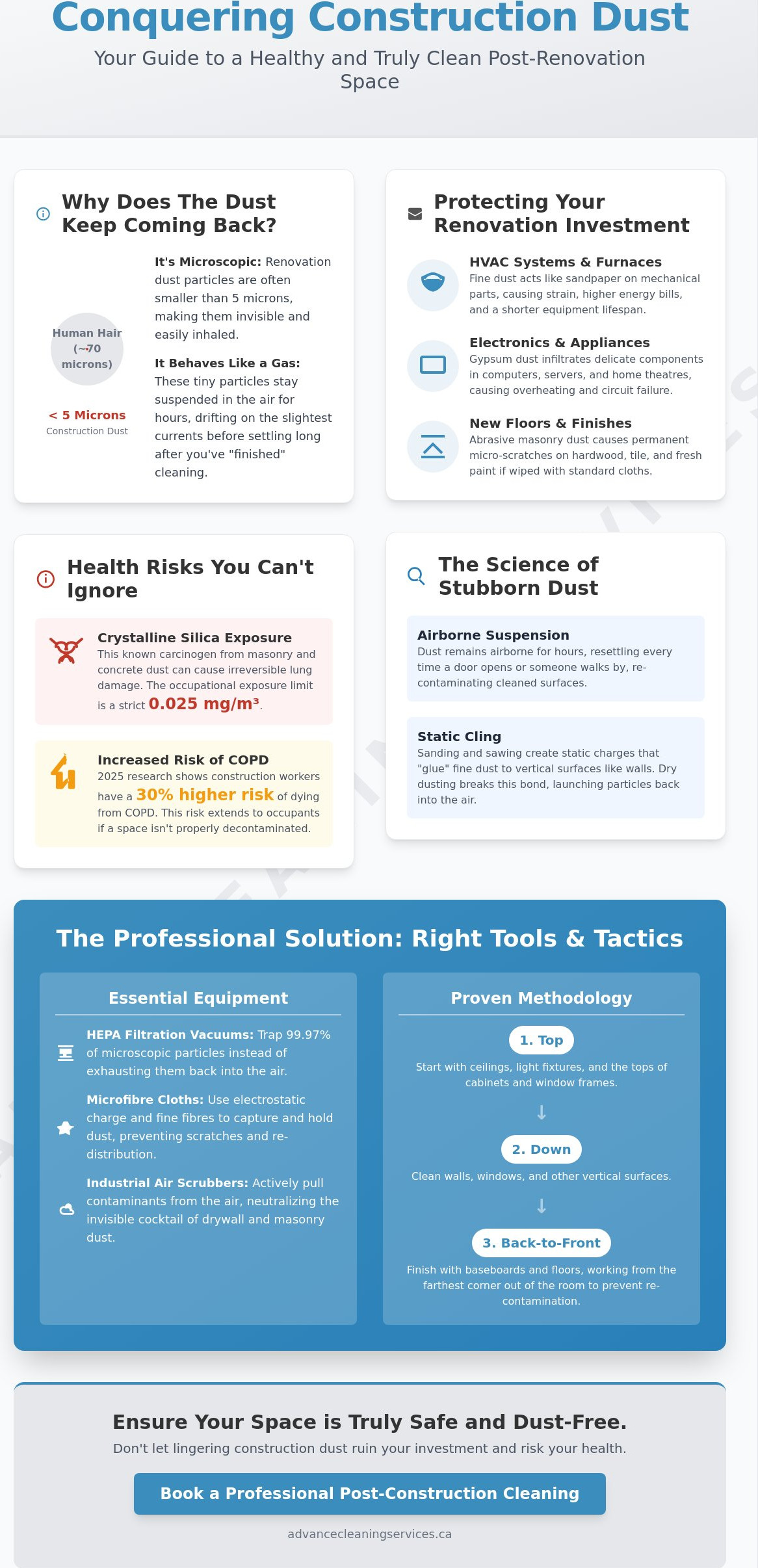
- Master the “Top-Down, Back-to-Front” methodology for construction dust removal to prevent the re-contamination of areas you’ve already cleaned.
- Learn why HEPA filtration and microfibre cloths are essential for trapping fine particulates rather than just pushing them back into the air.
- Discover how specialized equipment like industrial air scrubbers can neutralize the invisible cocktail of drywall and masonry dust lingering in your vents.
- Gain the confidence to protect your renovation investment by following a professional staging process that ensures every corner is truly safe and dust-free.
Understanding the Risks: Why Construction Dust Removal Is Essential
A completed renovation represents a significant investment of time and capital. However, the celebration often stops when you realize that your new space is coated in a persistent, grey film. Construction dust is not standard household dirt. It is a complex cocktail of drywall gypsum, wood fibres, masonry silica, and insulation particulates. These materials have different weights and textures; many are so fine they remain suspended in the air for hours after the last contractor leaves the site. Simply wiping down a countertop is not enough to secure the area. Effective construction dust removal requires a deep understanding of how these microscopic particles interact with your environment.
Health Implications of Silica and Drywall Particulates
The most pressing reason to prioritize thorough cleaning is the physical safety of the occupants. Crystalline silica, found in masonry and concrete, is a known carcinogen. In 2026, the occupational exposure limit for respirable crystalline silica in Alberta and British Columbia remains strictly set at 0.025 mg/m³ because of these dangers. Inhaling these particles can lead to irreversible lung damage. A 2025 study in Occupational and Environmental Medicine highlighted that construction workers have a 30% higher risk of dying from COPD than those in other industries. This risk extends to families and employees if the health risks of dust exposure are ignored after the project ends. Children and pets are particularly vulnerable as they spend more time near floor level where heavier particulates settle.
The Hidden Impact on HVAC Systems and Electronics
The Science of Settling: Why Post-Renovation Dust Keeps Coming Back
Have you ever noticed how a room looks spotless in the morning but is covered in a fine veil by the evening? This happens because construction dust particles are often smaller than five microns. At this size, they don’t fall like pebbles; they drift like a gas. These particles stay suspended for hours, waiting for a slight breeze to move them. Every time you open a door or walk across a room, you create air currents that redistribute this debris. This is why construction dust removal is a multi-stage process rather than a one-time event.
Static electricity also plays a massive role in why cleaning feels like an endless loop. During a renovation, friction from sanding and sawing creates a static charge that acts like a magnet. This charge “glues” fine particulates to vertical surfaces like walls, window frames, and even ceilings. Using a traditional feather duster or a dry broom is the worst choice you can make. These tools simply break the static bond and launch the dust back into the breathing zone. To truly clear a space, you need specialized post-construction cleaning techniques that neutralize these charges and remove the particles permanently.
Air Mobility and the Canadian Climate Factor
The local environment significantly dictates how dust behaves in your space. In Alberta, the notoriously dry winters create high levels of static electricity. This keeps dust airborne for much longer periods, meaning you might see settling for weeks if not handled professionally. Conversely, the higher humidity in British Columbia causes fine dust to absorb moisture. While this makes it heavier, it also turns gypsum and masonry dust into a sticky film that can stain new paint or porous stone if left too long. Understanding these regional shifts is vital for meeting OSHA construction dust standards and ensuring the air remains clear regardless of the weather outside. For BC build-outs specifically, a methodical final construction cleanup Vancouver process that accounts for humidity-driven dust bonding is essential to protecting new finishes.
Why Standard Household Tools Often Fail
Most domestic cleaning supplies are not designed for the volume or size of renovation debris. A standard household vacuum often acts like a “dust cannon.” Because their filters aren’t fine enough to trap micron-sized particles, they suck dust in the front and blast it out the exhaust. Similarly, cotton rags are too porous to hold fine powder; they simply push it around. When you use a traditional mop on a floor covered in drywall dust, you aren’t cleaning; you’re creating a thin layer of gypsum paste. This paste dries into a cloudy haze that is even harder to remove later. Professional construction dust removal relies on synthetic microfibre and HEPA technology to actually trap the material and pull it out of your home.
Essential Tools and Equipment for Effective Dust Remediation
Achieving a truly clean environment after a renovation requires more than a bucket and a sponge. You need tools specifically engineered to capture microscopic debris. Professional construction dust removal relies on a combination of high-efficiency filtration and advanced material science to ensure the space is safe for occupancy. To get the job done right, you must move beyond the basic supplies found in a typical broom closet and utilize equipment that actually traps particulates rather than just moving them around.
HEPA Filtration vs. Standard Shop Vacuums
A true HEPA (High-Efficiency Particulate Air) vacuum is the most critical tool in your arsenal. Unlike standard shop vacuums, which often exhaust fine particles back into the room, a HEPA-certified unit must trap 99.97% of particles as small as 0.3 microns. Using a standard vacuum on fine drywall dust is a common mistake that often ends in equipment failure. The powder is so fine it bypasses basic filters and enters the motor housing, leading to rapid overheating and motor burnout. During an intensive clean, you should check and clean filters frequently to maintain suction and protect the mechanical integrity of the vacuum.
Microfibre Technology and Static Mops
Microfibre technology has revolutionized how we handle fine particulates. These synthetic fibres are split during manufacturing to create millions of tiny hooks. These hooks grab and hold dust rather than just pushing it across a surface. When wiping down cabinetry or baseboards, use a “damp” rather than “wet” technique. Too much water turns drywall dust into a slurry that settles into wood grain and becomes nearly impossible to remove. For vertical surfaces like high walls and ceilings, static-charge mops are invaluable. They utilize the very static electricity discussed in the previous section to pull dust away from the surface without the need for ladders or heavy scrubbing.
For larger commercial projects, such as medical facility cleaning or dental facility cleaning, industrial air scrubbers are necessary. These machines pull the air through multiple stages of filtration, cleaning the entire volume of a room several times per hour. This is the only way to ensure that “invisible” dust suspended in the air is permanently removed. Regardless of the project size, you shouldn’t attempt cleaning without proper personal protective equipment (PPE). At a minimum, wear an N95 respirator and sealed eye protection. This simple step prevents immediate respiratory irritation and protects you from the long-term risks associated with airborne construction debris.
A Tactical Strategy for Complete Construction Dust Removal
Effective construction dust removal is a tactical operation. It requires a specific order of operations to ensure you aren’t simply moving debris from one surface to another. We utilize a “Top-Down, Back-to-Front” methodology. This approach follows the natural path of gravity. By starting at the highest point and moving toward the exit, you ensure that any disturbed particles settle on surfaces that haven’t been cleaned yet. You should also “stage” your project. Identify a clean zone and work systematically away from it to avoid tracking fine gypsum powder back into sanitized rooms.
Even when a surface looks clean, it often isn’t. We recommend the “Three-Pass Rule.” The first pass removes the bulk debris. The second pass captures the fine, static-charged film. The third pass is a final polish performed only after the air has fully settled. This methodical pace is what separates professional results from a standard weekend tidy. In the dry climate of Alberta, the “settling period” between passes should be extended because static keeps particles airborne longer. In more humid areas of BC, the “Three-Pass Rule” is vital to prevent dust from clumping and bonding to surfaces. For a complete breakdown of how these phases work together to achieve a move-in ready result, see our guide on thorough post construction cleaning and the multi-phase processes used by professionals in 2026.
Step 1: The Ceiling and High-Surface Pass
Begin with the architectural details that are often overlooked. Use an extendable static duster to reach crown moulding, ceiling fans, and light fixtures. You must pay special attention to the tops of door frames and the “hidden” upper edges of cabinetry. These horizontal surfaces act as shelves for fine particulates. If you miss these areas, every vibration from a closing door will send a fresh cloud of dust onto your newly cleaned floors. This step ensures that construction dust removal is comprehensive from the very start.
Step 2: Walls, Windows, and Mid-Level Surfaces
Step 3: Floors and Baseboards
The final phase focuses on the ground level. We employ the “Double Vacuum” method. Perform a thorough dry vacuuming with a HEPA unit, then wait several hours for any remaining airborne particles to settle before performing a second pass. Clean the baseboards and inside the floor vents where heavy debris often hides. If your project involved soft surfaces, you may need professional commercial carpet cleaning Calgary to extract deep-seated grit that standard vacuums cannot reach.
If the scale of your renovation feels overwhelming, our team provides meticulous post-construction cleaning to restore your space to a pristine state.
Professional Post-Construction Solutions in Alberta and BC
Medical-Grade Standards for Residential and Commercial Spaces
We believe that every environment deserves the highest standard of care. This is why we apply medical facility cleaning Alberta protocols to our post-construction projects. Removing physical debris is only the first step; we also focus on the sanitization of surfaces to eliminate any remaining contaminants. Our teams often utilize a detailed medical facility cleaning checklist to ensure high-stakes environments, such as clinics or dental offices, meet all 2026 compliance standards. This level of thoroughness ensures that your construction dust removal process is handled with surgical precision.
Customized Cleanup Plans for Every Project
Every renovation is unique, and we tailor our services to meet the specific needs of your site. We realize that square footage and the intensity of the dust levels are the primary factors in determining construction cleanup rates. Whether you are finishing a retail build-out in Vancouver or a residential remodel in Calgary or Edmonton, we provide transparent and organized service plans. For Vancouver projects in particular, our final construction cleanup Vancouver services are designed to meet 2026 WorkSafeBC regulations while protecting your new finishes from humidity-driven dust damage. Our goal is to act as a steady hand, helping you transition from a busy construction site to a pristine, functional space. Contact Advance Cleaning Services Inc. for a professional post-construction estimate and let our experts handle the final, most critical phase of your project.
Secure Your Renovation Investment with Professional Care
A successful renovation is only truly complete when the air is clear and every surface is safe to touch. You now realize that microscopic debris behaves differently than standard household dirt; it requires tactical movement and specialized equipment to remove permanently. By prioritizing construction dust removal, you protect both your new finishes and the long-term health of everyone in the building. Whether you’re managing a residential remodel or a large-scale commercial project, the final cleaning stage is your most important defensive measure.
Advance Cleaning Services Inc. has served Alberta and British Columbia for over 20 years. We bring specialized medical-grade cleaning protocols and HEPA-certified filtration equipment to every site we manage. Our teams are disciplined, thorough, and dedicated to restoring your environment to a pristine state. Don’t let persistent dust overshadow your hard work and investment. Get a Professional Post-Construction Cleaning Quote today and take the final step toward a healthy, dust-free space. You’ve built something beautiful; let us help you keep it that way.
Frequently Asked Questions
Is construction dust dangerous to breathe in?
Yes, inhaling construction dust is a serious health risk that can lead to permanent lung damage. Fine particulates like crystalline silica are particularly hazardous; exposure to these materials can cause respiratory irritation, coughing, and long-term inflammation. It is essential to wear an N95 respirator during any cleanup and ensure thorough removal to protect everyone in the home or office from these airborne hazards.
Can I use a regular shop vac for construction dust removal?
You should avoid using a standard shop vacuum for construction dust removal because it lacks the necessary HEPA filtration. Most domestic or utility vacuums have filters that are too porous to trap microscopic drywall and masonry dust. Instead of capturing the debris, the machine will exhaust fine particles back into the air. This process often causes the motor to overheat and burn out as the fine powder bypasses the filter.
How long should I wait after construction to start cleaning?
It is best to wait at least 24 hours after the final construction activity before beginning a deep clean. This window allows the finest airborne particulates to settle onto horizontal surfaces where they can be captured. If you begin cleaning too early, you will likely find a fresh layer of dust the following morning. For high-traffic commercial spaces, using industrial air scrubbers can help accelerate this process by actively pulling particles from the air.
Why does the dust keep coming back even after I wipe it down?
Dust reappears because microscopic particles remain suspended in the air for hours and are redistributed by air currents or static electricity. Every time a furnace turns on or a door opens, these “invisible” particles move onto surfaces you have already cleaned. Effective construction dust removal requires a multi-stage process and the use of microfibre technology to break the static bond and physically lift the debris away rather than just shifting it around.
Do I need to clean my air ducts after a renovation?
Professional duct cleaning is highly recommended after any major renovation project to prevent the circulation of debris. Fine dust easily enters return air vents and settles inside the HVAC system, where it can reduce efficiency and damage internal components like blower motors. If you don’t clear the ducts, the system will continue to blow construction particulates throughout your space every time the fan runs. You should also check your furnace filters daily during this period.
What is the best way to clean construction dust off hardwood floors?
The safest method for hardwood floors involves a thorough dry vacuuming followed by a damp microfibre mop pass. Use a vacuum with a soft brush attachment to avoid scratching the new finish with abrasive masonry grit. Avoid using traditional string mops or excessive water, as this creates a slurry that can settle into the wood grain. A pH-neutral cleaner and a barely damp microfibre pad will lift the remaining film without damaging the seal.
Should I hire a professional for post-construction cleaning?
Hiring a professional service is the most effective way to ensure a space is truly safe and dust-free. Professional crews have access to industrial-grade HEPA vacuums, air scrubbers, and specialized tools that standard household kits lack. We provide disciplined teams who follow organized protocols to handle the heavy lifting and fine-detail work. This investment protects your renovation finishes and provides the peace of mind that your indoor air quality is fully restored.
How do I get drywall dust out of carpets?
Removing drywall dust from carpets requires multiple passes with a high-efficiency HEPA vacuum. You must use a vacuum with a beater bar to agitate the fibres and pull deep-seated grit to the surface. If the accumulation is heavy, standard vacuuming may not be enough to prevent a “crunchy” texture. In these cases, professional carpet cleaning or extraction is necessary to remove the fine gypsum powder that has bonded with the carpet base.