A spotless operatory isn’t the same as a complete infection-control program. Dental office sanitation services focus on the clinic environment, supporting staff-led clinical procedures without replacing instrument cleaning, disinfection, or sterilisation. Knowing where one responsibility ends and another begins helps prevent missed tasks and confusion.
Routine commercial cleaning needs a scope that fits a dental setting. Clinics have distinct spaces, frequently handled surfaces, and a steady flow of patients and staff, so a generic checklist may not reflect how the facility is used. A practical cleaning plan accounts for the layout and operating routine while leaving clinical instrument processing to the appropriate trained staff.
This guide explains what environmental cleaning can cover, how it complements clinical infection-control procedures, and how to set a practical scope for your facility. It also outlines ways to coordinate recurring cleaning around patient flow and clinic operations. Advance Cleaning Services Inc. provides specialised dental facility cleaning for commercial clinics in Alberta and the Vancouver area, tailored to each facility’s needs.
Key Takeaways
- Set a practical cleaning scope by considering how reception, washrooms, staff areas, and treatment-room surroundings are used.
- Distinguish environmental cleaning from the disinfection or sterilization of reusable instruments and clinical devices.
- Use a focused checklist to assess how dental office sanitation services can fit your clinic’s layout, communication needs, and schedule.
- Plan cleaning by mapping clinic spaces, defining the scope, coordinating access, and agreeing on how updates will be shared.
- Advance Cleaning Services provides dental and medical facility cleaning for clinics in Alberta and the Vancouver area, including Calgary, Edmonton, Vancouver, and nearby communities.
What Dental Office Sanitation Services Cover in a Working Clinic
A dental clinic brings patients, staff, and clinical work together in a compact, actively used environment. Dental office sanitation services focus on cleaning environmental surfaces and shared spaces. Their purpose is to support a clean, orderly clinic, not to take over infection-prevention work performed by dental professionals.
The cleaning scope should reflect how each room is used. Reception and waiting areas have different cleaning needs from staff rooms or treatment-room surroundings. A useful plan identifies spaces, surfaces, and responsibilities clearly, so routine facility cleaning fits alongside the clinic’s own procedures.
Which dental office areas need an environmental cleaning plan?
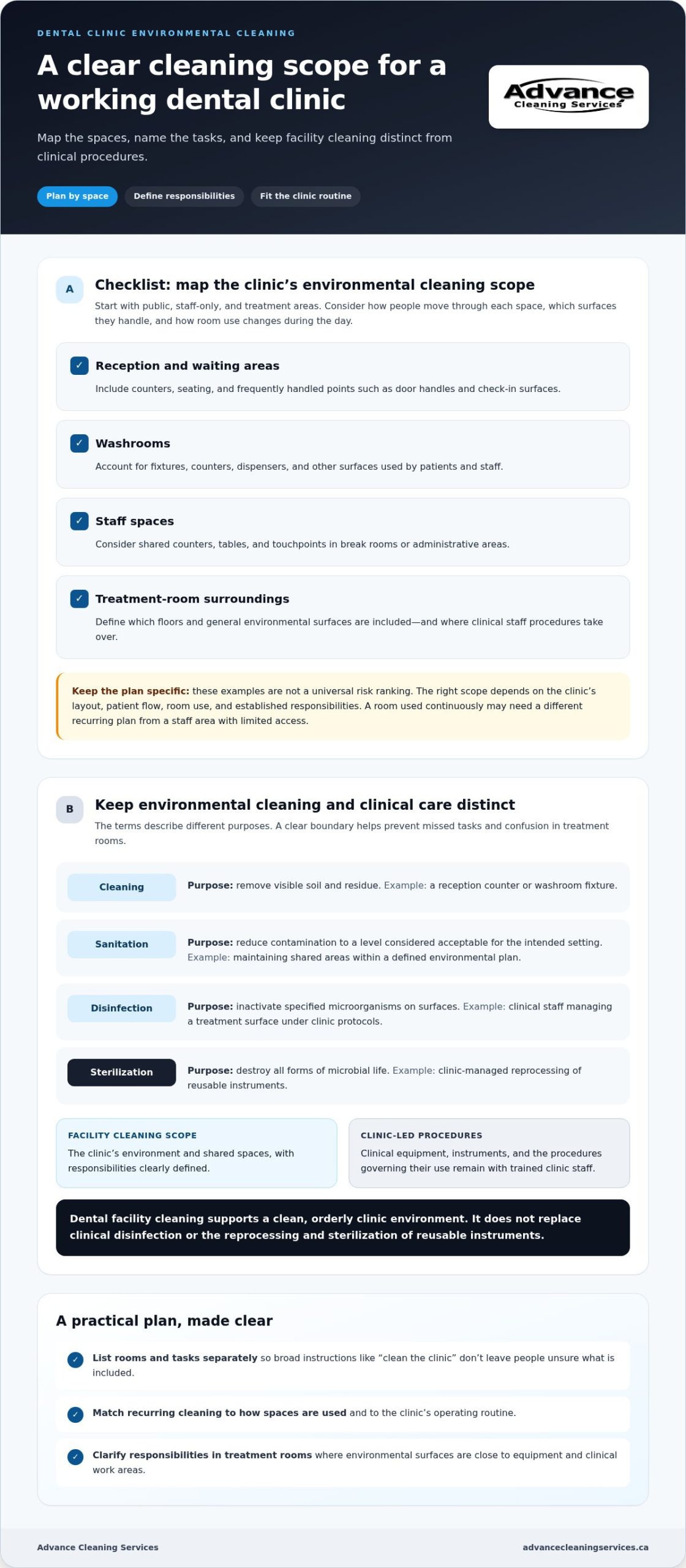
Start by mapping the clinic into public, staff-only, and treatment areas. Note how patients and employees move through those spaces, which surfaces they handle, and how room use changes during the day. This makes the plan specific to the clinic rather than a generic office checklist.
- Reception and waiting areas: Include counters, seating, and frequently handled points such as door handles and check-in surfaces.
- Washrooms: Account for fixtures, counters, dispensers, and other surfaces used by patients and staff.
- Staff spaces: Consider shared counters, tables, and touchpoints in break rooms or administrative areas.
- Treatment-room surroundings: Define which floors and general environmental surfaces are part of facility cleaning, and where clinical staff procedures take over.
These examples aren’t a universal risk ranking. The right scope depends on the clinic’s layout, patient flow, room use, and established responsibilities. A room used continuously may need a different recurring plan from a staff area with limited access. Listing rooms and tasks separately helps avoid broad instructions such as “clean the clinic” that leave staff unsure what is included.
Where sanitation ends and clinical procedures begin
Facility cleaning addresses the environment around clinical care. Clinical disinfection applies to items and surfaces managed under the clinic’s infection-control protocols, while reusable instruments require their own reprocessing and sterilization procedures. These activities have different purposes and must not be treated as interchangeable. For a general explanation of the term, see Sterilization (microbiology).
The clinic’s trained staff remain responsible for clinical equipment, instruments, and the procedures that govern their use. A cleaning plan should make boundaries clear, especially in treatment rooms where environmental surfaces sit close to equipment and work areas. Staff can identify which tasks belong to clinical protocols and which surroundings fall within the facility-cleaning scope.
Dental facility cleaning is the planned cleaning of a clinic’s environment; instrument sterilization is a separate clinical process for reusable instruments. Keeping that distinction clear helps clinics coordinate facility cleaning without confusing it with, or relying on it to replace, clinical care.
How Dental Office Sanitation, Disinfection, and Sterilization Differ
These terms describe different purposes and processes, not interchangeable tasks. Understanding the distinction helps clinic managers set a useful environmental cleaning scope and keep clinical responsibilities with the staff and procedures that govern them. Dental office sanitation services address the clinic environment; they don’t replace clinical disinfection or the reprocessing of reusable instruments.
What each term means in a dental facility
In plain language, cleaning removes visible soil and residue. Sanitation reduces contamination to a level considered acceptable for the intended setting. Disinfection uses an appropriate process or product to inactivate specified microorganisms on surfaces. Sterilization is a separate process intended to destroy all forms of microbial life. Exact product use and clinical processes must follow the clinic’s established protocols and applicable provincial guidance.
| Term | Plain-language meaning | Dental-facility example |
|---|---|---|
| Cleaning | Removing soil and residue from surfaces. | Cleaning a reception counter or washroom fixture. |
| Sanitation | Reducing contamination to a level suitable for the setting. | Maintaining shared areas as part of a defined environmental plan. |
| Disinfection | Inactivating specified microorganisms on surfaces. | Clinical staff managing a treatment surface under clinic protocols. |
| Sterilization | Destroying all forms of microbial life. | Clinic-managed reprocessing of reusable instruments. |
The examples explain differences in scope, not a task-by-task procedure. A waiting-room surface and a reusable instrument aren’t handled through the same process. Product selection, contact directions, and clinical procedures belong within the clinic’s protocols, informed by current guidance from the relevant provincial regulator.
How professional cleaners work alongside clinic staff
A defined environmental scope makes responsibilities easier to coordinate. It can identify which public, staff, and general room surfaces are included in recurring facility cleaning, while marking clinical equipment and instruments as clinic-managed. Treatment areas benefit from clear handoffs: staff establish which surfaces are ready for environmental cleaning, and the cleaning team follows the agreed scope without taking over clinical procedures.
This division supports a consistent routine and reduces ambiguity during busy operations. For broader context on facility-focused cleaning, see Advance Cleaning Services’ Alberta medical facility cleaning guide. Clinics can also explore dental facility cleaning support shaped around their layout and operating routine.
Facility cleaning covers the clinic environment; instrument reprocessing remains a clinical responsibility managed by trained staff under current clinic protocols and applicable provincial guidance. Keeping that boundary visible in the cleaning scope helps each team understand its responsibilities and how the work fits together.
How to Compare Dental Office Sanitation Services for Your Clinic
A useful comparison starts with the work itself, not a broad promise of “complete cleaning.” Dental office sanitation services should be described in practical terms: which areas are included, what task categories are covered, how often they’re scheduled, and where environmental cleaning stops. A general office checklist may overlook how treatment rooms, patient routes, staff areas, and clinic-managed equipment fit together.
What a clear dental cleaning scope should describe
Look for a plain-language scope that reflects the floor plan and daily use of your clinic. It should distinguish recurring environmental tasks from clinical duties and give staff a shared reference for what is included. A specific scope also makes it easier to update instructions when rooms or routines change.
- Areas: Identify reception, waiting spaces, washrooms, staff areas, and the agreed environmental surfaces around treatment rooms.
- Task categories: Describe the types of routine cleaning included for each area, without treating environmental work as instrument processing or clinical care.
- Service cadence: Record the agreed schedule for each part of the scope, based on use and clinic operations.
- Access and instructions: Explain how room access, restricted areas, clinic-specific directions, and changes to room use will be communicated.
- Responsibility boundaries: State which clinical equipment, instruments, and procedures remain under clinic staff management.
This level of detail helps prevent assumptions. For instance, “treatment rooms included” may be too broad unless the scope clarifies which environmental tasks are intended and how clinic-managed items are handled. A room-by-room list can make those limits easy to understand.
How to assess communication and service fit
Share a floor plan or walk through the clinic’s zones, access arrangements, patient routes, and operating routine. Explain which rooms see frequent use and which surfaces or areas have specific instructions. Advance Cleaning Services can tailor dental facility cleaning to the clinic’s layout and routine, rather than applying a standard office checklist without regard to dental workflow.
Agree on a consistent point of contact and a straightforward way to report missed tasks, access changes, or new instructions. Clear communication helps the clinic and cleaning team resolve practical issues without blurring responsibility for clinical procedures. Keep the written scope easy for relevant staff to find and update when the layout or room use changes.
As you assess service fit, consider whether the approach reflects the realities of a dental facility, whether responsibilities are explicit, and whether the schedule can be planned around patient flow and clinic operations. Advance Cleaning Services provides specialized medical facility cleaning, including dental facility cleaning, for commercial clinics in Alberta and the Vancouver area. Its cleaning approach can be tailored to the facility’s layout, use, and operating routine. Explore dental facility cleaning support as part of planning a clearly defined environmental scope.
How to Plan Sanitation Around Dental Clinic Operations
A dependable cleaning plan should work with the clinic’s routine, not disrupt it. Patient flow, room use, staff access, and operating hours all affect how environmental cleaning can be organized. There’s no single schedule that suits every practice. Build the plan around the spaces and activity in your facility, then record the agreed tasks and boundaries so everyone understands the arrangement.
Use this four-step sequence to turn the clinic’s layout and daily routine into a practical plan:
- Map spaces. Mark public, staff-only, and treatment areas, noting how patients and employees move through them. Identify rooms with different patterns of use, rather than treating the clinic as one uniform space.
- Define the scope. List the environmental areas and task categories included in recurring cleaning. Document which duties remain with clinic staff, especially for clinical equipment, reusable instruments, and clinical procedures.
- Coordinate access. Discuss when spaces are available, how room turnover works, and which areas have restricted access. Use appointment patterns, staff presence, and room availability to inform scheduling discussions.
- Review communication. Decide who shares updates, how changes or concerns are reported, and where staff can find the current instructions. Revisit the plan as clinic operations change.
Build a practical cleaning schedule
Group areas by use and expected activity. Reception, staff spaces, washrooms, and treatment-room surroundings may have different scheduling needs, so avoid applying one frequency across every area by default. Discuss cleaning windows in relation to appointments, room availability, and staff access. If hours, patient flow, or room use shift, review the schedule and adjust the agreed plan to suit the facility.
Prepare staff and spaces for a consistent service
Choose a clinic contact to share access arrangements, area-specific instructions, and updates with the cleaning team. Make restricted spaces and temporary changes to room use clear, especially if they affect which areas are ready for environmental cleaning. Keep instructions in a shared, current reference, and maintain a written boundary between facility tasks and clinic-managed clinical duties.
Clinical equipment and reusable instruments remain under clinic staff procedures. Clear handoffs help prevent misunderstandings: staff communicate access and room status, while the cleaning team works within the agreed environmental scope. Dental office sanitation services are more dependable when the plan reflects the clinic’s real workflow and provides a straightforward way to update instructions.
Advance Cleaning Services provides dental facility cleaning tailored to a facility’s layout, use, and operating routine. Plan dental facility cleaning for your clinic with a clear scope that supports day-to-day operations.
Dental Office Sanitation Services in Alberta and Metro Vancouver
Dental clinics across Alberta and the Vancouver area have different layouts, patient routines, and space requirements. A dependable cleaning plan should reflect those differences, not rely on a one-size-fits-all checklist. Advance Cleaning Services specializes in medical facility cleaning, including dental facility cleaning, with an environmental scope tailored to the clinic’s layout, use, and operating routine.
That local approach is practical for clinics planning around their reception areas, treatment-room surroundings, staff spaces, and access arrangements. Cleaning supports the clinic’s work, while its trained staff continue to manage clinical procedures and reusable instruments according to established protocols.
Local cleaning support for Alberta dental clinics
For broader context on the company’s medical facility focus, the Alberta medical facility cleaning guide explains the wider facility-cleaning perspective. Dental cleaning planning can then account for the clinic’s particular spaces and agreed environmental tasks.
Dental sanitation support in Metro Vancouver
Advance Cleaning Services also provides dental facility cleaning in Vancouver and nearby communities, including Richmond, Burnaby, Surrey, New Westminster, Coquitlam, Abbotsford, and Surry. For practice managers, local support is most useful when communication is clear and the cleaning scope reflects the actual site. A clinic with several treatment rooms, for example, may need access and room-use instructions documented differently from a smaller practice with shared spaces.
When outlining your facility’s needs, consider the areas in scope, how the clinic is used, operating hours, and any access or room-use instructions that shape the routine. Clear information gives the cleaning plan a practical starting point and helps keep facility tasks distinct from clinic-managed clinical responsibilities.
If your practice is in Alberta or the Vancouver area, share your layout, operating routine, and cleaning priorities with Advance Cleaning Services to discuss an approach suited to your dental facility.
Set Your Clinic Up for a Dependable Cleaning Routine
A well-planned cleaning routine gives your team a clear framework to revisit as patient flow, room use, or clinic priorities change. Treat the scope as a working document: keep instructions current, make responsibilities easy to understand, and review whether the arrangement still fits the way your practice operates.
With those details in view, you can shape a cleaning plan around your facility. Advance Cleaning Services specializes in medical facility cleaning, including dental facilities, for clinics across Alberta and the Vancouver area.
Discuss a dental facility cleaning plan with Advance Cleaning Services and take the next step towards dependable dental office sanitation services tailored to your clinic.
Frequently Asked Questions
How much do dental office sanitation services cost?
The cost depends on the clinic’s size, cleaning scope, service schedule, and how its spaces are used. A practice with several treatment rooms and shared staff areas may need a different plan from a smaller clinic with fewer spaces. To discuss a useful scope, outline the areas to be cleaned, the tasks required, and the routine that would fit your operations. Advance Cleaning Services tailors its cleaning approach to each facility.
Can dental office cleaning be scheduled around patient appointments?
Yes. The cleaning schedule can be planned around appointment patterns, room availability, and staff access. For example, a clinic may identify periods when certain rooms are unoccupied and clarify which shared spaces remain accessible during operating hours. Share regular schedule patterns and known exceptions so the plan reflects daily operations. If appointment volumes or hours change, revisit the arrangement with the cleaning team.
Does dental office sanitation include cleaning dental instruments?
No. Environmental cleaning covers the clinic’s facility surfaces, while reusable dental instruments are managed through the clinic’s own clinical reprocessing procedures. Keep instruments, instrument-processing areas, and related equipment under the responsibility of trained clinic staff. If an item’s responsibility is unclear, document who manages it before service begins. This helps avoid assumptions about clinical duties and keeps the cleaning scope focused on the facility.
Is dental office cleaning different from regular office cleaning?
What information should a dental clinic provide when planning sanitation services?
Provide a current floor plan or room list, the clinic’s operating hours, typical appointment patterns, and access instructions. Note restricted spaces, rooms with changing uses, and any areas where staff must be present. Identify a contact person for updates, and give the cleaning team a way to receive revised instructions if the layout or routine changes. Clear, current information helps shape a plan around the actual clinic.
Can one sanitation plan cover more than one dental clinic location?
One framework can help organize cleaning across multiple clinics, but each site should have its own location-specific details. A shared approach might use consistent task categories and communication practices, while separate site notes capture differences in floor plan, access, room use, and appointment routines. For example, a clinic in Calgary may have a different layout from another in Vancouver. Keep each location’s instructions clear and current.