A facility’s square footage is only one part of what determines cleaning costs. For heavy-duty cleaning services in Edmonton, the price depends on the building’s condition, the work required, how often cleaning is needed, and the type of facility. Healthcare, retail, school, and office spaces each have different cleaning priorities, so costs are tailored to the scope of work.
It’s reasonable to want a clear budget picture before arranging professional cleaning. This article explains what shapes a cleaning scope, why the same plan won’t suit every building, and what to consider when planning service for a busy facility.
You’ll also learn how customised cleaning can address the distinct needs of healthcare, retail, school, and office environments. The goal is to help you understand what influences cost and how a well-defined scope of work can support a clean, consistently maintained building.
Key Takeaways
- Understand why a building’s size, condition, cleaning scope, and schedule can all affect service costs.
- See how a customised cleaning plan can account for the different needs of healthcare, retail, school, and office spaces.
- Learn which details help define the work required for a commercial cleaning plan.
- Explore professional cleaning options for maintaining busy facilities, from janitorial services to carpet cleaning.
How much are cleaning services in Edmonton?
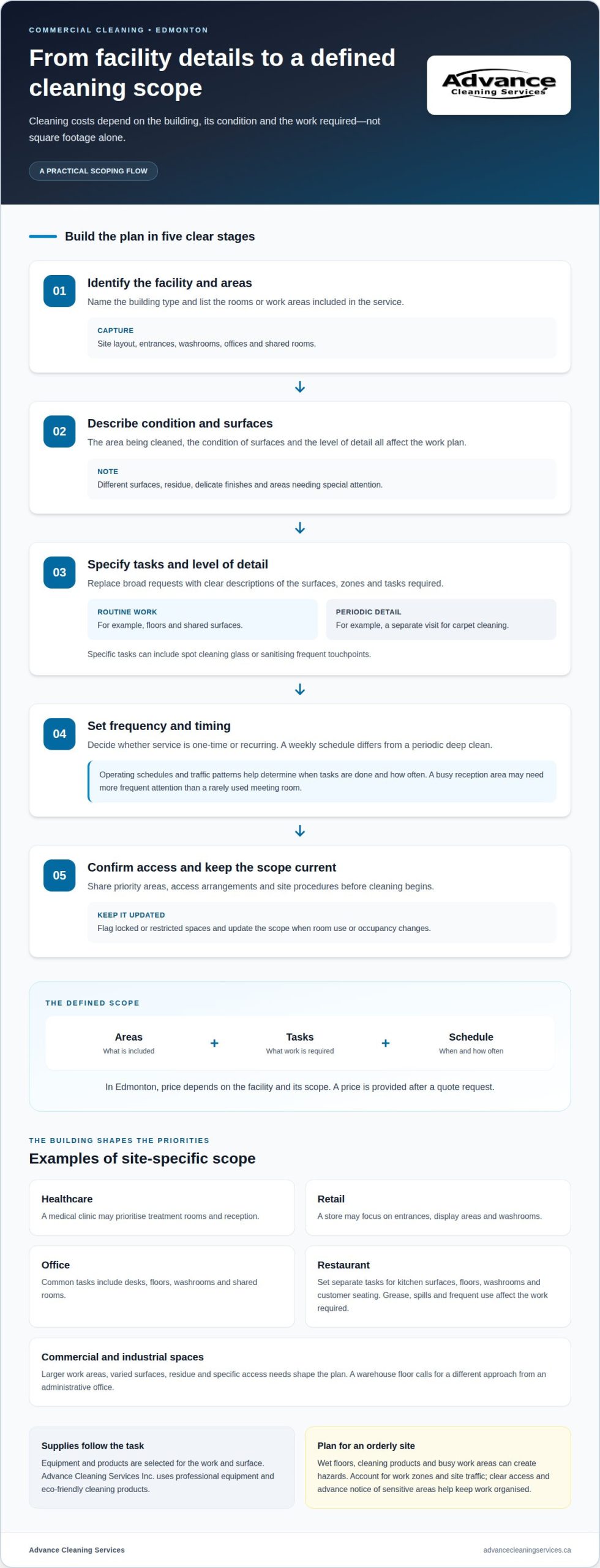
Cleaning costs in Edmonton depend on the building, its condition, and the work required. Residential cleaning is usually scoped differently from commercial or industrial work. For a meaningful estimate, the scope should identify the rooms or work areas, cleaning tasks, and service frequency.
A price depends on the facility and scope, and is given after a quote request. Key cost factors include the area being cleaned, the condition of surfaces, the level of detail, and whether service is one-time or recurring. A weekly schedule, for example, differs from a periodic deep clean.
Which Edmonton companies offer heavy-duty cleaning services? Commercial cleaning companies and janitorial providers serve businesses and facilities across Edmonton. The right service category depends on the site: an office, restaurant, school, healthcare space, or industrial building each calls for a defined scope.
For homes, the plan can reflect the rooms, their condition, and the requested tasks. A home needing attention to kitchens and bathrooms has different priorities from one needing routine upkeep throughout. Sharing the property type and priorities helps define the work.
Commercial cleaning and janitorial services can maintain shared areas, washrooms, and workspaces. A facility’s operating schedule and traffic patterns help set task timing and frequency. A busy reception area, for example, may need more frequent attention than a rarely used meeting room.
Restaurant cleaning needs a clear scope for food-preparation and dining areas. Grease, spills, and frequent use affect the work required. The plan can specify separate tasks for kitchen surfaces, floors, washrooms, and customer seating.
Light commercial and office cleaning often centres on desks, floors, washrooms, and shared rooms. An office manager can outline which spaces need routine care and which need periodic detail. A recurring schedule keeps the planned tasks aligned with changes in occupancy and workplace use.
Commercial and industrial cleaning can involve larger work areas, varied surfaces, and specific access needs. The facility’s layout and the type of residue affect the work plan. A warehouse floor, for example, requires a different approach from an administrative office.
What equipment and cleaning products are used for heavy duty cleaning? The right supplies depend on the task and surface. Advance Cleaning Services Inc. uses professional equipment and eco-friendly cleaning products, selecting an approach suited to the work rather than using the same method everywhere.
What should clients do to prepare a home or facility? Share the site layout, priority areas, access arrangements, and any delicate surfaces before cleaning begins. For a restaurant, identify kitchen and dining zones; for an office, note shared rooms and restricted areas.
What safety risks or precautions apply? Wet floors, cleaning products, and busy work areas can create hazards. A well-organized cleaning plan accounts for work zones and site traffic. Clear access and advance notice of sensitive areas help keep the work orderly.
Customised building cleaning services
A tailored cleaning plan turns a building’s needs into a defined scope. It identifies the areas, tasks, and schedule. A medical clinic may prioritise treatment rooms and reception, while a retail store may focus on entrances, display areas, and washrooms. This detail aligns the work with how people use the space.
Start by separating routine tasks from periodic work. A regular schedule may cover floors and shared surfaces, while a separate visit addresses carpet cleaning. At home, the plan might prioritise kitchen counters and a bathroom while giving less-used rooms less attention. A clear scope sets priorities without treating every room alike.
Use specific descriptions instead of broad requests such as “make it spotless.” Identify the surfaces, zones, and tasks, such as spot cleaning glass or sanitising frequent touchpoints. Note delicate finishes and restricted areas. These details help the cleaning team choose suitable supplies and organise the work.
- Map the site: Identify entrances, washrooms, offices, and shared rooms.
- Set priorities: Separate essential recurring tasks from occasional detail work.
- Define access: Note operating hours, locked spaces, and any site procedures.
- Record changes: Update the scope when room use or occupancy shifts.
Tasker vetting matters because building cleaning involves access to private or operational spaces. Review the provider’s documented screening process, staff training approach, and method for handling site instructions. For a facility, clarify who coordinates work and how schedule changes or missed tasks are communicated. Reliable customer support gives the site contact a clear route for sharing updates.
Are Edmonton heavy duty cleaning companies insured, bonded, or WCB-covered? Coverage varies, and insurance, bonding, and WCB coverage are separate matters. Review relevant documentation and understand which entity and work it applies to before booking.
How do I arrange heavy duty cleaning in Edmonton? Share the building type, areas, current condition, priority tasks, and preferred schedule. Include access details and surfaces needing special attention. A retail site, for example, can identify customer areas separately from staff spaces.
A clear request also helps define the service boundaries. Note which rooms are included, which tasks matter most, and how the site contact will communicate changes. These details make it easier to plan and adjust the work as the building’s needs evolve.
For a facility-specific scope, explore commercial cleaning planning as part of setting priorities for your building with Advance Cleaning Services Inc.
Establishing clear service priorities ensures that every area receives the appropriate level of attention. Confirm how missed items are handled: customers must report a missed item within 24 hours to receive a no-charge re-clean. Recurring schedules also have stated savings: customers booking weekly recurring cleaning save 20% from their second visit; customers booking bi-weekly recurring cleaning save 15% from their second visit; and customers booking recurring cleaning every four weeks save 10% from their second visit. Include the chosen schedule and these terms in the booking discussion so expectations about follow-up and recurring visits are clear.
Cleaning for healthcare, retail, schools, and offices
Healthcare, retail, school, and office buildings need different cleaning priorities. A cleaning company can shape its work around each site’s rooms, surfaces, and daily activity. In Alberta, a clinic’s treatment spaces call for a different task plan from a store’s entrance or a school’s classrooms. The goal is to define the work clearly for each environment.
In a medical facility, the plan can distinguish reception, staff areas, and patient-care rooms. A dental clinic, for example, may have separate treatment rooms and waiting areas. The scope should identify the surfaces and floors requiring attention and explain how access will be coordinated. Room-by-room instructions keep the work organized.
Retail cleaning focuses on customer-facing areas and spaces that support daily operations. An Edmonton shop might prioritize its entrance, sales floor, fitting rooms, staff washroom, and break-room kitchen. Floor care depends on material and foot traffic: a carpeted display area needs a different approach from a hard-surface entrance.
Schools have classrooms, corridors, washrooms, and shared areas with distinct uses. A cleaning plan can identify high-use rooms, touchpoints, and floor types without treating every space alike. A library’s carpet and desks need tasks suited to those surfaces, while a gym floor needs its own care plan. School schedules also shape access.
Office cleaning can cover workstations, meeting rooms, reception, kitchens, and washrooms. A shared kitchen may need attention to counters, tables, and floors, while a boardroom may need dusting and carpet care. The facility contact can identify daily-use rooms and areas needing periodic detailed cleaning, keeping the task list practical.
A building’s entrances also affect the cleaning scope. Areas exposed to tracked-in dirt need different floor care from interior offices. Seasonal conditions in Edmonton can change what accumulates near doors, so entrance care can be planned separately from routine work elsewhere. Match the schedule to how the site is used.
- Healthcare: Separate treatment, waiting, and staff areas in the task plan.
- Retail: Distinguish sales floors, entrances, fitting rooms, and staff spaces.
- Schools: Match classroom, corridor, library, and gym tasks to their surfaces.
- Offices: Set priorities for workstations, meeting rooms, kitchens, and washrooms.
Deep cleaning can cover tasks beyond routine upkeep, such as carpet cleaning or detailed attention to a heavily used shared room. The scope should name the spaces and surfaces involved, giving the facility contact and cleaning team a shared reference for the work.
Before cleaning begins, the site contact can provide a floor plan, identify restricted rooms, and describe access procedures. A clinic might mark treatment areas, while a school could identify rooms used after regular classes. These details help organize the work around the building’s needs.
Cleaning service pricing factors
A cleaning quote reflects the work required, not just the building’s name. For an Edmonton office, the estimate can depend on floor area, room use, surface types, and requested tasks. A house cleaning visit may need a different scope from cleaning a busy commercial site. Price depends on the specific job and is provided after a quote request.
Condition affects the time and detail involved. A site with accumulated dust or marked floors needs a different plan from one receiving regular upkeep. A recurring schedule can distinguish routine tasks from work that needs separate attention. Clear priorities make the scope easier to understand.
Frequency matters, too. A regular plan may focus on maintaining agreed areas, while a one-time visit may address a different set of needs. In an office with a shared kitchen, counters, floors, and washrooms can be included in routine janitorial work, with carpet cleaning handled separately. The plan should reflect the selected tasks and schedule.
Location matters when arranging cleaning across Edmonton and nearby communities. Advance Cleaning Services serves Edmonton as well as Calgary, Red Deer, Okotoks, Lethbridge, Strathmore, Chestermere, Airdrie, Cochrane, and other communities in Alberta, along with Vancouver-area communities. Share the site address when discussing the work.
Post-construction cleaning has its own scope. A newly renovated commercial space may need debris removal and detailed cleaning of surfaces and floors. The work depends on the condition and size of the area. Identify which rooms are complete and ready for cleaning, and which areas are outside the project.
- Building type: A house, office, or retail site has different rooms and cleaning needs.
- Condition: Build-up, staining, and renovation residue affect the work required.
- Task list: Identify routine cleaning separately from carpet or detailed surface care.
- Schedule: State whether the request is one-time or recurring.
- Location: Provide the Edmonton-area address to account for travel.
Pets can also affect the cleaning tasks needed at home. Include this detail with the property type and requested work to describe the scope accurately.
To describe the work clearly, provide the building address, type, areas to be cleaned, current condition, and preferred schedule. A business in Calgary, for example, can identify its entrance, work areas, washrooms, and any post-construction cleaning needs. These details help shape a practical plan.
When reviewing cleaning plans, compare the tasks and spaces included, not just the overall scope. If one plan includes kitchen floors and washrooms while another excludes them, they cover different work. A clear task list helps set expectations.
service needs and address, then ask how travel applies. Including the job type and location in the request helps clarify which travel charge may apply alongside the cleaning tasks.
What types of heavy-duty cleaning services are available in Edmonton?
Edmonton facilities may need more than routine surface cleaning. The right service depends on the site, its condition, and the work required. A medical clinic, renovated office, and property affected by hoarding each need a different scope. Heavy duty cleaning can include different services, not one checklist for every building.
Medical facility cleaning supports dental, doctor, and veterinary clinics. The scope can account for treatment rooms, waiting areas, staff spaces, and shared surfaces. A dental facility, for example, has distinct rooms and equipment areas to consider. The plan should define the spaces and tasks rather than treating the whole facility as one zone.
Office cleaning and janitorial services support workplace upkeep. A plan may include offices, reception areas, meeting rooms, washrooms, and shared kitchens. Janitorial services suit buildings needing ongoing care across common areas. Carpet cleaning can also be arranged for carpeted rooms needing focused attention.
Retail business cleaning focuses on customer and staff areas. An Edmonton shop may need its entrance, sales floor, fitting rooms, and staff spaces cleaned. A condominium building can require janitorial care for lobbies and shared corridors. Day porter services help maintain active spaces during the day.
Post-construction cleaning is for sites after building or renovation work. A newly finished office, for instance, may need dust and residue removed from surfaces and floors. The scope should identify which rooms are complete and ready for cleaning, focusing the work on areas affected by construction.
Biohazard cleanup and crime scene cleaning address specialized contamination and sensitive situations. These services differ from routine janitorial work because the site and materials involved shape the scope. Extreme hoarding cleanup is another specialized service for properties with extensive accumulation. Each job starts with understanding the affected spaces and work required.
Residential cleaning can also be tailored to specific needs. Maid services support home cleaning, while carpet and upholstery cleaning focus on particular furnishings and surfaces. A home may need carpet care in a heavily used living room without requiring cleaning throughout the property. Defining the area keeps the requested work specific.
- Routine facility care: Office cleaning, janitorial services, retail cleaning, and condominium janitorial services.
- Focused surface care: Carpet cleaning and upholstery cleaning.
- Specialized situations: Medical or dental facility cleaning, post-construction cleaning, biohazard cleanup, crime scene cleaning, and extreme hoarding cleanup.
Choose a service category by identifying the building type, affected spaces, and primary cleaning need. A renovated retail unit may need post-construction cleaning before regular retail upkeep begins. A clinic may need medical facility cleaning, while an office may need recurring janitorial care. Explore professional cleaning options for the needs of your facility.
Advance Cleaning Services
Advance Cleaning Services helps Edmonton facilities plan professional cleaning around their buildings and priorities. Turn to the team when a clinic, office, or shared commercial space needs a clear scope tailored to the site.
Services include Medical Facilities cleaning, Commercial & Office Cleaning, Janitorial and Day Porter Services, and Carpet and Tile Cleaning. The right plan depends on the areas needing attention, surface conditions, and whether the work is ongoing or focused on a particular task. Sharing those details helps shape a practical service plan.
For a healthcare facility, office, or building with recurring cleaning needs, discuss the spaces and priorities that matter most. Contact Advance Cleaning Services Inc. to discuss cleaning for your facility.
Set a clear plan for your facility
Choosing heavy duty cleaning services in Edmonton is a chance to set expectations before work begins. Consider how the building is used, which areas need professional attention, and what your team needs from the service. A clear scope turns those priorities into a plan that fits daily operations.
Advance Cleaning Services provides Medical Facilities cleaning, Commercial & Office Cleaning, and Janitorial and Day Porter Services for facilities with different cleaning needs. Share your building type, priority areas, and preferred service approach to start a conversation about the work.
When you’re ready to discuss a cleaning plan for your facility, contact Advance Cleaning Services Inc. A clear next step can help you move forward with confidence.
Frequently Asked Questions
How much does heavy-duty cleaning cost in Edmonton?
Heavy-duty cleaning costs in Edmonton depend on the property and requested scope, so there isn’t one set price. A quote is provided after a request, with the estimate shaped by site condition, the rooms and surfaces involved, access, and whether the work is specialized or recurring. Include the location, priority areas, and any spaces that must remain operational during cleaning. These details help outline the work and plan its sequence.
How do Edmonton heavy-duty cleaning companies compare by services, ratings, and pricing?
Commercial cleaning companies and janitorial providers offer services tailored to facility type and scope, including recurring cleaning and task-specific care. Pricing is quoted based on the areas, condition, cleaning tasks, and schedule; no ratings or company-by-company comparison is provided.