
There isn’t one known cause of hoarding disorder, and it often runs in families. About half of people with the condition say they have a relative who also hoards. If you’re looking for help for a family member who hoards in Alberta, understanding possible causes can help you respond with patience rather than blame.
It can be painful to watch clutter affect someone you care about, especially when earlier efforts to help have led to conflict. Hoarding isn’t simply untidiness or a lack of effort. This article explains possible contributing factors, how hoarding can affect daily life, and practical ways to offer support while respecting your family member’s choices. It also covers support options in Alberta and when professional cleaning may help with unsafe or overwhelming conditions at home.
Key Takeaways
- Learn why hoarding is more than ordinary clutter and how to recognize common misconceptions.
- Use respectful, collaborative conversations and small, safety-focused steps to support your family member.
- Notice when clutter is affecting essential activities at home, such as cooking, sleeping, or keeping the space clean.
- Understand how stress, family history, and other factors may relate to hoarding disorder.
- Explore Alberta support options, including counselling, community resources, and professional cleanup when home conditions need attention.
What is hoarding disorder?
Hoarding disorder is a mental health condition that can make discarding possessions extremely difficult. A person may feel strongly attached to belongings and struggle to part with items others would readily discard, donate, or recycle. The effects can go beyond crowded rooms: possessions may get in the way of everyday activities such as preparing food or sleeping in a bed.
Hoarding is not simply collecting or being untidy. A collector can usually organize and display items without stopping rooms from serving their everyday purpose. For example, a collection arranged on shelves differs from belongings covering the kitchen counter until meal preparation becomes difficult. About 1 in 40 Canadians experience struggles with problematic clutter, difficulty discarding, or excessively acquiring.
Understanding hoarding can help families see why “just throw it out” may not resolve the situation. People with hoarding disorder may find decision-making, planning, and organization difficult. Sorting a box can mean making repeated decisions about each object while worrying about losing something meaningful. A sudden cleanout may increase distress instead of helping someone build skills to manage belongings over time.
In Alberta, the Residential Tenancies Act requires tenants to keep their homes reasonably clean. A landlord may serve a 24-hour Notice of Entry to inspect if they think a tenant is hoarding, and may serve a 14-day eviction notice under the Act. The Alberta Human Rights Act also protects tenants from discrimination based on mental disability and requires accommodation to the point of undue hardship.
There is no single clutter level that automatically determines when Alberta authorities will intervene. Hoarding-related concerns may draw attention when conditions create health, safety, or housing issues, such as blocked access to essential areas. A landlord’s inspection notice is a specific housing process, not a diagnosis.
A doctor can assess symptoms and health history and may conduct a physical exam. A home visit may sometimes help with diagnosis. Treatment mainly involves counselling and medicine. Counselling can help build organization, decision-making, and relaxation skills. Treatment may include counselling and medication, depending on the person’s needs.
Alberta Health Care coverage depends on the type of treatment and how it is delivered. A doctor’s assessment and counselling are different services, so ask about coverage arrangements when setting up care. Don’t assume every counselling option is covered in the same way.
These distinctions can guide a more useful conversation. Describe a specific concern, such as a blocked cooking area, rather than calling the person messy. Keeping the focus on daily function and safety makes the discussion more practical.
How to support a family member who hoards
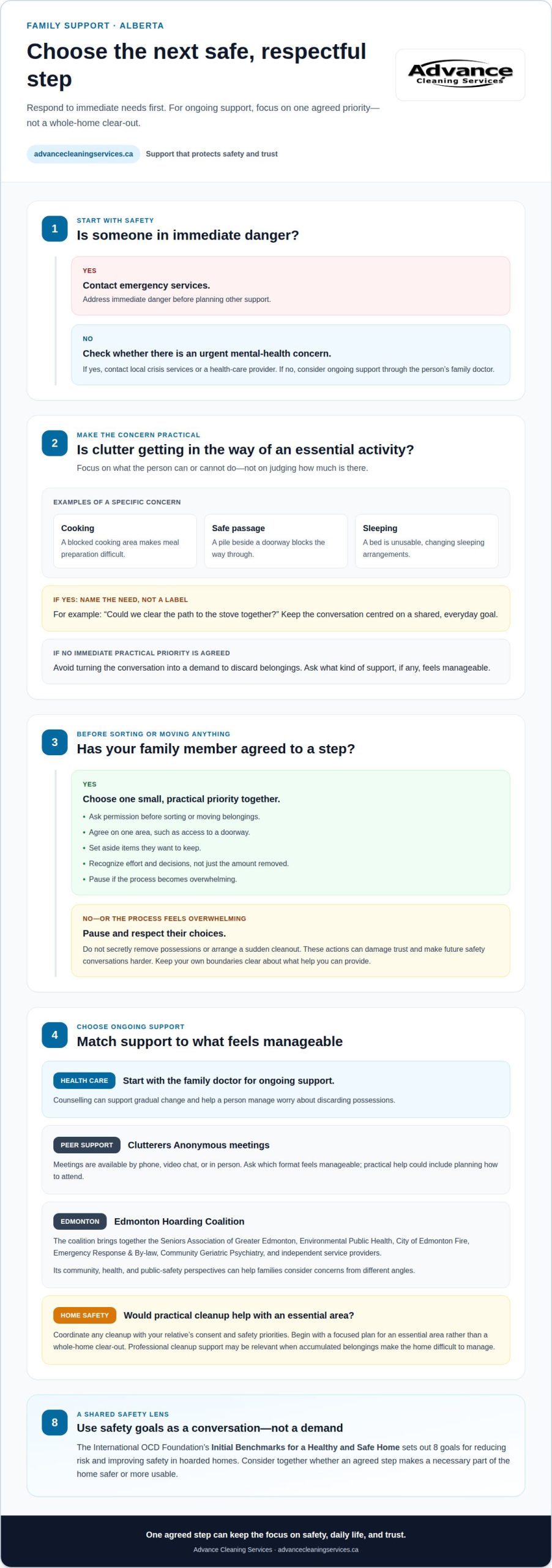
Support works best when it respects your family member’s choices while addressing practical safety concerns. Focus on one agreed step instead of trying to resolve the entire home at once.
If someone is in immediate danger, contact emergency services. For urgent mental-health concerns, contact local crisis services or a health-care provider. For ongoing support, start with the person’s family doctor.
Ways to Support a Family Member
Family and friends may have tried to intervene repeatedly without success. Before raising a concern, decide what you’ve noticed and what specific help you can offer. For example, ask, “Could we clear the path to the stove together?” rather than demanding that your relative discard belongings. A calm, focused request can keep the conversation centred on a shared goal.
- Ask permission before sorting or moving belongings.
- Agree on one practical priority, such as access to a doorway.
- Recognize effort and decisions, not just the amount removed.
- Keep boundaries clear about what help you can provide.
The International OCD Foundation’s Initial Benchmarks for a Healthy and Safe Home sets out 8 goals for reducing risk and improving safety in hoarded homes. Use the goals as a way to discuss priorities together, rather than as a demand to clear everything. Consider whether an agreed step makes a necessary part of the home safer or more usable.
Support Services in Alberta
In Edmonton, the Edmonton Hoarding Coalition brings together the Seniors Association of Greater Edmonton, Environmental Public Health, City of Edmonton Fire, Emergency Response & By-law, Community Geriatric Psychiatry, and independent service providers. Its mix of community, health, and public-safety perspectives can help families consider concerns from different angles.
Counselling can support gradual change while helping a person manage worry about discarding possessions. Clutterers Anonymous meetings are available by phone, video chat, or in person. Ask your family member which format feels manageable, and offer practical help, such as planning how to attend.
When conditions at home require practical attention, coordinate any cleanup with your relative’s consent and safety priorities. A focused plan can begin with an essential area, rather than a whole-home clear-out. Professional cleanup support may be relevant when accumulated belongings make a home difficult to manage.
Symptoms and effects on daily life
Look at what clutter prevents your family member from doing, not just how much is visible. A pile beside a doorway matters if it blocks safe passage. Belongings covering a kitchen counter may make food preparation difficult. If a bed becomes unusable, sleeping arrangements may change. These examples show how hoarding can affect everyday activities throughout the home.
As clutter increases, ordinary routines can become harder to maintain. Hoarding can make living conditions unhealthy when belongings interfere with daily life. A crowded bathroom may complicate cleaning, while a crowded kitchen can hinder food preparation. More clutter can also make it harder to stay clean, eat well, and get enough sleep. These effects deserve attention alongside the possessions themselves.
Notice patterns over time. Hoarding often worsens, and rooms may gradually lose their original purpose. A table used for storage may no longer be available for meals. Boxes narrowing a hallway can make it difficult to move through the home. Describe a specific change, such as “we can’t reach the sink,” rather than judging your relative.
The Activities of Daily Living-Hoarding survey offers one way to describe practical difficulties. It lists 15 activities and asks the person experiencing hoarding behaviour to rate difficulty completing each on a scale from 1 to 5. Activities can help identify where support matters most. For example, difficulty using the kitchen points to a different immediate priority than difficulty reaching a closet.
Sanitation concerns are another part of the picture. The Home Environment Index consists of 15 items measuring sanitation problems created by hoarding behaviour in a home. This can help distinguish general clutter from conditions affecting the home environment. For family discussions, focus on visible, specific concerns, such as an area that cannot be cleaned or a necessary fixture that cannot be reached.
The effects can extend beyond the home. The Hoarding Disorder Foundation of Alberta says past interventions for many people with hoarding disorder have led to damaged relationships, isolation, eviction, and homelessness. That makes the approach to support important. Abrupt action can strain trust, while avoiding every difficult conversation can leave practical concerns unaddressed.
Keep a short record of affected spaces and activities. Note what has become difficult, such as cooking, sleeping, or cleaning, and which concern feels most urgent to your family member. Use those observations to agree on one manageable priority. A clear example gives the conversation a practical focus without reducing the person to the condition.
Possible causes and family history
The exact cause of hoarding disorder is unknown, and the condition often runs in families. About half of people with hoarding disorder say they have a relative who also hoards. This family pattern may help explain why relatives recognize similar difficulties across generations. It doesn’t establish a single cause for one person or mean every family member will develop the condition.
Family history is one part of a person’s story, not a diagnosis. A relative may notice that several family members find it hard to discard belongings, but only a health professional can assess an individual’s symptoms and health history. Keep observations specific: note who has struggled with clutter, what difficulties were visible, and whether they affected daily life.
Many people with hoarding disorder say their behaviour began after a stressful or traumatic event. The timing may feel meaningful to them, but it doesn’t prove the event alone caused the disorder. If your family member connects changes in their belongings to a difficult period, listen without pressing for details. Let them decide what they feel comfortable sharing.
Other mental health concerns may also be part of the picture. Many people with hoarding disorder experience depression or anxiety. These conditions may affect how someone feels while making decisions about possessions, so discussing wellbeing can be more useful than focusing only on clutter. Ask how they’re coping, and encourage them to talk with a doctor about mood, worry, and hoarding concerns.
The cause may not be obvious to a family member. Two people can face stressful experiences and respond differently; visible clutter alone can’t explain why one person has difficulty discarding. Avoid blaming a relative, past event, or personality trait. Instead, listen to what the person shares to understand what support feels acceptable and which concerns need attention.
These steps can make a discussion about family history more respectful:
- Ask whether hoarding or difficulty discarding has affected relatives, without making assumptions.
- Invite your family member to describe when they first noticed the behaviour, if they wish.
- Separate what you’ve observed from what you’re guessing about its cause.
- Encourage a health assessment when the person wants help understanding their symptoms.
A family pattern or stressful event can provide context, but neither should become a label. Keeping the conversation grounded in the person’s own experience helps families discuss possible causes without treating them as proof or assigning blame.
What hoarding support services are available in Alberta?
Support in Alberta can involve health care, counselling, peer meetings, community coordination, and practical help at home. Match the first step to the main concern: emotional distress, difficulty managing belongings, animal welfare, or unsafe living conditions. One service may address only part of the situation; a coordinated plan can connect separate needs.
A family doctor can assess symptoms and health history and may conduct a physical exam. A home visit may sometimes help with diagnosis. Before an appointment, your relative could write down what feels difficult, how long it has been happening, and which daily activities are affected. For example, they might describe trouble using a particular room or making decisions about possessions.
Counselling for hoarding disorder can help someone gradually part with unneeded possessions while learning to manage anxiety or worry. Ask what the person hopes to work on, such as organizing a specific area or practising decisions about belongings. A gradual approach keeps the work focused on their goals rather than treating a fast, whole-home clear-out as the only measure of progress.
Peer support offers another way to connect with people who understand similar challenges. Clutterers Anonymous meetings take place by phone, video chat, or in person. Your relative can consider which format feels most comfortable and whether they want help joining. Leave the choice to them, and don’t make attendance a condition of your support.
For concerns in the Edmonton area, the Edmonton Hoarding Coalition brings together health, municipal, seniors, and independent service-provider perspectives. Its members include Environmental Public Health, City of Edmonton Fire, Emergency Response & By-law, Community Geriatric Psychiatry, and the Seniors Association of Greater Edmonton. Families can use this local network as a starting point to consider which concerns need attention.
Animal welfare concerns call for a different route. If you’re concerned about animal hoarding in Alberta, contact the local Humane Society or SPCA. Describe what you’ve observed, such as animals appearing unable to access a clear area. Keep animal welfare concerns separate from decisions about belongings or household cleanup.
To organize next steps, write down the main concern and the help your relative is willing to consider. That might mean discussing counselling, exploring a peer meeting, or seeking advice about animal welfare. If health or safety issues occur alongside emotional distress, note both rather than expecting one service to resolve everything. A clear plan based on consent makes it easier to coordinate support while respecting your family member’s choices.
For mental health support, a family doctor can assess symptoms and health history, and counselling can help with hoarding-related anxiety and decisions about possessions. Clutterers Anonymous offers peer meetings by phone, video chat, or in person. For Edmonton-area concerns, the Edmonton Hoarding Coalition can help families consider what type of support is needed.
Advance Cleaning Services: Medical Facility Cleaning
Advance Cleaning Services Inc. provides professional Medical Facility Cleaning for dental, doctor, and veterinary facilities. This service is for medical environments, not for assessing or treating hoarding disorder or addressing clutter in a family member’s home. If the concern is a residence, focus on health-care and counselling support, alongside practical steps your relative agrees to.
Medical Facility Cleaning is relevant when a hoarding concern affects a clinic and professional cleaning support is needed there. The next step depends on the setting and its cleaning requirements. For a family member’s home, focus support on their needs and appropriate home-based resources.
Choose a practical next step
Supporting a relative can begin with one respectful conversation and one manageable priority. If you need help for a family member who hoards in Alberta, keep health-care support separate from practical work to make a home safer and more usable. Extreme Hoarding Cleanup may be appropriate when accumulated belongings require professional cleanup, with your family member’s preferences central to planning.
Advance Cleaning Services also provides Medical Facility Cleaning, Office cleaning, and Janitorial Services for those settings. These services address cleaning needs in facilities and workplaces, while Extreme Hoarding Cleanup is the relevant service for a home affected by hoarding. Cleaning does not replace assessment or counselling, but it can form part of a broader support plan.
If professional cleanup is the next practical step, contact Advance Cleaning Services Inc. to discuss your needs. A thoughtful plan can make room for progress while preserving dignity and trust.
Frequently Asked Questions
What causes it?
The cause of hoarding disorder is unknown, and family history or stressful experiences may provide context rather than a simple explanation. A relative’s habits don’t prove what caused another person’s behaviour. If your family member wants to explore possible causes, suggest discussing their history and current difficulties with a doctor. Focus on what they’re experiencing now, rather than trying to identify one event or person to blame.
How can family members help someone with hoarding disorder in Alberta?
If you need help for a family member who hoards in Alberta, begin by asking what kind of support they would accept. Offer a specific option, such as helping arrange a doctor’s appointment or attending a counselling session with their permission. If they decline, keep communication open and revisit the offer later. For concerns involving animals, Alberta families can contact their local Humane Society or SPCA.
How can families talk to a loved one about hoarding without causing conflict?
Choose a private, calm moment and describe one observable concern without labelling your loved one. For example, say, “I’m worried the hallway is difficult to get through,” rather than criticizing how they keep their home. Ask what would make the conversation useful, then listen without arguing about the value of individual belongings. Agreeing to pause when emotions rise can protect trust and make another discussion possible.
What are the health and safety risks of hoarding in a home?
Risks arise when possessions interfere with essential parts of daily life. A blocked kitchen can make food preparation difficult, while an unusable bed can affect where someone sleeps. Clutter may also make it harder to keep the home clean, eat well, or get enough rest. Describe the specific area or activity affected. This helps distinguish an immediate practical concern from general discomfort about how a home looks.