
A fresh office-chair spill can take about five minutes to blot and clean. Stubborn stain removal or seasonal deep cleaning takes about 30 minutes, followed by at least 10 minutes of air-drying, or longer depending on the office air. Careful upholstery stain removal for office chairs starts with checking the care tag and testing the cleaner in an inconspicuous spot.
A stain can make an office chair look faded or discoloured, but vigorous scrubbing or excess moisture may make it worse. A careful approach to upholstery stain removal for office chairs helps lift the mark while protecting the fabric and its colour.
This guide covers how to read common upholstery care codes, test a cleaner, blot and spot-treat stains, and control moisture. You’ll also learn how to let the fabric dry and why cleaning the full surface can help the chair look more even after treatment.
Key Takeaways
- Read the chair’s care tag before choosing a cleaner, then test it on an inconspicuous spot.
- Blot spills instead of scrubbing to help keep the stain from settling deeper into the fabric.
- Use a light touch with cleaning products and moisture to reduce the risk of leaving the upholstery damp.
- Allow time for both stain treatment and air-drying; stubborn cleaning can take about 30 minutes, plus drying time.
- Clean the fabric evenly to help the chair’s colour look more consistent after spot treatment.
Testing cleaners on an inconspicuous area
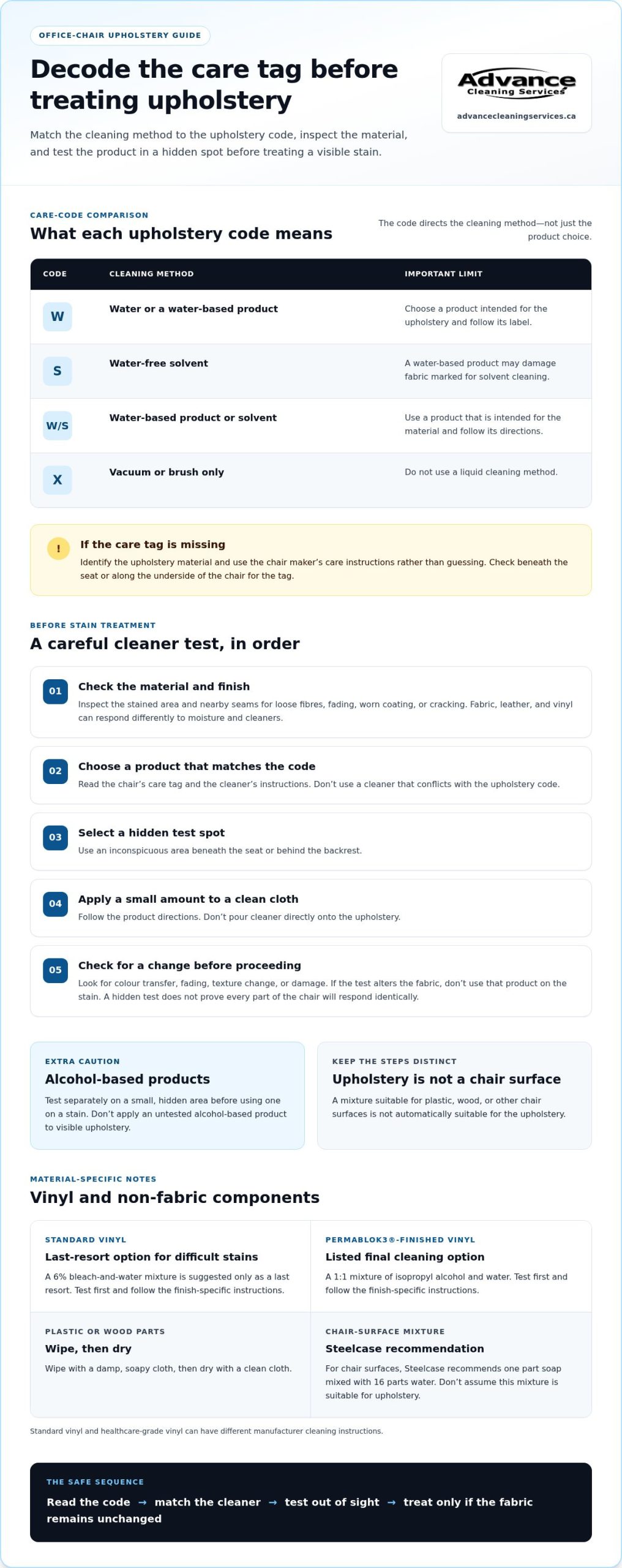
Choose a cleaner based on the chair’s upholstery code and finish. A product made for water-cleanable fabric may damage fabric marked for solvent cleaning, so check the care tag before treating a stain.
Don’t use a cleaner that conflicts with the care code, or apply an alcohol-based product without testing it first. Check the manufacturer’s instructions for leather, fabric or vinyl before choosing a cleaner.
- Find the care tag. Look beneath the seat or along the underside of the chair for its cleaning instructions. Upholstery tags may show W, S, S/W or X. If the tag is missing, identify the upholstery material and use the chair maker’s care instructions rather than guessing.
- Match the cleaner to the code. Use water or a water-based product on W upholstery. Use a water-free solvent on S upholstery. A W/S label allows either a water-based product or a solvent. For X upholstery, vacuum or brush only. These codes direct the cleaning method, not just the product choice.
- Inspect the fabric and finish. Check the stained area and nearby seams for loose fibres, fading, worn coating or cracking. A fabric cover, leather surface and vinyl finish can respond differently to moisture and cleaners. Select a product intended for the material and follow its label.
- Test an inconspicuous spot. Choose a hidden area beneath the seat or behind the backrest. Apply a small amount of the chosen cleaner with a clean cloth, following its directions. Don’t pour cleaner directly onto the upholstery. Check the test area for colour transfer, fading, texture change or damage before cleaning the visible stain.
- Test alcohol-based products separately. Before using one on a stain, apply it to a small, hidden area to check for fabric damage. If the test alters the colour or texture, don’t use that product on the stain. Avoid treating an untested patch as proof that every part of the chair will respond identically.
- Use care with vinyl finishes. Standard vinyl and healthcare-grade vinyl can have different manufacturer cleaning instructions. For difficult stains on standard vinyl, a 6% bleach-and-water mixture is suggested only as a last resort. For PERMABLOK3®-finished vinyl, the listed final cleaning option is a 1:1 mixture of isopropyl alcohol and water. Test first and follow the finish-specific instructions.
- Clean non-fabric parts separately. Wipe plastic or wood chair components with a damp, soapy cloth, then dry them with a clean cloth. Steelcase recommends one part soap mixed with 16 parts water for chair surfaces. Don’t assume a mixture suitable for a chair surface is suitable for its upholstery.
Spot-treating stubborn stains
For coffee or tea, blot the spill first, then treat the remaining mark with a cleaner compatible with the chair’s upholstery code. Use a clean cotton cloth and a gentle touch, then remove any cleaner residue with a damp cloth.
- Clear loose material. Lift away crumbs or dried residue without scraping the fabric. Use the edge of a clean spoon for solid deposits, keeping it flat so it doesn’t catch fibres. For a dried coffee ring, loosen nothing with a sharp tool; start with the fabric-safe cleaning method instead.
- Blot from the outside inward. Press a clean, absorbent cloth onto the stain to lift liquid. Move towards the centre rather than spreading the mark across the seat. Turn to a clean part of the cloth as it absorbs coffee, tea or other residue.
- Choose a cleaner that matches the upholstery. Follow the chair’s care code and the cleaner’s directions. Apply product to a clean cloth rather than pouring it onto the chair. A cotton cloth gives you control over where the solution goes and helps prevent oversaturating the spot.
- Use rubbing alcohol sparingly, if suitable. Test an alcohol-based cleaner on a hidden area first. If it’s appropriate for the fabric, use only a few drops on the stain. Avoid saturating the upholstery, and don’t assume alcohol suits every material or finish.
- Work in small passes. Dab the mark with the treated cloth, then check the cloth and fabric before continuing. For a tea stain, use light pressure and fresh cloth sections as the colour lifts. Repeated, controlled passes let you monitor the result without spreading loosened residue.
- Remove leftover product. Once the spot has been treated, press it with a clean, damp cloth to pick up residue. Don’t scrub the area or soak it during this step. Allow the upholstery to air-dry so you can assess the cleaned patch accurately.
- Check the dry result before repeating. Compare the treated area with the surrounding fabric after it has dried. If a visible ring remains, review the care instructions and repeat a compatible spot treatment carefully. Stop if the fabric changes colour or texture.
- Consider upholstery cleaning for persistent marks. If stains cover several chair areas or remain after careful spot treatment, professional upholstery cleaning can be a practical next step. Keep the stain type and upholstery material in mind when describing the cleaning need.
Keep treatment controlled: use a compatible cleaner, work with a clean cloth, and make small, gentle passes instead of broad strokes. If rubbing alcohol is suitable, apply only a few drops and avoid saturating the fabric. Check the cloth and upholstery as you work, and stop if the fabric changes colour or texture. This lets you assess the result before deciding whether another pass is appropriate.
Avoiding excess moisture
- Start with the chair’s care code. Check whether the upholstery is marked W, S, W/S or X before adding liquid. A W code permits water-based cleaning; an S code calls for a water-free solvent. On X upholstery, stick to vacuuming or brushing. Choosing the right method helps prevent unnecessary wetting.
- Apply cleaner to a cloth, not the seat. Put a small amount of suitable product on a clean cloth, then treat the stain with controlled dabs. Pouring cleaner directly onto fabric can wet a broader area than intended. A cloth also makes it easier to keep liquid away from seams and chair mechanisms.
- Use a damp cloth for residue. After spot-treating, wipe the area with a clean, damp cloth to lift leftover product. Damp means the cloth is moistened, not dripping. Press it gently against the surface, then use a dry cloth to absorb remaining moisture without rubbing the fabric.
- Work in small sections. Treat one stained patch at a time instead of wetting the full seat. For a mark near a seam, apply cleaner to the cloth and keep each pass within the stained area. This limits how much upholstery becomes damp and makes it easier to monitor the fabric.
- Don’t repeat wet passes automatically. Inspect the fabric after each careful application. If the stain remains, pause and let the spot dry before deciding on another compatible treatment. Adding more liquid immediately can spread moisture beyond the mark and leave a larger area requiring attention.
- Allow airflow while the upholstery dries. After spot cleaning, air-dry the fabric for at least 10 minutes, or longer depending on the office air. Keep the chair uncovered and avoid sitting on the damp patch. The surface can feel dry before the underlying upholstery has finished drying.
- Keep chair components dry. Avoid letting cleaning solution run onto wood, plastic, metal or moving parts. For arms and legs, use a damp, soapy cloth and dry them with a clean cloth. Steelcase recommends one part soap mixed with 16 parts water for cleaning chair surfaces, not as a reason to soak upholstery.
- Plan around the cleaning time. Regular chair maintenance can take as little as 15 minutes, plus air-drying time. Stubborn stain removal or seasonal deep cleaning takes about 30 minutes. Treat those as cleaning times, not drying times; leave the fabric to air-dry before returning the chair to use.
Blotting stains
- Act as soon as a spill happens. Move papers and other items away from the wet area, then reach for a clean, absorbent cloth. A quick response helps lift coffee, tea or water before it settles further into the upholstery. Daily spill cleanup by blotting takes about five minutes.
- Press, then lift. Place the cloth over the spill and press down gently. Lift it straight off rather than dragging it across the seat. This transfers liquid into the cloth while avoiding the friction that can push stain-causing compounds deeper into the fabric.
- Start at the edge of the mark. For a spreading spill, blot around its outer edge first, then work towards the centre. This helps contain the wet area instead of pushing liquid outward. Use controlled presses, especially on a chair seat where the fabric may absorb liquid beneath the surface.
- Change to a clean part of the cloth. As the cloth absorbs the spill, fold it to expose a dry area. Keep blotting with that clean section instead of pressing the absorbed liquid back onto the upholstery. If the cloth becomes wet throughout, replace it with another clean, absorbent cloth.
- Lift solids without grinding them in. For a spill containing crumbs or food, remove loose pieces carefully before blotting any liquid. Use a spoon edge to lift material from the surface, then press the cloth against the remaining wet mark. Avoid scraping or rubbing, which can catch fibres and spread residue.
- Keep the pressure measured. Press firmly enough for the cloth to absorb liquid, but don’t bear down with your full weight. Excessive pressure can drive a spill into the chair’s cushioning. On a small coffee spot, use several light presses and check the cloth between each pass.
- Blot before choosing a spot treatment. Once the cloth stops picking up visible liquid, consult the upholstery care instructions before applying cleaner. The right next step depends on the chair’s material and cleaning code. A damp tea mark on water-cleanable fabric calls for a different method than upholstery marked for solvent cleaning.
- Stop when the spill is lifted, then let the chair dry. Don’t keep working a patch that no longer transfers liquid to the cloth. Repeated rubbing can disturb the fabric and enlarge the treated area. Leave the upholstery open to air so moisture can evaporate before the chair is used again.
Keep the cleanup focused on lifting the mark, not working it into the upholstery. Scrubbing may feel like a faster way to remove a stubborn patch, but the friction can carry stain-causing compounds farther into the fabric. A gentle press followed by a lift keeps the action controlled and avoids that downward, spreading motion. If the mark remains visible, resist switching to a back-and-forth motion; continue with careful blotting instead.
The key is to absorb what is on the surface rather than grind the stain into the material. Use a clean, absorbent part of the cloth for each press, and pause to see whether it is still picking up the spill. When it stops, stop blotting. This measured approach helps prevent cleanup from driving stain-causing compounds deeper into the fabric.
Stain removal and upholstery colour restoration
Cleaning may remove residue that dulls upholstery, but it cannot restore colour worn away from the material. Treat the stain, assess the chair once it is dry, then clean the fabric evenly to reduce visible differences.
-
Remove Stains from Leather and Faux Leather
Wipe a leather or faux-leather stain with a soft cloth and a cleaner specified for that finish. Check the chair maker’s care instructions first, since fabric upholstery codes don’t establish a safe method for leather. Avoid scrubbing, soaking the surface or using a product that could affect its coating.
-
Remove Odours and Old Stains
For an old mark, identify the material and check its care instructions before treating it again. Remove surface debris, then use a compatible spot-cleaning method and let the upholstery air-dry. To address odours, clean the residue causing the smell rather than masking it with fragrance, and avoid saturating the cushion.
-
Restore Upholstery Colour
Clean the full fabric surface evenly when a spot-treated patch looks different from the surrounding area. Apply cleaning foam across all parts of the upholstered chair fabric, following the product directions. After spot cleaning, let the fabric dry for at least 10 minutes, or longer depending on the office air, before judging its colour.
- Choose a material-specific solution. For Crypton upholstery, the recommended cleaning solution combines 1/4 cup of mild dishwashing liquid per gallon of lukewarm water. Use it only in keeping with the upholstery’s care instructions. Water-based cleaning is commonly used on office chair upholstery made from 100% polyester with acrylic or latex backing. Polyester blends can have different cleaning requirements, so don’t assume the same solution suits every fabric.
- Assess vinyl stains cautiously. For difficult stains on standard vinyl office chairs, a 6% bleach-and-water mixture is suggested as a last resort. For PERMABLOK3®-finished vinyl, the final listed cleaning option is a 1:1 mixture of isopropyl alcohol and water. These are finish-specific methods, not general upholstery recipes. Follow the manufacturer’s directions and test any product on a hidden area first.
Advance Cleaning Services Inc.: Medical Facility Cleaning
Advance Cleaning Services Inc. provides professional carpet and upholstery cleaning, along with office cleaning and janitorial services. If stains persist or your workplace needs broader cleaning support, these services can help care for office chairs, carpets and surrounding work areas. Medical Facility Cleaning is available for dental, doctor and veterinarian facilities.
For healthcare settings, Advance Cleaning Services Inc. provides Medical Facility Cleaning. For offices, Commercial & Office Cleaning and Janitorial and Day Porter Services can support workplace cleaning needs. The right service depends on the space and the cleaning required.
Visit advancecleaningservices.ca to discuss cleaning support for your workplace.
Keep your workspace ready for the next workday
Careful upholstery stain removal for office chairs is about more than lifting a mark. It also means respecting the material, preventing avoidable colour changes and letting the chair dry before it returns to use. For a stubborn stain or a broader workplace cleaning need, choose a next step that fits the space and the task.
Contact Advance Cleaning Services Inc. to discuss cleaning support for your workplace. A thoughtful approach can help keep your office comfortable and ready for the work ahead.
Frequently Asked Questions
How long will this take to clean?
Allow about 15 minutes for regular chair maintenance, plus air-drying time. A stubborn stain treatment or seasonal deep clean takes about 30 minutes, with drying afterward. A fresh spill may take about five minutes to blot, but the stain and cleaning method affect the total time. Keep the chair out of use until the upholstery is dry, especially if the damp area sits where someone will lean or sit.
How to remove ink and marker stains from office chair fabric
Check the chair’s care code and test any cleaner on a hidden area first. If rubbing alcohol is suitable for the fabric and the test causes no change, apply a few drops to a clean cloth and dab gently. Remove residue with a damp cloth, then let the upholstery air-dry.