
What does a small office need to stay clean without adding unnecessary tasks? Office cleaning for small business works best when it reflects how people use the space, from the reception area and shared kitchen to washrooms and workstations. The practical questions are which jobs need regular attention, how often to schedule them, and how to fit cleaning around staff and visitors.
A useful plan starts with clear priorities. This guide explains how to set a scope, choose a suitable cleaning frequency, and arrange a consistent approach that fits your workplace. You’ll learn how to match tasks to your office layout and daily activity, and when routine janitorial service or day porter support may help. The goal is a clean, welcoming office with a manageable routine, not a checklist that doesn’t suit your business.
Key Takeaways
- Shape office cleaning for small business around your layout, daily activity, and the areas staff and visitors use most.
- Separate routine tasks from periodic maintenance to set clear priorities for floors, workstations, washrooms, kitchens, and shared touchpoints.
- Compare in-house upkeep, occasional deep cleaning, and recurring janitorial service by the staff time, consistency, and disruption each involves.
- Make cleaning easier to coordinate by documenting priorities, access details, timing, and workplace restrictions.
- Advance Cleaning Services Inc. provides office cleaning and routine janitorial service, as well as day porter support for workplaces that need daytime attention.
Why office cleaning for small business needs a right-sized plan
Office cleaning for small business should be planned around the space people actually use, not treated as a smaller version of a large corporate programme. A compact workplace might have a reception area, several workstations, a meeting room, a washroom, and a kitchenette. Each area has a different purpose and level of use, so cleaning priorities and frequency can differ.
Clean, orderly surroundings help make day-to-day work more comfortable and present a cared-for space to clients and visitors. Shared areas can show crumbs, fingerprints, waste, or tracked-in dirt quickly. To set a sensible scope, consider who uses each space, how often they use it, and which surfaces need attention.
Commercial cleaning covers a broad range of tasks, techniques, and equipment, as outlined in this overview of commercial cleaning. For a small office, begin with the areas that affect daily operations, then decide what care each one needs. A generic checklist might overlook a busy client entrance or give too much attention to a room that is rarely used.
Which parts of a small office need the most attention?
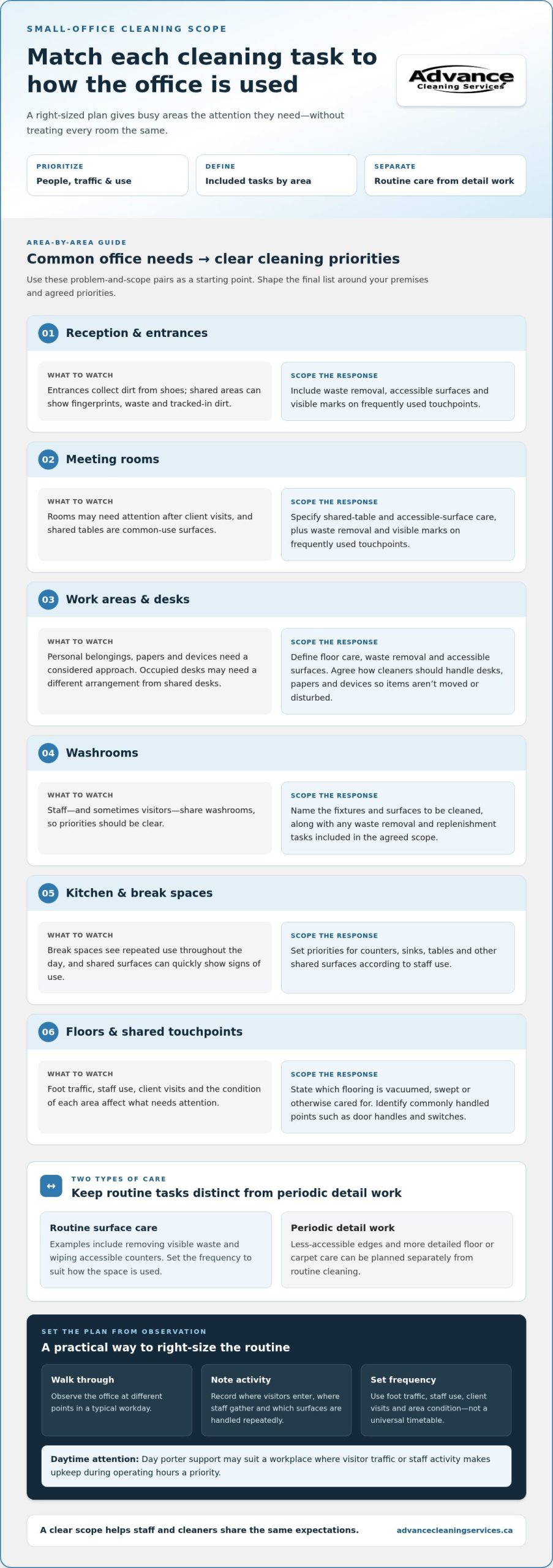
Walk through the office and observe how people move through it. Entrances collect dirt from shoes, meeting rooms may need attention after client visits, and break spaces see repeated use throughout the day. Workstations need a considered approach when staff have personal items or sensitive equipment. Washrooms and kitchens also need clear priorities because staff, and sometimes visitors, share them.
Separate routine surface care from occasional detail work. Removing visible waste and wiping accessible counters are different tasks from cleaning less-accessible edges or giving floors more detailed attention. Set frequency according to foot traffic, staff use, client visits, and the condition of each area, rather than relying on a universal timetable.
What a consistent cleaning routine can help prevent
A defined routine helps prevent visible dust from accumulating, waste from lingering, and shared spaces from being overlooked. It also gives staff and cleaners a shared understanding of which areas are included and what needs attention. That makes it easier to adjust priorities after a busy meeting or a period of heavier kitchen use.
A right-sized office cleaning plan matches each task to how often a space is used and what it needs to stay presentable. This is a practical standard, not a promise of specific health or business results. It keeps the focus on reliable upkeep and helps prevent a cleaning scope from becoming too broad to manage or too limited for the workplace.
To set priorities, walk through the office at different points in a typical workday. Note where visitors enter, where staff gather, and which surfaces are handled repeatedly. Use those observations to decide what belongs in routine cleaning and what can be handled as periodic detail work.
What should office cleaning for small business include?
A useful scope turns your office’s priorities into defined tasks. It should identify the areas covered, what surface care involves, and which jobs are routine versus periodic. For example, a small workplace might schedule regular attention to washrooms and a kitchenette, then arrange more detailed carpet care separately. Build the plan around the premises and agreed priorities instead of assuming every office needs the same checklist.
Use an area-by-area list to make expectations clear:
- Reception and meeting rooms: Remove waste, clean shared tables and accessible surfaces, and address visible marks on frequently used touchpoints.
- Work areas: Define floor care and waste removal. Include accessible surfaces while respecting documents, personal belongings, and equipment.
- Washrooms: Specify the fixtures and surfaces to be cleaned, along with waste removal and replenishment tasks included in the agreed scope.
- Kitchens and break spaces: Include counters, sinks, tables, and other shared surfaces, with priorities shaped by staff use.
- Floors and shared touchpoints: State which flooring is vacuumed, swept, or otherwise cared for, and identify commonly handled points such as door handles and switches.
For a broader look at routine janitorial work, see this commercial janitorial services guide. A written scope distinguishes included duties from tasks that need separate planning. It also tells staff what to move or leave accessible before cleaning.
Routine tasks for work areas and shared spaces
When to plan for day porter or periodic floor care
Some workplaces need attention while business is underway. Day porter support can suit offices where shared areas need upkeep during operating hours, rather than only during a recurring janitorial visit. Consider it when visitor traffic or staff activity makes daytime care a priority.
Keep routine janitorial tasks separate from periodic carpet or upholstery cleaning. Vacuuming and routine floor care may be part of a regular scope, while deeper carpet work can be planned around the flooring, its condition, and how the office is used. This commercial carpet cleaning guide offers more context for planning that work.
Document access instructions and surface-care concerns in the cleaning brief. Note areas with limited access, equipment that should not be handled, and workplace procedures relevant to cleaning products or protective equipment. Advance Cleaning Services provides office cleaning and routine janitorial services, with day porter support for workplaces that need daytime attention. Office cleaning services can be organized around your workplace priorities.
In-house, occasional, or recurring office cleaning: how to compare options
| Approach | Consistency | Staff time | Task coverage and disruption |
|---|---|---|---|
| In-house upkeep | Depends on staff routines | Uses employee time and coordination | Often suited to light tidying; tasks compete with regular work |
| Occasional deep cleaning | Provided at planned intervals | Less routine staff effort, with preparation needed | Useful for specific detail work; activity may need to be coordinated around the visit |
| Recurring professional janitorial service | Agreed tasks follow a repeatable schedule | Reduces the need to assign routine cleaning to employees | Scope can cover recurring priorities; timing is planned with business operations in mind |
These are planning distinctions, not fixed rules. An office with few shared areas and limited visitor traffic may need a different balance from a client-facing workplace with a busy reception and frequently used meeting room.
When in-house upkeep may be enough
In-house care can suit a small team that only needs light tidying between professional visits, such as clearing personal dishes or keeping individual work areas orderly. The business still needs to assign responsibility and make time for those tasks. Avoid adding specialized or unfamiliar cleaning duties to employees’ roles without suitable direction and training.
When recurring professional cleaning can make sense
In-house upkeep can reduce the need for scheduled service, while recurring professional cleaning can make agreed tasks more consistent and free staff to focus on their roles. That trade-off is central to office cleaning for small business. The choice doesn’t have to be all or nothing.
A blended arrangement can be practical: employees handle simple day-to-day tidying, while scheduled janitorial service covers tasks that need consistent attention. Occasional carpet or other detail cleaning can be planned separately according to the space and its condition. This gives the business flexibility without treating every task as equally frequent or assigning every responsibility to staff.
Advance Cleaning Services provides office cleaning and routine janitorial service for businesses, with day porter support for workplaces needing attention during operating hours. A tailored approach aligns the service routine with your priorities and office use. Explore office cleaning services to consider a practical arrangement for your workplace.
How to organize office cleaning for a small business
A clear setup turns cleaning priorities into a routine that fits your workday. Start with a walkthrough, then record what needs attention, how cleaners can access the space, and how staff can share feedback. This gives everyone a practical plan to refer to.
Use this sequence to organize office cleaning for small business:
- Map the space: Note the entrance, reception, work areas, meeting rooms, washrooms, kitchen, and any rooms with restricted access.
- List priorities: Identify the areas and tasks that matter most, including surfaces or flooring that need particular care.
- Agree on access: Set out entry instructions, alarm procedures, and who is authorized to provide access. Share sensitive details through an appropriate secure method.
- Set timing: Consider operating hours, staff presence, scheduled meetings, and visitor flow when choosing a suitable cleaning window.
- Establish communication: Name a point person and decide how to report a missed priority or request a change to the routine.
Prepare a simple cleaning brief for the office
Keep the brief concise and specific. Include a basic layout, commonly used areas, agreed tasks, and surfaces that need care. Record where cleaners should not enter and how to manage personal workstations, documents, or equipment. Clear instructions respect staff privacy and help the routine stay aligned with the way the office operates.
Include access arrangements and alarm procedures, but don’t circulate security codes in a general cleaning document. Identify who handles access and how updates will be shared if instructions change. Use one agreed channel for feedback and describe the issue, location, and relevant visit. This makes it easier to clarify priorities than relying on informal messages passed between staff.
Choose timing that works around business operations
Consider whether cleaning during operating hours or at another agreed time better suits the office. Daytime support can work well where shared spaces need attention while staff and visitors are present. A quieter visit window may reduce interruptions in some workplaces, but requires suitable access arrangements. Match timing to actual activity rather than assuming one schedule fits every office.
Staff communication can prevent avoidable disruption. Let employees know which areas are included, when shared spaces may be attended to, and whether anything should be cleared from desks or meeting tables. Whether your office is in Calgary, Edmonton, or Vancouver, account for its layout and business routine, then document the agreed arrangement.
Map the office, set priorities, arrange access, choose a workable time, and keep communication clear. This gives a small business a straightforward foundation for a dependable service routine. Advance Cleaning Services provides office cleaning and routine janitorial services, with day porter support for workplaces that need daytime attention. Arrange office cleaning for your business with a plan shaped around your workplace.
Arrange local office cleaning for your small business with Advance Cleaning Services
A practical cleaning arrangement starts with understanding how your office works. Advance Cleaning Services provides office cleaning and routine janitorial services for local businesses, with day porter support for workplaces that need attention during operating hours. The service plan can reflect your premises and priorities instead of relying on a generic checklist.
Advance Cleaning Services serves businesses in Calgary, Edmonton, Red Deer, Okotoks, Lethbridge, Strathmore, Chestermere, Airdrie, Cochrane, Vancouver, Richmond, Burnaby, Surrey, New Westminster, Coquitlam, and Abbotsford. Whether your office welcomes clients throughout the day or is used mainly by a small staff team, describing the space helps establish which areas matter most and how cleaning can fit into regular operations.
What to share when requesting an office cleaning plan
Start with a simple overview of your workplace. Include its layout, the areas staff and visitors use most, and the tasks you want the cleaning routine to address. Note whether the reception area sees regular visitors, whether meeting rooms are used frequently, and which shared spaces need particular attention. These details help shape a plan around actual use.
Describe your preferred service timing and any operating constraints. Share access instructions through an appropriate channel, identify areas with limited access, and explain staff privacy considerations, such as personal workstations or sensitive documents. A clear brief makes priorities easier to understand and helps reduce avoidable disruption during scheduled cleaning.
A practical next step for local businesses
You don’t need a complex facilities plan to begin. Bring together the essentials: the office layout, main cleaning priorities, shared areas, visitor activity, access arrangements, and timing that fits your operations. If a daytime presence would help keep common spaces attended to, include day porter support in the plan. A clear description of the workplace makes it easier to choose a suitable service approach.
Office cleaning for small business should feel manageable and dependable, with a scope that reflects the space rather than adding unnecessary tasks. Share what matters most in your office and discuss a tailored plan with Advance Cleaning Services.
Request office cleaning for your business
Make your next cleaning decision a practical one
Identify one recurring frustration in your workplace, such as a shared area that’s difficult to keep ready for visitors or cleaning that interrupts focused work. Use that need to guide your first conversation and shape a service plan around what matters most. Priorities may change as the team, space, or daily routine changes, so a clear starting point makes future adjustments easier.
With office cleaning for small business, the aim isn’t to add more tasks. It’s to establish a routine that fits your workplace and feels manageable for the people who use it. Advance Cleaning Services can help turn your priorities into a tailored approach for your office.
Discuss a cleaning plan for your workplace and take the next step toward a routine that works for your business.
Frequently Asked Questions
How much does office cleaning for a small business cost?
There isn’t one standard price for every small office. The service scope, layout, flooring, areas included, and requested visit pattern all affect the plan. To make a useful request, describe the rooms and tasks you want covered, and distinguish routine janitorial work from occasional carpet or upholstery cleaning. Advance Cleaning Services can use those details to discuss an office cleaning plan tailored to your workplace.
Can office cleaners clean computers and other electronics?
Electronics need careful handling, so clarify how workstations should be treated in the cleaning scope. Cleaners should avoid spraying liquids directly onto monitors, keyboards, or other devices. Staff can secure sensitive equipment and follow the manufacturer’s care instructions for personal electronics. For example, specify that the desk surface around a computer is to be cleaned while the device itself is left untouched.
What should employees do before an office cleaning visit?
Employees can put away confidential papers, secure valuables, and remove personal dishes or food from shared spaces. Ask staff to keep walkways clear and flag delicate items that shouldn’t be moved. If a workstation contains sensitive documents or equipment, make the expected boundaries clear. These preparations help cleaners focus on accessible areas and reduce the chance of disturbing work materials.
Should a small business provide cleaning supplies?
Set out supply arrangements as part of the service plan. The scope can identify which cleaning products and equipment are provided for scheduled work and which items, such as staff kitchen supplies, remain the business’s responsibility. Keep workplace products labelled and stored appropriately, and avoid mixing chemicals. A clear agreement helps prevent duplicated purchases or gaps in supplies needed for routine tasks.
Does office cleaning include carpet cleaning?
It depends on the agreed scope. Routine office cleaning may address everyday floor upkeep, while deeper carpet cleaning is a separate task that can be planned according to the carpet’s condition and use. Advance Cleaning Services provides carpet cleaning as well as office cleaning. If carpet care is a priority, describe the flooring and areas with heavier foot traffic when outlining your needs.
Is professional office cleaning worthwhile for a small business?
It can be worthwhile if cleaning tasks are taking staff away from their main responsibilities or shared spaces are difficult to maintain consistently. A small business in Calgary, Edmonton, Red Deer, Vancouver, Burnaby, or Surrey can weigh the service scope against its actual needs and available staff time. A tailored routine can leave employees responsible for light tidying without making them accountable for the whole cleaning plan.