
A standard cleaning service is never enough when a traumatic event occurs in your home or business. The biological risks left behind are often invisible and can remain hazardous for weeks if they aren’t handled with forensic precision. When you’re facing the aftermath of a crisis, the emotional weight is heavy enough without the added fear of health risks or legal liabilities. It’s natural to feel overwhelmed by the logistics and the specialized care required for crime scene cleaning Vancouver residents can trust.
You deserve a partner who understands both the technical demands of biohazard remediation and the human need for discretion. This guide explains how professional decontamination restores your property to a safe, pre-incident state while providing much-needed peace of mind. We’ll outline the essential steps for permanent sanitization, how to navigate WorkSafeBC safety regulations, and the ways the Crime Victim Assistance Program provides financial support during these difficult times. Our goal is to help you move forward with confidence and security.
Key Takeaways
- Learn why forensic-level remediation is required to eliminate invisible biological hazards that standard cleaning methods often miss.
- Understand the specialized protocols involved in crime scene cleaning Vancouver experts use to ensure a property is biologically safe and legally compliant.
- Discover why household chemicals and standard janitorial services are insufficient for handling bloodborne pathogens and structural decontamination.
- Identify how to navigate insurance claims and access the BC Crime Victim Assistance Program to help manage the costs of professional remediation.
- Gain clarity on the discreet, methodical steps taken by professionals to restore a sense of security and safety to your home or business.
Understanding Crime Scene Cleaning in Vancouver: Why Professional Intervention is Essential
Many people assume that a standard mop and bucket can handle the aftermath of a traumatic event. This is a dangerous misconception. Professional crime scene cleaning Vancouver services involve a rigorous, medical-grade process known as forensic remediation. To understand what is crime scene cleaning, one must look beyond the visible surface. It’s the specialized removal and decontamination of blood, bodily fluids, and other infectious materials. While a room might look “clean” to the naked eye, it isn’t necessarily safe. Biological decontamination requires neutralizing microscopic threats that standard janitorial products simply cannot kill.
Pathogens such as HIV, Hepatitis B, and Hepatitis C pose significant health risks to anyone entering an untreated site. These viruses are resilient and can remain active even after fluids have dried. For Vancouver business owners, the stakes are even higher. Under WorkSafeBC regulations, employers have a legal obligation to provide a safe workplace for their staff. Attempting to clean a biohazard scene without professional training or proper personal protective equipment (PPE) can lead to severe liability. Professional intervention ensures you meet these safety standards while protecting everyone who enters the property.
The Invisible Dangers of Trauma Scenes
Pathogens don’t simply disappear when a surface dries. Some viruses can survive on hard surfaces for weeks, remaining infectious long after the incident. If you try to clean these areas without specialized equipment, you risk creating aerosolized contaminants. This happens when liquid cleaners or scrubbing actions turn microscopic pathogens into airborne particles. These particles are easily inhaled or spread through ventilation systems. Porous materials like drywall, carpeting, and subflooring often absorb fluids deeply. In these cases, superficial cleaning is insufficient. These structural elements usually require complete removal and disposal as biohazardous waste to ensure the environment is truly restored.
Discretion and Compassion in the Vancouver Area
Recovering from a traumatic event is an emotional process. We recognize that privacy is a top priority for families in residential neighbourhoods like Kitsilano or Burnaby. Our teams arrive in unmarked vehicles to maintain a low profile and protect your privacy from curious onlookers. Beyond the technical decontamination, we focus on the human element. Managing the emotional weight of a trauma scene requires a steady, respectful hand. By restoring the property to its pre-incident state, we help remove the physical reminders of the event. This allows the healing process to begin in a space that feels safe and renewed once again.
The Biohazard Decontamination Process: How Specialists Restore Safety
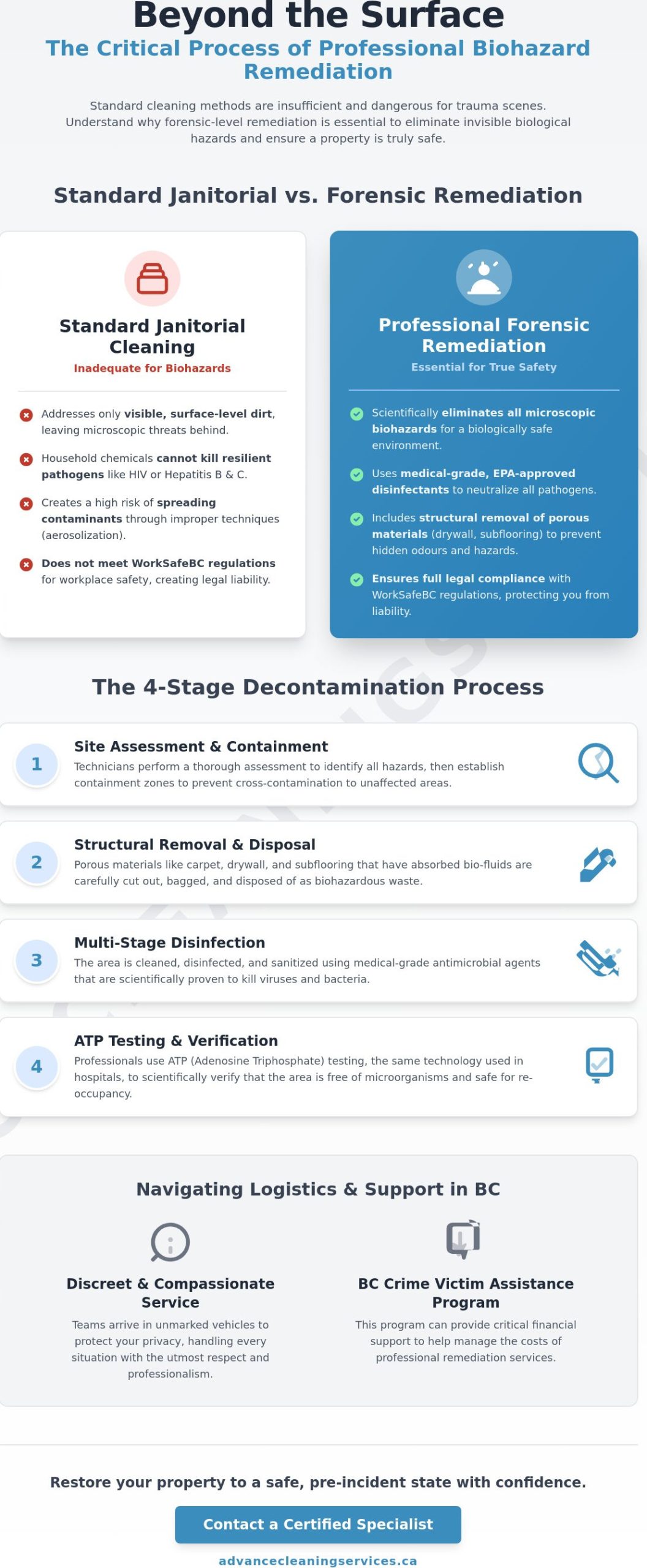
Restoring a property after a traumatic event is a highly technical task. It requires more than just effort; it requires a scientific approach to sanitation. Professional crime scene cleaning Vancouver specialists follow a strict four-stage protocol to ensure every trace of biohazardous material is gone. This methodical process is designed to eliminate both visible and microscopic threats, making the space safe for occupancy again.
Step 1: Site Assessment and Containment. The first priority is safety. Technicians conduct a thorough walkthrough to identify all affected areas and potential hazards. We then establish “hot zones” and “clean zones” using physical barriers. This containment strategy prevents pathogens from spreading to unaffected parts of the building during the cleaning process.
Step 2: Structural Removal. Visible biological materials are carefully removed. Often, this involves more than just surface cleaning. If blood or fluids have seeped into carpet padding, subflooring, or drywall, those materials must be cut out and professionally disposed of. This ensures no hidden hazards remain trapped beneath the surface where they could cause future health issues or odours.
Step 3: Multi-Stage Disinfection. Once all visible matter is gone, we apply medical-grade antimicrobial agents. These chemicals are specifically formulated to kill resilient viruses and bacteria. Following the Biohazard Decontamination Process ensures the site meets the highest safety standards required by provincial law.
Step 4: Biological Verification. We don’t guess when it comes to safety. We verify our results using ATP (Adenosine Triphosphate) testing. This technology detects organic matter that isn’t visible to the eye. It provides a definitive “pass” or “fail” for the cleanliness of a surface. We don’t consider a job finished until the environment is proven to be biologically neutral.
Specialized Equipment and PPE Requirements
Technicians never enter a scene without full-body personal protective equipment (PPE). This includes chemical-resistant suits, double gloves, and full-face respirators. To manage air quality, we deploy industrial air scrubbers equipped with HEPA filtration. These units are vital for removing aerosolized pathogens and lingering odours from the air. You can learn more about the technical side of these biohazard remediation services to understand the depth of our commitment to safety.
Handling Hazardous Waste Disposal in BC
Disposing of biohazardous waste is a highly regulated task in British Columbia. We adhere to strict provincial transport laws to ensure public safety. Every bag of waste is carefully manifested and tracked from the site to the disposal facility. It is then transported to a certified medical waste facility for incineration. This prevents any biological trace from entering the local waste stream or harming the Vancouver environment. If you’re currently facing a situation that requires this level of care, trust our experienced professionals to handle the logistics and the cleanup with the utmost precision.
Standard Janitorial vs. Crime Scene Cleaning: Why Expertise Matters
Standard janitorial services play a vital role in maintaining the daily cleanliness of our offices and homes. However, they aren’t equipped to manage the biological complexities found at a trauma site. Professional crime scene cleaning Vancouver specialists use a different set of tools and logic. While a regular cleaner focuses on removing visible dirt and grime, a forensic technician focuses on biological neutrality. Household bleach is a common tool for many, but it’s often insufficient for this level of work. Bleach can kill surface bacteria, but it fails to penetrate and break down the dense biological proteins found in blood and tissue. Specialized enzymatic cleaners are necessary to dissolve these proteins at a molecular level, ensuring the site is truly decontaminated.
Our team brings a high level of technical skill to every job. We apply the same rigorous standards developed for our medical facility cleaning Alberta operations to every Vancouver trauma scene we handle. This background in clinical sanitization ensures that we don’t just “clean” a space; we restore it to a medical grade of safety. Because the cost of specialized remediation can be a concern for families, it’s helpful to know that Victim Services in BC provides resources and financial assistance programs that may help cover these essential professional services.
Cross-Contamination Risks in High-Traffic Areas
Cross-contamination is the unintentional transfer of pathogens between surfaces. This is the greatest risk when an untrained person attempts to clean a trauma scene. Using the wrong equipment can easily spread pathogens into HVAC systems or porous subflooring. We utilize strict “clean-room” protocols to isolate the affected area. By establishing physical barriers and using specific entry and exit procedures, we ensure that contaminants stay contained. This level of discipline protects the rest of the building and its occupants from secondary exposure.
Odour Neutralization at the Molecular Level
Lingering odours are a major concern, especially in cases of an unattended death. Masking scents or standard air fresheners only provide a temporary solution because they don’t address the source of the smell. We use industrial ozone generators and hydroxyl machines to permanently neutralize odour molecules in the air and on surfaces. It’s also essential to reach contaminants that have trapped themselves behind baseboards or inside wall cavities. Without this deep, molecular-level treatment, the odour will eventually return, serving as a constant reminder of the incident. Our methodical approach ensures the air is fresh and safe for the long term.
Navigating Logistics: Insurance, Costs, and Victim Services in BC
Managing the financial and administrative side of a traumatic event is often the last thing on a property owner’s mind. However, understanding your options can significantly reduce the stress of the situation. Most homeowner and commercial insurance policies in British Columbia include coverage for biohazard remediation. Because biological contaminants are considered a form of property damage, professional crime scene cleaning Vancouver services are typically a covered expense. We work directly with insurance adjusters to streamline the process. By providing detailed documentation and forensic reports, we help ensure that the claim is handled accurately, allowing you to focus on more personal matters.
Documentation is a critical part of our service. We record every step of the decontamination process, from the initial site assessment to the final biological verification. This reporting isn’t just for insurance; it serves as a legal record that the property has been restored to a safe state. Whether you are a landlord, a business owner, or a resident, having a clear paper trail is essential for future property transfers or safety audits. If you need immediate guidance on starting this process, contact our team for professional assistance.
The BC Crime Victim Assistance Program
If the incident was the result of a violent crime, you may be eligible for financial support through the BC Crime Victim Assistance Program (CVAP). This program is managed by the Ministry of Public Safety and Solicitor General. It provides benefits to victims, immediate family members, and witnesses to help with the costs of recovery. For crimes that occurred on or after January 1, 2024, applicants have two years from the date of the incident to apply for benefits. We have extensive experience providing the specific invoices and remediation reports required by CVAP to facilitate these claims. This program helps ensure that the cost of professional cleaning doesn’t become an additional burden during a time of crisis.
Commercial Liability and WorkSafeBC Compliance
For business owners, the return to work must be handled with extreme care. Employees in Vancouver have the “Right to Refuse Unsafe Work” under provincial law. If a workplace hasn’t been professionally decontaminated, staff may feel unsafe returning to their duties. Non-compliance with safety regulations can result in significant administrative penalties. As of January 1, 2026, the maximum administrative penalty for an OHS violation is $816,148.69. We provide a professional Certificate of Disinfection upon completion of our work. This document serves as proof that the environment meets all health and safety standards. It gives your staff the confidence they need to return and protects your business from potential liability claims.
Choosing Advance Cleaning Services for Discreet Vancouver Remediation
Selecting a provider for such a sensitive task requires a high degree of trust. At Advance Cleaning Services, we pride ourselves on being more than just a cleaning crew. We act as a steady, reliable partner for families, property managers, and law enforcement agencies facing difficult circumstances. Our teams remain available 24/7 across Vancouver, Richmond, Burnaby, and the entire Lower Mainland. We recognize that a crisis doesn’t follow a schedule. That’s why we maintain a state of constant readiness to provide immediate, methodical support when you need it most. Our goal is to arrive quickly and begin the restoration process with the quiet professionalism you deserve.
Our approach integrates medical-grade sanitation protocols into every trauma scene we remediate. This ensures that the technical standards are as high as the emotional support we provide. We don’t just clear a site; we restore its safety and its dignity. By choosing a professional team, you ensure that every step of the process is handled with the absolute discretion and expert precision required for crime scene cleaning Vancouver property owners expect. We take the burden of decontamination off your shoulders so you can focus on the recovery of your family or your business operations.
Our Local Vancouver Expertise
Our service area is extensive, reaching from North Vancouver all the way to the Fraser Valley. This regional knowledge is vital because different municipalities often have specific bylaws regarding biohazard disposal and site management. We ensure full compliance with all local regulations, taking the guesswork out of the logistics for you. For those managing estates or properties that span across provincial lines, you may find our trauma scene cleanup Alberta guide helpful for understanding how we maintain consistent, high-end standards regardless of the location.
Restoring Safety and Peace of Mind
The final stage of our work involves a comprehensive walkthrough and quality assurance protocol. We don’t consider our job finished until you feel completely confident in the safety of the environment. Our team is trained to catch even the smallest details, ensuring the space is both physically and biologically restored. We prioritize clear, honest communication throughout the entire project. This “Reliable Partner” approach means we’re here to answer your questions and provide a steady hand during a busy and stressful time. We take pride in our workmanship because we know it’s the foundation of your peace of mind. If you’re ready to begin the restoration process, contact Advance Cleaning Services for discreet Vancouver crime scene cleanup.
Restoring Safety and Peace of Mind to Your Property
Navigating the aftermath of a traumatic event is a complex journey. You’ve learned that true decontamination requires more than surface-level attention; it demands a scientific approach to biological safety. By understanding the rigorous protocols of crime scene cleaning Vancouver specialists and the financial support systems available in BC, you can make informed decisions for your property and your people. Our team is committed to delivering medical-grade sanitation standards while maintaining the highest level of discretion. We utilize WorkSafeBC compliant protocols to ensure every environment we treat is safe for immediate return. With our 24/7 emergency response, you don’t have to face these challenges alone. We’re here to provide the steady hand and expert care needed to restore your peace of mind. Contact Advance Cleaning Services for Discreet Crime Scene Cleaning in Vancouver today. Our specialists are ready to help you move forward in a safe, renewed space.
Frequently Asked Questions
Who is responsible for the cost of crime scene cleaning in Vancouver?
The property owner is generally responsible for arranging and paying for remediation services. However, you don’t always have to bear this cost alone. Most professional crime scene cleaning Vancouver services are covered by insurance policies or provincial assistance programs designed to support victims and property managers during a crisis.
Does my homeowner insurance cover biohazard and trauma cleanup in BC?
Yes, the majority of homeowner and commercial insurance policies in British Columbia cover biohazard remediation. Insurance companies typically view biological contaminants as a form of property damage. We recommend checking your specific policy, but professional cleaning is usually a covered expense once your deductible is met.
How quickly can a professional cleanup team respond to a scene in Vancouver?
Response times depend on the specific provider’s current schedule and your location within the Lower Mainland. Many specialized teams recognize the urgency of these situations and aim to arrive as quickly as possible. It’s best to call a provider directly to confirm their immediate availability for your neighbourhood.
Can I clean up a trauma scene myself if I have the right supplies?
Cleaning a trauma scene yourself is strongly discouraged due to the risk of exposure to bloodborne pathogens. Standard household disinfectants aren’t strong enough to neutralize resilient viruses like Hepatitis B. Additionally, business owners must follow WorkSafeBC regulations, which often require professional certification to prove the space is safe for re-entry.
What is the BC Crime Victim Assistance Program and how does it help with cleaning costs?
The BC Crime Victim Assistance Program (CVAP) provides financial benefits to victims and family members affected by violent crime. If the incident occurred in British Columbia, the program can help cover the costs of professional cleaning. For crimes occurring on or after January 1, 2024, you have two years from the date of the event to apply for these benefits.
How long does a typical crime scene decontamination process take?
The timeframe varies based on the severity of the scene and the materials involved. A simple decontamination in one room might take four to six hours. More complex situations that require removing flooring or drywall can take several days. A professional team will provide a more accurate estimate after their initial site assessment.
Is the cleaning process discreet for residential neighbourhoods in the Lower Mainland?
Discretion is a core part of professional biohazard remediation. Teams typically use unmarked vehicles and plain containers for their equipment to avoid drawing unnecessary attention from neighbours. This allows the work to be completed quietly and respectfully, protecting your privacy during a difficult time.
What happens to the items that cannot be cleaned after a traumatic event?
Items that are too porous to be safely decontaminated, such as mattresses or heavily saturated carpets, are removed from the site. These materials are sealed in biohazard packaging and transported to a certified facility. They are then destroyed through medical-grade incineration to ensure no biological trace remains in the environment.