What if the safest first step after a biohazard incident isn’t using a stronger disinfectant, but keeping people away from the affected area? If you’re asking, “what does biohazard cleanup involve,” the answer is a controlled remediation process, not routine cleaning with extra effort. Blood, bodily fluids, and contaminated materials can pose exposure risks, and the affected area may extend beyond what’s immediately visible.
Questions about odours, privacy, affected belongings, and when it’s safe to return are understandable. Professional cleanup differs from ordinary cleaning because specialized work practices help limit exposure and prevent contamination from spreading.
This guide covers the general stages, from assessing and containing the area to removing affected materials, cleaning, managing odours, and handling waste. You’ll also learn what to do before help arrives. Advance Cleaning Services provides specialized biohazard cleanup for sensitive residential and commercial situations in Alberta and the Vancouver area.
Key Takeaways
- Learn what does biohazard cleanup involve and why the right approach depends on the material, surfaces, and circumstances.
- See how a cleanup plan can move from an initial discussion and site assessment to controlled removal and final review.
- Understand why routine janitorial cleaning isn’t designed for every biological contamination situation.
- Know how keeping people and pets away can help prevent further disturbance.
- Find out how Advance Cleaning Services supports sensitive residential and commercial cleanup needs in Alberta and the Vancouver area.
What Does Biohazard Cleanup Involve, and When Is It Needed?
Biohazard cleanup is the specialized assessment, cleaning, and decontamination of an area affected by biological material. If you’re asking “what does biohazard cleanup involve,” the answer depends on what is present, where it may have spread, the surfaces involved, and the circumstances. Crime scene cleanup, also known as biohazard remediation, involves the cleanup of blood, bodily fluids, and other potentially infectious materials. A trained team uses the site conditions to determine the appropriate work instead of applying the same approach to every situation.
The affected area may extend beyond what’s visible. Material can reach nearby objects, porous surfaces, or less visible spaces. That doesn’t mean every suspected hazard needs the same level of remediation. A professional assessment helps identify what needs attention and which steps suit the site.
Which situations may call for specialized biohazard cleanup?
Specialized cleanup may be needed after blood contamination, a trauma scene, certain unattended deaths, or other incidents involving biological materials. These situations can occur in homes, rental properties, workplaces, and commercial buildings. The scope varies: a small, contained area may call for a different work plan than an incident affecting multiple surfaces or belongings.
- Blood or bodily-fluid contamination in a room or on belongings
- Cleanup following a trauma or crime scene
- An unattended death where the affected area requires careful assessment
These examples don’t determine the scope on their own. The type of material, site conditions, and surfaces involved all inform the assessment. Don’t judge the affected area by visible marks alone. An assessment helps establish what may need cleaning, decontamination, or removal.
Why is biohazard cleanup different from ordinary cleaning?
Routine housekeeping manages everyday dirt and maintains a space. It isn’t designed to address every incident involving biological contamination. Specialized cleanup uses controlled work practices and suitable protective equipment to help limit contact with affected materials and reduce the chance of spreading contamination.
A surface can look clean without that appearance showing whether it has been appropriately decontaminated. Wiping away visible material may not address affected items or nearby surfaces, and it can disturb material that needs careful handling. The work plan considers the site as a whole, including what can be cleaned and what may need to be removed. For sensitive residential and commercial situations, professional biohazard cleanup provides an approach based on the circumstances, not simply a stronger cleaning product.
The Biohazard Cleanup Process, From Initial Assessment to Final Review
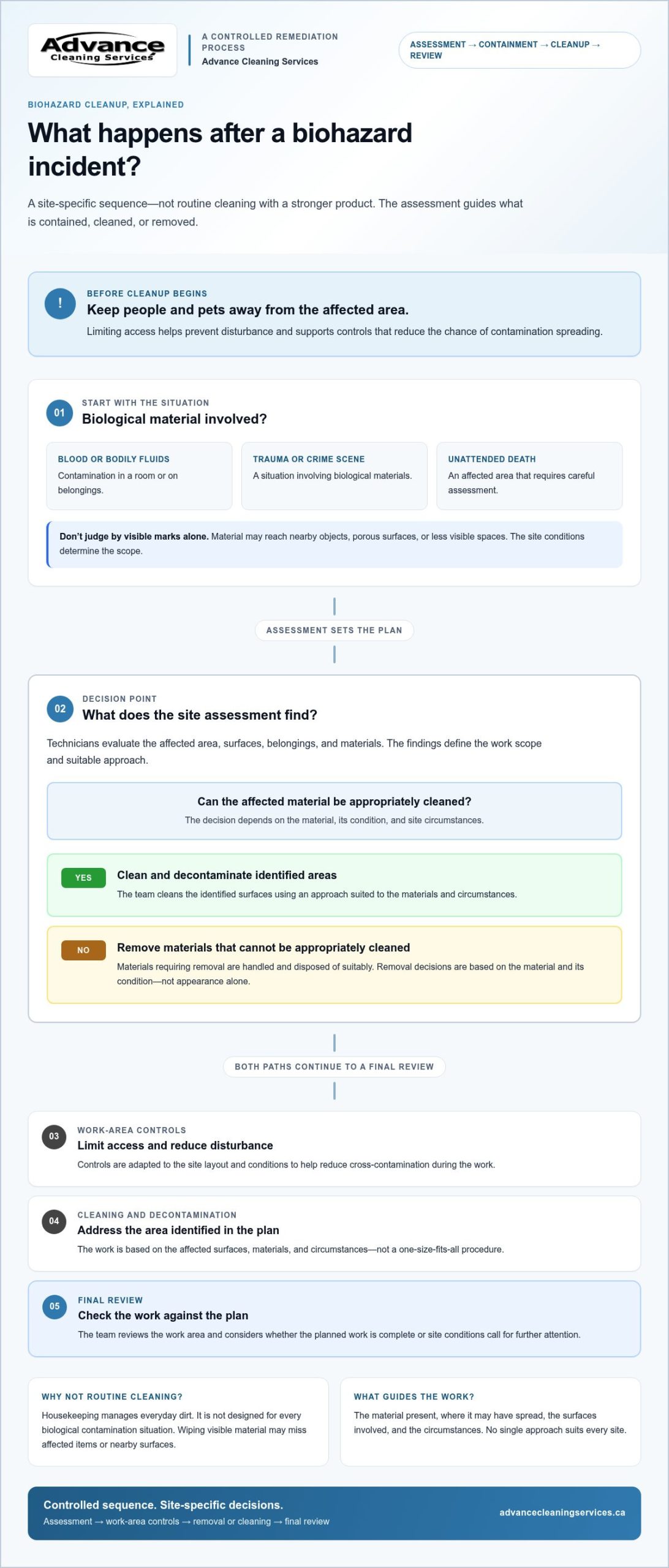
Professional remediation is planned around the site. It isn’t just a matter of applying disinfectant and moving on. The team first gathers information about the incident, then assesses the affected area and identifies surfaces, belongings, and materials that may need attention. This guides a work plan suited to the circumstances, rather than assuming every cleanup follows the same steps.
Biohazard cleanup is a controlled sequence of assessment, containment, removal, cleaning, and review, not a single disinfection step.
- Initial discussion: The team gathers relevant details about the situation and location. This helps prepare for an on-site assessment without asking occupants to inspect or handle affected materials.
- Site assessment: Technicians evaluate the work area, affected surfaces, and items that may require cleaning, removal, or specialized handling. Their findings help define the scope and suitable approach.
- Work-area controls: The affected zone is managed to limit access and reduce the chance of disturbance or cross-contamination during the work. Controls are adapted to the site layout and conditions.
- Removal: Materials that can’t be appropriately cleaned may be removed for suitable handling and disposal. Decisions depend on the material and its condition, not just whether it looks affected.
- Cleaning and decontamination: The team cleans identified surfaces and addresses the affected area using an approach suited to the materials and circumstances.
- Final review: The team reviews the work area and considers whether the planned work is complete or site conditions call for further attention.
How do assessment and work-area controls guide the cleanup?
Assessment connects what’s known about the incident with what technicians observe at the site. They identify affected areas and materials requiring specialized handling, and may document relevant conditions to guide the work. Limiting access keeps occupants away from active remediation and helps protect the work area. The assessment and controls vary with the property and incident; no single approach suits every situation.
What happens during cleaning, decontamination, and final review?
After materials requiring removal are addressed, technicians clean and decontaminate the identified area. The final review lets the team check the work against the plan and note any remaining considerations. The appropriate next steps depend on the site and the work completed, so don’t assume a particular odour outcome, restoration result, or test result.
Worker protection is part of organized remediation. The Occupational Safety and Health Administration (OSHA) provides U.S. resources on worker protection from bloodborne pathogens. OSHA is a U.S. agency, so its information is background rather than Canadian workplace guidance. Local requirements depend on the jurisdiction.
Advance Cleaning Services provides specialized biohazard cleanup and remediation for sensitive residential and commercial situations in Alberta and the Vancouver area. Learn more about professional biohazard cleanup.
Professional Biohazard Cleanup vs. Routine Cleaning: What Is the Difference?
Routine cleaning keeps a property presentable and supports regular maintenance. Biohazard cleanup addresses a specific incident involving biological contamination. The difference isn’t simply the strength of a cleaning product. It’s the purpose of the work, the precautions used, and how affected materials are handled.
| Consideration | Routine cleaning | Biohazard cleanup |
|---|---|---|
| Purpose | Manage everyday soil and maintain spaces. | Respond to a specific contamination incident. |
| Training | Follow procedures for recurring janitorial tasks. | Use specialized knowledge to assess and address affected areas. |
| Work controls | Use ordinary work practices for scheduled cleaning. | Apply controls suited to the incident and work area. |
| Affected materials | Clean commonly maintained surfaces and items. | Assess whether materials need cleaning, decontamination, or removal. |
Why can ordinary cleaning products and methods fall short?
A household disinfectant or an intensive wipe-down doesn’t automatically make specialized work unnecessary. The appropriate product and method depend on the material, surface, and site conditions. Routine cleaning may remove visible marks without addressing all affected items or areas. Appearance alone can’t establish that incident-specific cleanup is complete. Avoid disturbing suspected contamination; an assessment can determine the suitable scope of work.
How does specialized cleanup differ from routine facility cleaning?
Janitorial services support recurring maintenance, such as cleaning common surfaces and keeping a facility orderly. Biohazard remediation is incident-specific. Its scope depends on what happened and which materials or areas are affected. It involves decisions about work-area controls and the handling of affected items, rather than following a standard daily cleaning schedule.
Medical-facility cleaning is a distinct service, focused on the ongoing cleaning needs of healthcare environments. Advance Cleaning Services provides professional medical facility cleaning in Alberta. That work is different from remediation after a specific biohazard incident.
Using a stronger household product isn’t a substitute for understanding the contamination and choosing an appropriate method. The Centers for Disease Control and Prevention (CDC) provides information about infectious diseases and infection prevention. Its resources offer general public-health context, while Canadian requirements depend on the applicable jurisdiction.
For an incident that calls for specialized remediation, Advance Cleaning Services provides biohazard cleanup for sensitive residential and commercial situations.
What to Do Before Biohazard Cleanup Professionals Arrive
Keep the next steps simple and focused on safety. You don’t need to inspect the area or work out how far contamination may extend.
- Keep people and pets away from the affected area until it has been assessed.
- Don’t touch or move anything that may be contaminated.
- Contact emergency services if there’s immediate danger or an active medical emergency.
- Share what you already know with the cleanup team, without taking photos or handling materials.
These precautions can limit unnecessary contact while the situation is being assessed. If you’re unsure what does biohazard cleanup involve, focus on keeping others away from the area and sharing known details with the team.
What should occupants avoid doing before assessment?
Don’t touch, sweep, vacuum, or try to remove suspected contaminated materials. Avoid applying household cleaners, improvising protective gear, or attempting do-it-yourself testing. These actions may disturb material, create additional contact, or complicate the assessment. You don’t need to identify the substance yourself. Leave the area as it is and let trained professionals determine the next steps.
Where practical, prevent people from walking through the affected space or carrying items out of it. Don’t put belongings, clothing, or other materials into regular rubbish if they may be affected. You don’t need to photograph the scene for the cleanup team. A verbal account of what happened and what you know is a helpful starting point; the team can assess the site directly.
Which Canadian and provincial guidance may be relevant?
Applicable workplace guidance can depend on the province, setting, and type of incident. In Alberta, consult Alberta Occupational Health and Safety (OHS) resources; in British Columbia, check current WorkSafeBC guidance. These are sources for workplace information, not a substitute for a site assessment or advice specific to an incident.
If the situation is in a workplace, share relevant details about the location and incident with the appropriate workplace contact and cleanup team. Don’t assume requirements from another country apply in Canada. U.S. agencies such as OSHA and the EPA set U.S. rules, which shouldn’t be presented as Canadian requirements. Provincial guidance may differ, so use current information for the location involved.
For a residential or commercial site, you can make the handoff easier by sharing the address, the type of incident as you understand it, and any known access considerations. Don’t delay seeking emergency help to gather details. The team can ask follow-up questions and assess conditions without requiring you to enter or examine the area.
Advance Cleaning Services provides specialized biohazard cleanup and remediation in Alberta and the Vancouver area. Arrange biohazard cleanup support and keep the area undisturbed until it can be assessed.
Arranging Biohazard Cleanup in Alberta or the Vancouver Area
Once the immediate area has been kept clear, professional help can make the next steps easier to manage. Advance Cleaning Services provides specialized biohazard cleanup and remediation for sensitive residential and commercial situations in Alberta and the Vancouver area. Sharing a few practical details helps the team understand the location and general circumstances before assessing the site. Service communities include Calgary, Edmonton, Red Deer, Okotoks, Lethbridge, Strathmore, Chestermere, Airdrie, Cochrane, Vancouver, Richmond, Burnaby, Surrey, New Westminster, Coquitlam, and Abbotsford.
What information helps the team understand the situation?
You don’t need to inspect the affected area or prepare a detailed account. Share what you already know. A clear, general description is enough to begin the conversation.
- Property location: Provide the address or general location so the team understands where help is needed.
- Incident type: Describe the situation broadly, such as blood contamination, a trauma-related incident, or another concern involving biological material.
- Affected area: If you know without entering or examining the space, mention which room or part of the property may be involved.
- Access concerns: Explain whether occupants are still nearby, the area is restricted, or there are practical access considerations.
There’s no need to share graphic details, take photographs, or handle materials to provide this information. If you’re unsure what does biohazard cleanup involve, the team can explain the general process and assess the site to determine the appropriate scope. If circumstances change before the assessment, share relevant updates without re-entering the affected area.
When does hoarding cleanup overlap with biohazard remediation?
Some properties involve both a high accumulation of belongings and biological contamination. In these cases, the work may need to address the contents and affected areas as separate concerns. For background on the distinct scope of professional hoarding cleanup in Alberta, see the dedicated guide.
Biohazard cleanup needs vary with the incident and property. Initial information helps orient the team, but it doesn’t replace an on-site assessment. You don’t need to decide which materials are affected or what work is required before reaching out. Keep people and pets away, avoid disturbing the area, and share any immediate access concerns so the situation can be approached with care.
Take the Next Step with a Clear Plan
After a difficult incident, the next decision doesn’t need to solve every detail at once. Start by identifying the immediate concern: restoring use of a room, coordinating access, or understanding what may happen to affected belongings. A measured conversation can help turn uncertainty into a practical plan without requiring you to make technical decisions before the site is assessed.
If the question “what does biohazard cleanup involve” is still on your mind, use the first conversation to explain what you know and ask what to expect next. You can also mention practical priorities, such as which areas matter most to daily routines and who should receive updates. Clear, factual communication helps everyone focus on the next appropriate step.
For specialized biohazard cleanup in Alberta or the Vancouver area, contact Advance Cleaning Services to discuss the situation and arrange the next step.
Frequently Asked Questions
Is professional biohazard cleanup necessary after every blood spill?
No, not every blood spill automatically requires professional biohazard cleanup. A small, contained spill differs from an incident involving a larger area, multiple materials, or circumstances that make the affected space difficult to assess. The surface and nearby belongings also matter. If you’re unsure about the extent or appropriate handling, avoid disturbing the area and seek an assessment. An incident connected to trauma or an unattended death may call for specialized remediation.
Can occupants stay in a property during biohazard cleanup?
It depends on the affected area, site conditions, and whether the work zone can be kept separate from occupied spaces. Don’t assume another room is suitable for use if occupants need to pass through the affected area to reach it. Discuss access and household needs with the cleanup team before deciding to stay. This is especially relevant for children, older adults, pets, or anyone who may need to move through the property.
How long does biohazard cleanup take?
There isn’t one reliable duration for every job. The time required depends on the extent of the affected area, the materials involved, access to the site, and whether affected items need to be removed. A property with one isolated area may differ considerably from a site involving several rooms. The team can discuss the expected work after assessing the specific conditions, and the plan may need to change if new affected areas are identified.
How much does biohazard cleanup cost?
The cost depends on the service scope and site conditions, so a general price range may not reflect the work required at your property. Factors can include the size and complexity of the affected area, the materials involved, and whether items need to be removed. An assessment helps clarify the appropriate work. When reviewing an estimate, make sure you understand which tasks and areas it covers before making arrangements.
Is biohazard cleanup covered by home or business insurance?
Coverage depends on the policy wording, the circumstances of the incident, and the insurer’s assessment. Don’t assume a home or commercial policy will reimburse cleanup costs. Review your policy and contact your insurer to ask how the incident should be reported and what documentation they require. For a property in Alberta or British Columbia, the policy and claim process still depend on the specific insurer and coverage in place.
What happens if contamination has reached porous materials or furnishings?
The appropriate handling depends on the material, its condition, and the site assessment. Items such as upholstered furniture, mattresses, or carpets may need a different response than hard, non-porous surfaces. The team determines whether affected belongings can be addressed or should be removed. Don’t assume an item can be restored based on its appearance or value. The assessment guides the work, but restoration of every porous item can’t be guaranteed.